

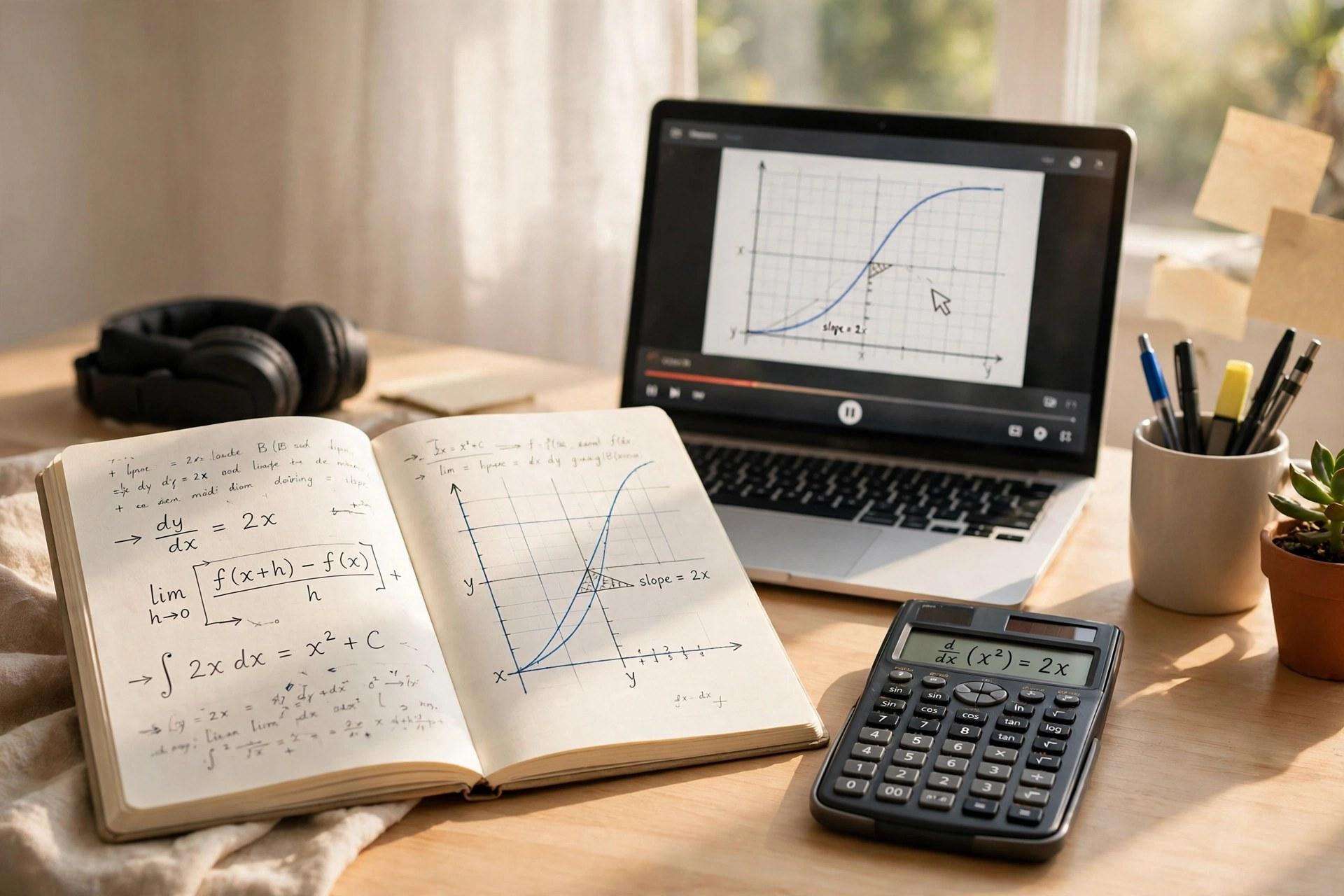

Ask A Level Physics students which questions they dread and the same three answers come back: the practical-based questions, anything with a graph and an uncertainty, and the maths-heavy problems that look nothing like the textbook examples. None of these are unfair. They are, however, taught differently from the rest of the course, and students who treat them as a separate skill to train, rather than a surprise to survive, pick up marks that others leave behind.
The required practicals are examinable, not optional
Every exam board sets a list of required practicals, twelve for AQA, with similar lists for Edexcel, OCR, and Eduqas. Students complete them in class and keep records, but the crucial point is that around 15 percent of the marks on the written papers test practical knowledge. Examiners ask how a measurement was taken, why a procedure was done in a particular order, and how the experiment could be improved.
The fix is to revise practicals like theory topics. For each one, a student should be able to state the aim, sketch the apparatus, name the independent, dependent, and control variables, and describe the main source of uncertainty. A one-page summary per practical, written in the student's own words, is worth more than re-reading a lab book the night before.
Uncertainty and graph questions: a repeatable routine
Uncertainty questions follow patterns. Percentage uncertainty combines by adding the percentage uncertainties of each measurement. On graphs, examiners love the line of worst fit: draw the steepest and shallowest lines that still pass through the error bars, calculate both gradients, and express the difference from the best-fit gradient as the uncertainty.
Students lose marks here through untrained habits rather than weak physics: axes without labels or units, scales that squeeze data into a corner, and gradients calculated from points not on the line. A short routine, practised until automatic, removes most of these losses. Check the scale uses more than half the grid, plot carefully, draw one clean line of best fit, and read the gradient from two widely spaced points on the line itself.
Combo Tutors Academy has provided one-to-one online tutoring since 2020 across IGCSE, GCSE, A Level and IB. Lessons start from $15 per hour, begin with a free 30-minute trial, and matching normally happens within 24 hours. There is a free rematch if the tutor is not a fit, and female tutors are available on request.
The maths content is bigger than students expect
Roughly 40 percent of A Level Physics assessment is mathematical. Logarithms appear in radioactive decay and capacitors, trigonometry in projectiles and waves, and calculus-style reasoning in rates of change, even where formal integration is not required. Students who were comfortable with GCSE Maths sometimes stall because the maths arrives dressed as physics.
Working with A Level physics tutors online gives students a place to slow these questions down: identify the principle, write the equation in symbols first, substitute values with units, and check the answer's size for sanity. That last habit, asking whether an answer is physically plausible, catches more errors than any other single step.
Synoptic questions: the final boss
Paper 3 and the longer questions on Papers 1 and 2 combine topics: mechanics inside an electricity problem, thermal physics inside an astrophysics context. Students fear them because the starting point is unclear. The reliable method is to list what is given, list what is asked, and hunt for the quantity that connects the two halves of the question. Energy and momentum are the usual bridges.
None of this requires genius. It requires treating practical skills, data handling, and problem routines as trainable techniques with their own revision time. Students who give them one session a week from the autumn term onwards walk into the exams having already met their most feared questions many times.
FAQ
Do the required practicals have a separate exam?
No. Practical competence is assessed through questions inside the written papers, plus a teacher-assessed practical endorsement reported separately from the A Level grade. The written questions are where the marks are.
How much maths do I need to be good at for A Level Physics?
You should be fluent with rearranging equations, standard form, trigonometry, and graphs, and comfortable with logarithms by the second year. A GCSE Maths grade 7 or above is a sensible benchmark, but specific techniques can be built with practice.
What is the fastest way to improve on graph questions?
Practise the full routine on past paper questions: sensible scale, labelled axes, line of best fit, gradient from two distant points, and worst-fit lines where error bars are given. Mark schemes reward each step separately, so the routine itself earns marks.


