


The first thing that surprised me on a factory floor was that a decorated napkin is never decorated as a napkin; the pattern goes onto a wide, continuous web of tissue long before anybody cuts or shapes anything, so the small square you end up holding is only a fragment of a design that was laid down across the full width. A Party Printed Paper Napkins Manufacturer has to work in that order because the artwork repeats across the width of the roll, which means the cylinders carrying the design are made with the repeat already worked out, and the material passes beneath them at a steady pace while it is still flat and open instead of sitting in neat little stacks.
Every colour in the artwork gets a roller of its own, and persuading them to sit on top of one another without a white fringe or a smeared edge is mostly patient adjustment at the start of a run. I remember an operator crouched beside the press with a small magnifying glass, nudging a roller by what looked like a hair's width, then pulling a sample off the moving web to hold against the approved proof. Because tissue is thin and soft the ink has to dry quickly and stay near the surface, so a warm section follows, and the air around it carries a faint smell of toasted fibre that anyone who has opened a fresh pack will probably recognise.
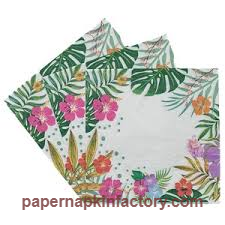
The sample sitting on the table at FuRong, a workshop in Zhuji that also makes paper straws and paper cups, was a plain floral square, and it answered something I had wondered about, namely why a workshop busy with straws and cups would also turn out serviettes: the habits of registering colour and watching moisture carry over from a curved wall to a flat piece, and custom printed work of any shape starts from a digital file and a proof sent back for approval. Nobody there treated the sample as unusual; it was just another job waiting its turn beside a batch of cups.
After printing, the web meets its other layers. A napkin of this kind is built from thin plies pressed together lightly along the edges, and that border of tiny dots or a wavy line is not just ornament, because it is what keeps the layers from sliding apart when you pull one off a stack. The colour sits only on the outer face, while the layer beneath stays plain, which is partly why the back of a patterned sheet feels much like an ordinary plain one when you rub it between thumb and finger, and why a dark pattern seldom shows through unless it gets wet.
Cutting and folding come next, and this is the stage where I noticed how much the printed face dictates what happens. The wide roll is slit into lanes, cut to length and folded, usually in half and then in half again, and the unit runs with a steady slapping rhythm that nobody tries to count. The creases are sharp because the machine forms them, not because anyone smoothed them by hand, and a slightly mistimed crease gives itself away at once because the motif is no longer centred on the piece, so operators catch a drifting machine by glancing at the front instead of reaching for a ruler.
Counting and packing come last. Stacks are counted automatically, wrapped, and put into cartons, and since custom work means the order changes each time, the cylinders get swapped and the shade matching starts again from the beginning, which is the slow stretch of the whole process and the reason that small changes to a design get settled at the start instead of halfway through a run. The cartons are bound for buyers in many countries, so the outer labelling is read and checked on its own before anything is sealed, and I saw a pallet being wrapped while a worker read the markings aloud to a colleague holding a clipboard.
A balloon theme and a quiet leaf motif run through the same wide roll and the same cylinders at a Party Printed Paper Napkins Manufacturer, and the difference between them on the line is mostly the shade matching at the outset of the day. Photographs of finished pieces on https://www.papernapkinfactory.com show the stamped border as a faint row of dots around each square, and on a real one that border is the first place where the plies begin to part if you tug gently at a corner.


