

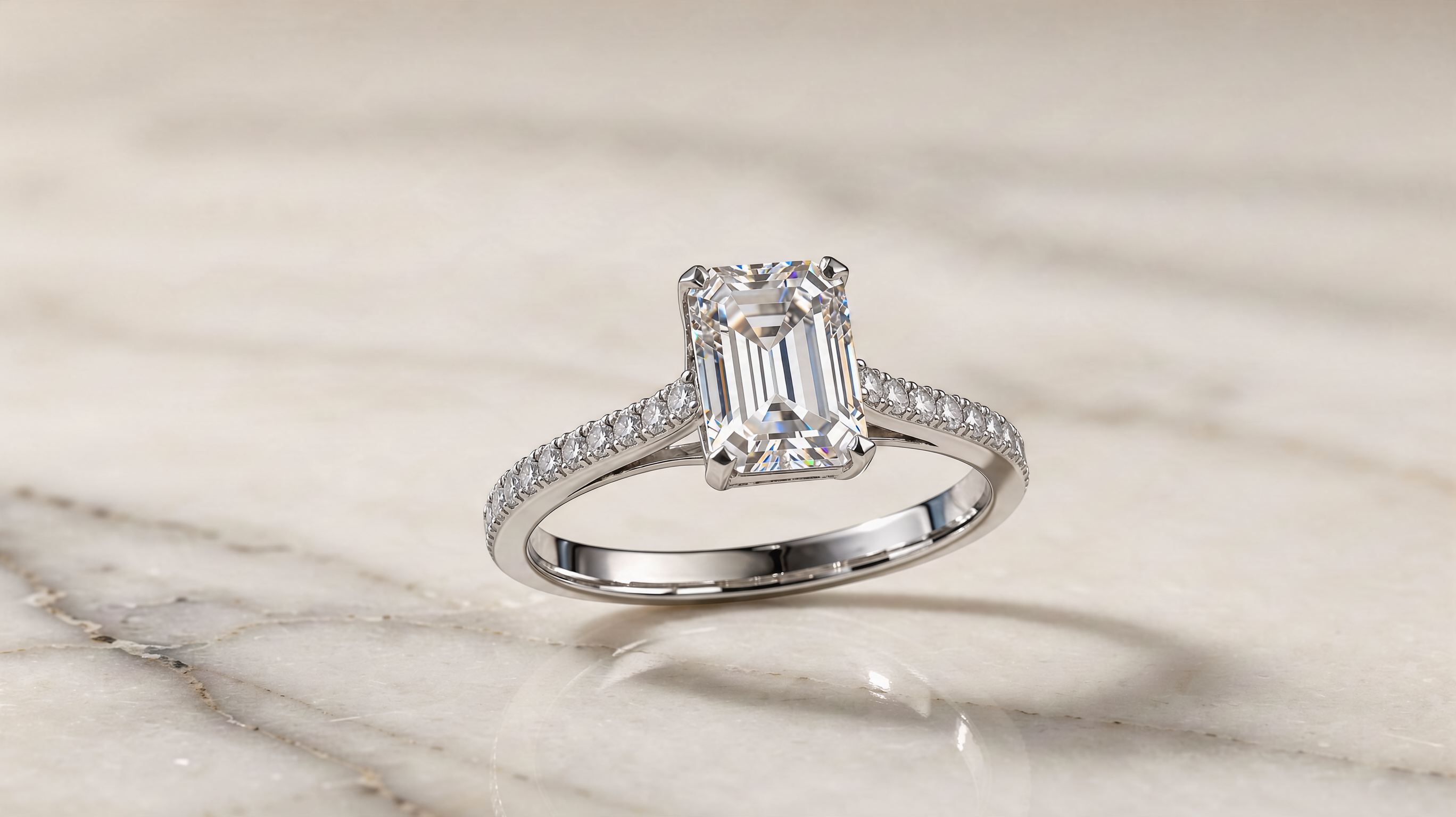

Most people walking into a jewelry store are looking for a stone that sparkles. Then someone slides a rectangular diamond with long, clean facets across the glass, and the conversation shifts. Suddenly the question isn’t how much fire a ring throws off. It’s how the ring feels when you look at it. That quiet pull is the reason emerald cut engagement rings keep finding their way back into the conversation.
The Appeal of Emerald Cut Engagement Rings
The emerald cut doesn’t rely on the brilliance of a round stone. The step-cut facets create broad, flat planes, and light moves across them in slow, deliberate flashes. Some people find that too subdued. Plenty of others find it more elegant, more like a window than a mirror.
The shape also has history. It was a favorite in Art Deco jewelry, and it still appeals to people who want something that looks intentional rather than trendy. Proportions matter a lot. Poorly cut stones can look glassy or murky, so it’s worth paying attention to how the stone was made, not just how big it is.
Emerald Cut Solitaire Styles
It’s easy to assume a solitaire is the safe pick, but with this shape it reads more like a statement. A single stone on a simple band puts all the attention on the cut itself. That’s one reason emerald cut solitaire rings remain popular with people who want something quiet and modern at once.
Four-prong settings let in the most light and show off the stone’s length. A bezel setting wraps the edges, which suits someone who wears a ring every day and doesn’t want it catching on sweaters.
Emerald Cut Halo Designs
What surprises many people is how much a surrounding ring of small stones changes the look. The accent diamonds make a step cut appear larger and add brightness to the flatter faceting. The reality is that a halo can cost more than it first appears, since those small stones add up quickly.
Still, for someone who wants more visual impact without a bigger center stone, this is a practical route. Emerald cut halo engagement rings work especially well when the center stone is a bit smaller than the budget would otherwise allow.
Settings That Suit Emerald Cuts
Settings matter more with this shape than most people expect. The pointed corners are the weak spot, so many jewelers recommend a V-prong or a bezel to protect them. Three-stone designs with tapered baguettes have a vintage lean that pairs nicely with the cut’s Deco roots.
Metal changes the mood too. Yellow gold feels warm and a little old-world, while platinum or white gold gives a crisper, cooler finish. Whichever metal you choose, the setting is what keeps emerald cut diamond engagement rings looking their best over time, so it’s worth asking the jeweler to show you how each option holds the corners.
Choosing the Right Emerald Cut Ring
Here’s where the trade-offs get real. Due to the size of its open top, the clarity in this stone appears clearer than in a round diamond. The inclusions close to the center of the diamond are easily visible, hence the preference by most buyers to have a clear diamond instead of the minimum one. The color also is visible, hence the preference for an upper grade.
Carat weight matters less than it used to. A well-cut stone can look bigger than its number suggests, so it’s worth comparing how the stones look side by side.
|
Setting |
Look |
Best for |
|
Four-prong solitaire |
Open, bright, lets light in |
Daily wear with a classic feel |
|
Bezel |
Sleek, edges fully protected |
Active lifestyles |
|
Halo |
Larger visual size, extra sparkle |
A smaller center stone on a set budget |
|
Three-stone with baguettes |
Vintage-leaning, layered |
Anyone drawn to Art Deco style |
If you’re getting close to a decision, try seeing a few stones in person, both in daylight and in a dimmer room. A stone that looks perfect under bright showroom lights can look different at home. A good jeweler will be glad to walk you through those differences.
Conclusion
Emerald-cut engagement rings are appreciated because of their classic design and elegant simplicity, not fashion. Choosing the right diamond is based on a number of considerations like its cut, clarity, and setting, which affect how good a diamond looks. A good choice may give you a timeless design. Looking at the variety of rings and diamonds may help in choosing one.
Also Read: What an Oval Halo Engagement Ring Says About Your Love Story?
FAQs
Q1. Is a step-cut stone more fragile than a round one?
The corners are the vulnerable part, so a protective setting makes a real difference. With that in place, daily wear is fine. Having the prongs checked once a year is a good habit with any ring.
Q2. How can I tell if a stone looks clean enough?
Look at it face up in natural light and check for dark spots or cloudy areas near the middle. Ask the jeweler whether the stone is eye-clean, meaning no flaws are visible without magnification.
Q3. Does a surrounding ring of small stones make a ring cost much more?
Usually, yes, since the accent stones add to the price. It can also make a smaller center stone look more substantial, so the total often balances out depending on what you want the ring to look like.


