

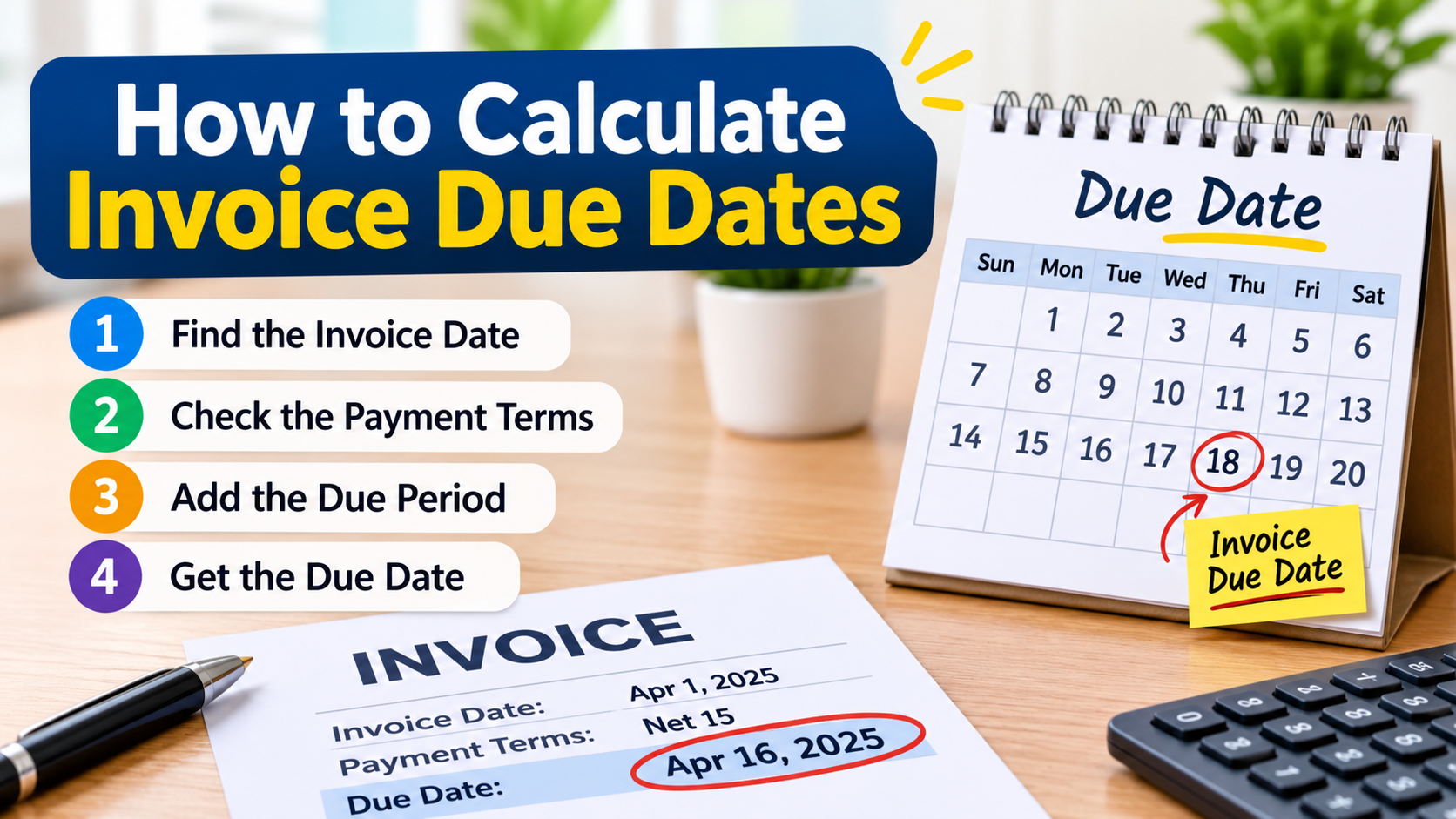

An invoice due date answers one question: by when must the money arrive? The rule is simple. You take the invoice date, add the number of days in the payment terms, and mark the result. But a few details, like the start date, month ends and weekends, can change the answer. At CalcifyAI, we like to show date sums in plain steps, and this guide does that for invoices.
This is general information, not legal or financial advice. Always follow the wording on your own invoice or contract.
The formula
Due date = invoice date + number of days in the terms.
If the terms say "30 days" or "Net 30", you add 30. If they say "due on receipt", the due date is the day the invoice is received. If they say "14 days", you add 14.
Example 1: Net 30
An invoice is dated Wednesday 28 January 2026, with Net 30 terms.
-
January has 31 days. From 28 to 31 January is 3 days.
-
30 − 3 = 27 days left.
-
Count 27 days into February: 27 February.
The due date is Friday 27 February 2026.
Example 2: Net 14
An invoice is dated 20 February 2026 with Net 14 terms. February 2026 has 28 days. From 20 to 28 February is 8 days, and 14 − 8 = 6. So the due date is 6 March 2026.
Example 3: Net 60 across a year-end
An invoice is dated 15 December 2026 with Net 60 terms.
-
From 15 to 31 December is 16 days. Remaining: 44.
-
January has 31 days. Remaining: 13.
-
That is 13 February 2027.
The due date is 13 February 2027. The year changed on the way, so write the year on your answer.
What if the date falls on a weekend?
Check your terms. Some businesses pay on the last working day before the weekend, and some pay on the next working day. If your terms do not say, ask the other side. If you are the one paying, pay early rather than late.
How many days until it is due?
Once you know the due date, count the days left. Say it is 10 February and the due date is 27 February. You can calculate days to confirm that you have 17 days. Put the date and the count into your calendar, and set a reminder a few days before.
Different terms, different dates
Not all terms are "Net 30". Here are some other styles you may see, using an invoice dated 10 March 2026.
-
Due on receipt: due as soon as the invoice arrives.
-
Net 7: due on 17 March 2026.
-
Net 14: due on 24 March 2026.
-
Net 45: due on 24 April 2026.
Short terms help the person who sends the invoice, because they get paid sooner. Longer terms help the person who pays, because they have more time. Many people agree on the terms before the work starts.
When does the clock start?
This is the most common source of disputes. The start can be:
-
the invoice date
-
the date the invoice was sent
-
the date it was received
-
the date the work was finished or goods arrived
Read your terms. If they do not say, ask in writing, and keep the reply.
Writing clear terms
If you send invoices, make the due date easy to see. Write the exact date on the invoice, not just "Net 30". For example: "Invoice date: 28 January 2026. Payment due: 27 February 2026." That way nobody has to count.
You can add a short note about late payments, such as a fee or interest, if your agreement allows it. Check the rules in your area first.
Send reminders
A polite reminder a few days before the due date can help. Send another on the day after, if payment has not arrived. Keep a record of each reminder.
Keep a simple log
A small list of invoice number, date, terms and due date makes it easy to see what is coming. Sort by due date, and check it every week. Mark each one as paid when the money arrives.
Common mistakes
-
Starting the count from the wrong date.
-
Mixing up "30 days" and "end of month" terms.
-
Forgetting that months have different lengths.
-
Writing the terms but not the date.
-
Not checking whether weekends move the date.
A short checklist
-
Find the invoice date and the terms.
-
Decide when the clock starts.
-
Add the days, month by month.
-
Check for weekends and holidays.
-
Write the exact due date on the invoice.
Final thoughts
To calculate an invoice due date, add the days in the terms to the starting date, work through each month, and check for weekends. Write the exact date on every invoice, and keep a log. At CalcifyAI, our advice is simple: if you can show the date, you do not need to argue about the count.


