

Launch Your Stage and Studio Career with a Music-Focused Degree at AAFT University

Music, performance, and sound now sit at the center of film, streaming, live events, and digital media. Students who love singing, playing instruments, or producing tracks no longer have to treat that passion as a hobby. A structured bachelor in performing arts gives you the training, studio access, and industry exposure to turn talent into a profession. This guide covers what the degree offers at AAFT University in Raipur, who it suits, and where it can take you.
What Is the Bachelor of Performing Arts (Honors) at AAFT?
AAFT's program is a four-year Honors degree worth 160 credits. It deepens musical practice through advanced performance training, critical listening, and creative exploration. The aim is to refine your musical sensibility, build expressive performance skills, and prepare you for careers in music, media, and allied creative fields.
Learning Built Around Six Pillars
The teaching approach rests on six pillars:
-
Experiential and practice-based learning
-
Learn, apply, and perform pedagogy
-
A strong theoretical and musical foundation
-
Technology and studio-oriented training
-
Collaborative and project-based learning
-
Mentorship, reflection, and industry exposure
You spend less time memorizing and more time performing, recording, and collaborating.
Curriculum Highlights and Core Subjects
A well-designed ba in performing arts should balance tradition with technology, and AAFT's syllabus does exactly that.
Indian Classical and Western Music
You study Indian Classical Music across multiple levels, covering ragas, talas, gharanas, and styles such as thumri and bhajan. Alongside this, you learn Western music, harmony, orchestration, and Western vocals. Advanced instrumental tracks in guitar, keys, and percussion let you specialize as you progress.
Music Technology and Production
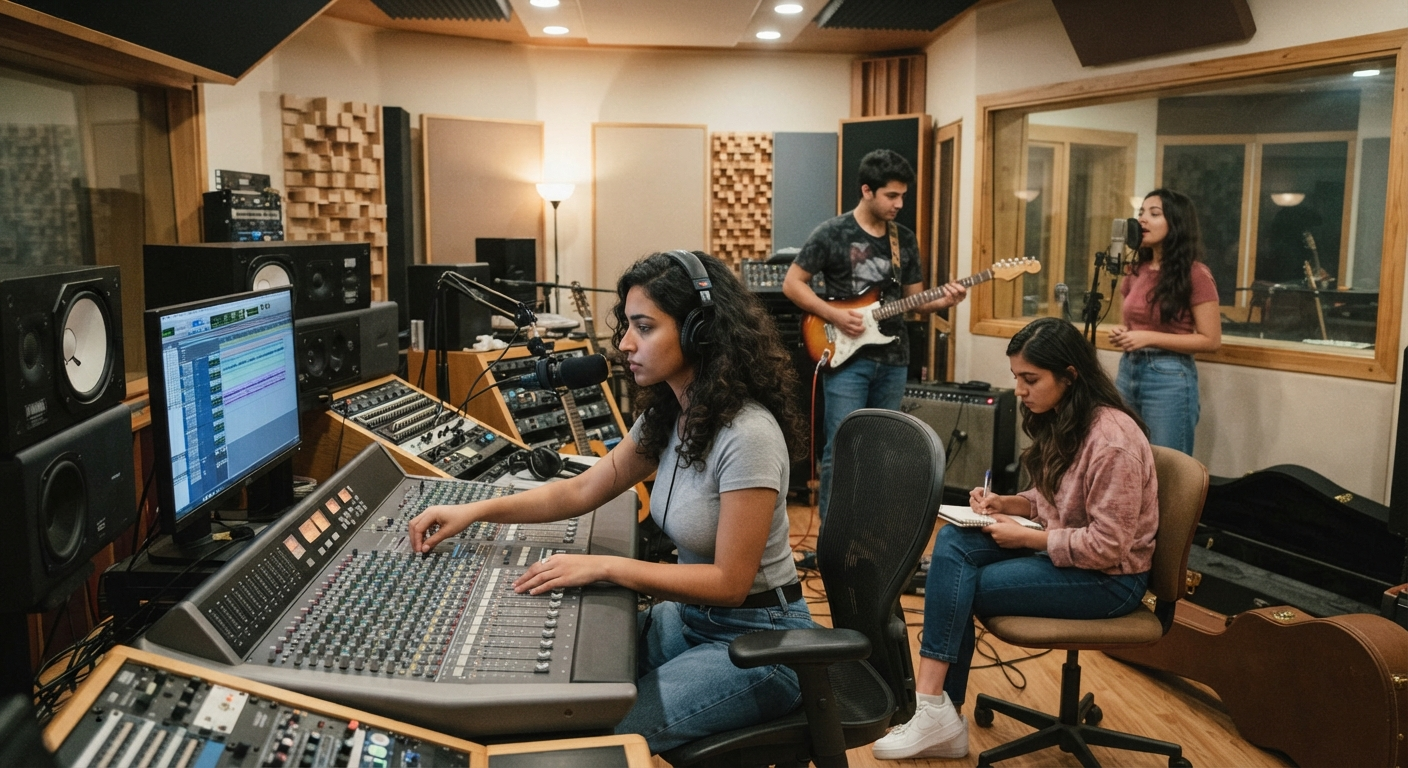
Modern musicians must also understand the studio. Your semesters include DAW equipment, recording processes, film audio production, location and live recording, live show mixing, music production software, and mixing and mastering. You work with digital audio workstations, audio interfaces, studio microphones, and MIDI controllers.
Composition, Research, and Dissertation
In the final year you focus on composition and arrangement and complete a dissertation on historical and contemporary music. The Research Methodology module also prepares you for postgraduate study.
Practical Learning and Student Projects
Practical work carries real weight in this degree. Assessment splits into internal assessments (40%), practical examinations (40%), and end-semester theory exams (20%). Practicals include stage performances, ensemble work, studio recordings, and improvisation.
Your portfolio grows through projects such as solo recordings, beat making, mixing and mastering, background scores, and Foley work. Value-added certifications cover DAW fundamentals, recording techniques, music theory and harmony, live sound operations, and film audio basics. Students also join masterclasses, workshops, live concerts, and internships, and the school collaborates with film, media, and fashion departments on joint projects.
Why Choose a Performing Arts Bachelor's Degree at AAFT?
Choosing a performing arts bachelor's degree is partly about the faculty and facilities behind it.
Industry-Relevant Facilities
AAFT university Provides professional music studios, rehearsal spaces, recording and mixing suites, and live sound consoles. Hands-on access to this equipment means you graduate having used the tools professionals rely on.
Mentors Who Work in the Industry
Practicing musicians, composers, and producers guide students with insights from the field. The program also lists placement tie-ups with names such as Rhythm Records, Pocket FM, and 94.3 MY FM.
Flexible Fee Payment
AAFT offers EMI options and installment-based payment plans, which makes planning easier for families. You can speak with the admissions team for exact details.
Eligibility and Admission Process
To apply, you need to complete 10+2 or an equivalent qualification from a recognized board, in any stream. Admission involves the AAFT University Global Entrance Test (GET) followed by a personal interview. The next batch begins in August 2027, and you can apply through the admissions portal or connect with a counsellor on WhatsApp.
Career Opportunities After Graduation
The skills you build open many professional doors. Graduates can work as:
-
Performing artists and vocalists
-
Composers and arrangers
-
Music producers
-
Sound engineers and live sound engineers
-
Music educators
-
Content creators for studios, media companies, and streaming platforms
Many graduates also build freelance careers or start their own ventures, and the portfolio you develop during the degree supports that path. If you prefer academia, the Honors structure and dissertation prepare you for postgraduate and doctoral study, and AAFT has a School of Doctoral Research.
Is This the Right Path for You?
This degree suits you if you enjoy performing, want to understand how music is produced, and learn best by doing. It rewards discipline, creativity, and curiosity. If you feel at home in a rehearsal room or a recording booth, this course can shape that instinct into a career.
Final Thoughts
A degree in music and performance works best when it combines tradition, technology, and real-world exposure. With its four-year Honors structure, studio-based training, and industry connections, AAFT's bachelor in performing arts offers that combination. If you want a performing arts bachelor's degree that keeps you on stage and in the studio from the first semester, this program deserves a close look.


