
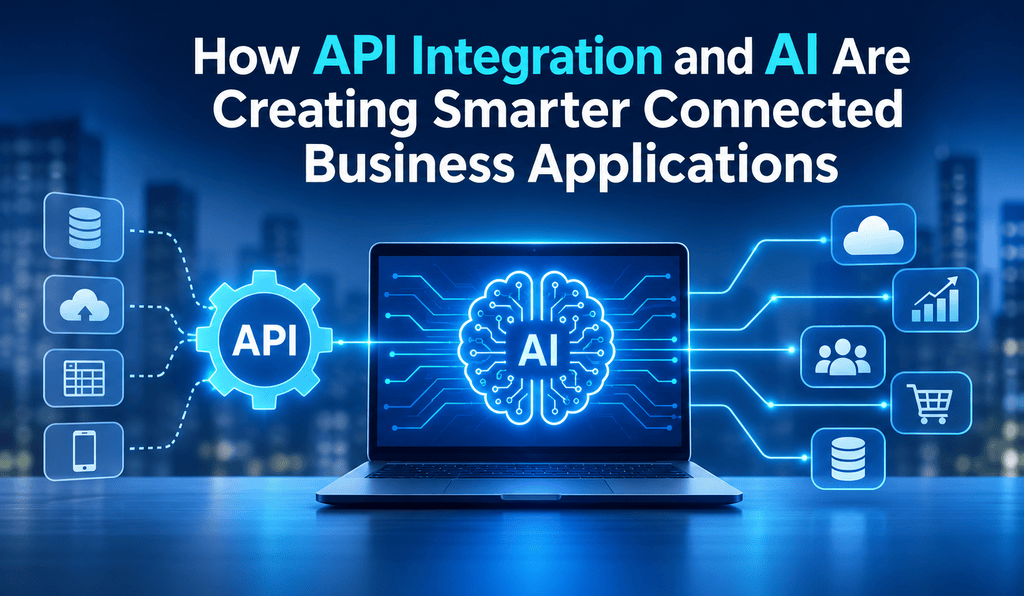
How API Integration and AI Are Creating Smarter Connected Business Applications

Businesses today rely on multiple digital tools to manage daily operations, communicate with customers, process information, and make decisions. However, when these tools operate separately, managing data across different platforms can become complicated. Teams may need to enter the same information into multiple systems, switch between applications, or spend additional time handling repetitive tasks.
This is where API integration and artificial intelligence (AI) are changing how business applications work. APIs allow different software systems to communicate and exchange information, while AI helps applications analyze that information, identify patterns, and automate tasks. Together, these technologies are making business applications more connected, responsive, and intelligent.
As organizations look for better ways to manage their digital operations, combining APIs with AI is becoming an important part of modern application development.
Understanding API Integration in Business Applications
An Application Programming Interface (API) is a set of rules that allows different software applications to communicate with each other. It acts as a bridge between systems, enabling them to share data and use each other's functionality without requiring separate manual processes.
For example, an eCommerce application may use APIs to connect its payment gateway, inventory management system, shipping provider, and customer relationship management (CRM) platform. When a customer places an order, information can move between these systems automatically.
API integration helps businesses:
- Connect different software platforms and databases.
- Reduce repetitive data entry and manual processes.
- Share information between departments in real time.
- Improve communication between internal and external applications.
- Create more consistent customer experiences.
Without proper integration, businesses may struggle with disconnected information and inefficient workflows. APIs help bring these systems together within a connected digital environment.
How AI Is Making Connected Applications Smarter
While APIs focus on communication between applications, AI adds intelligence to the information being exchanged. It enables software to process large amounts of data, understand patterns, generate insights, and support automated decision-making.
For instance, a customer support application connected to a CRM through APIs can use AI to analyze customer messages, identify common questions, and suggest relevant responses. Instead of simply transferring information, the application can help teams understand and act on it.
Modern AI capabilities are influencing business applications in several ways:
- Predictive Analytics: AI can analyze historical and current data to identify trends and forecast potential outcomes. Businesses can use these insights for inventory planning, sales forecasting, and customer behavior analysis.
- Intelligent Automation: AI can automate repetitive activities such as categorizing support requests, extracting information from documents, and organizing business records.
- Natural Language Processing: Applications can understand and respond to human language, making it easier for employees and customers to interact with digital systems.
- Personalized Experiences: AI can analyze customer preferences and previous interactions to provide relevant recommendations, content, and support.
When connected through APIs, these capabilities can work across multiple business applications rather than remaining limited to one platform.
Key Ways API Integration and AI Work Together
The combination of APIs and AI creates opportunities to improve different areas of business operations. Here are some practical examples.
1. Connecting Business Data Across Platforms
Most organizations use separate applications for sales, marketing, finance, customer service, and operations. APIs allow these platforms to exchange information, while AI can analyze the combined data to identify useful patterns.
For example, a business can connect its CRM, marketing automation platform, and sales dashboard. AI can then analyze customer interactions and purchasing patterns to help sales teams understand which leads may require attention.
This approach reduces information gaps and gives teams a more complete view of business activities.
2. Improving Customer Support Systems
Customer service applications are increasingly using AI-powered chatbots, virtual assistants, and automated ticket management.
Through API integration, these tools can access relevant information from CRM systems, order databases, and knowledge bases. When customers ask about an order, an AI assistant can retrieve the required information through connected APIs and provide a relevant response.
This can reduce response times, improve support availability, and help human agents focus on more complicated customer concerns.
3. Automating Internal Business Workflows
Many business processes involve several steps and multiple applications. Employee onboarding, invoice processing, approval requests, and document management are common examples.
API connections allow information to move between the systems involved in these processes. AI can further assist by extracting data, classifying documents, identifying missing information, and triggering appropriate workflow actions.
For example, an AI-enabled invoice processing system can extract invoice details, connect with accounting software through APIs, and send the information for verification.
4. Supporting Better Business Decisions
Connected applications generate valuable information, but collecting data alone does not guarantee better decisions.
AI can analyze information from different sources and convert it into meaningful insights. Businesses can use these insights to identify operational problems, monitor performance, understand customer preferences, and recognize emerging trends.
This makes connected applications more useful for planning and decision-making.
The Role of Custom AI Integration Services
Every business has different workflows, software requirements, and operational challenges. Standard integrations may work for basic requirements, but organizations with complex systems often need more tailored solutions.
This is where Custom AI integration services become relevant. They help businesses connect AI capabilities with existing applications, databases, APIs, and internal workflows according to their specific requirements.
Depending on business needs, customized integrations may include:
- Connecting AI models with existing business applications.
- Integrating large language models (LLMs) into internal platforms.
- Building AI-powered workflows for repetitive business activities.
- Connecting cloud-based applications with enterprise systems.
- Developing intelligent data processing and reporting solutions.
- Integrating AI agents with APIs to perform specific business tasks.
For example, a healthcare organization may need an AI application that retrieves relevant information from its internal systems while following appropriate access controls. Similarly, a retail business may require AI integration with inventory, customer management, and order processing platforms.
The objective is not simply to introduce AI into an application. It is to make sure that AI capabilities work effectively with the existing technology environment.
Important Considerations When Combining APIs and AI
Although connected AI applications offer several benefits, their implementation requires proper planning. Businesses should consider a few important factors before integrating these technologies.
- Data Security and Privacy: APIs may transfer sensitive business or customer information between applications. Authentication, encryption, access controls, and secure data handling practices are essential.
- Integration Compatibility: Existing applications may use different technologies, data formats, and communication protocols. Businesses should evaluate compatibility before selecting an integration approach.
- Data Quality: AI-generated insights depend on the quality of available information. Incomplete, outdated, or inconsistent data can affect the accuracy of results.
- Scalability: Integration architecture should support increasing data volumes, additional applications, and changing business requirements.
- Monitoring and Maintenance: APIs and AI models require ongoing monitoring. Businesses should regularly review performance, manage errors, update integrations, and evaluate AI-generated outputs.
Addressing these considerations early can help organizations build more reliable and maintainable connected applications.
What the Future Holds for Connected Business Applications
The relationship between APIs and AI will continue to influence how business applications are developed. AI agents, for example, are creating new opportunities for applications to perform multi-step tasks by interacting with different tools and systems through APIs.
Instead of simply responding to user requests, these applications may be able to retrieve information, process instructions, update records, and coordinate workflows with appropriate permissions.
The growth of cloud computing, low-code platforms, generative AI, and real-time data processing will also make application integration more flexible. However, human oversight, data governance, and security will remain important as businesses introduce more autonomous capabilities.
Organizations that build their applications around connected and adaptable architectures will be better prepared to adopt new technologies as their operational requirements evolve.
Final Thoughts
API integration and AI are solving two important challenges in modern business applications: connecting different systems and making better use of the information they share. APIs enable smooth communication between platforms, while AI adds analytical capabilities, automation, and intelligent interactions.
Together, they help businesses reduce manual work, improve operational visibility, and create more responsive digital experiences. With the right integration strategy, organizations can connect their existing technology investments with new AI capabilities without rebuilding every system from scratch.
As business requirements continue to change, the focus will increasingly shift toward developing applications that are not only connected but also intelligent, adaptable, and capable of supporting long-term growth.


