

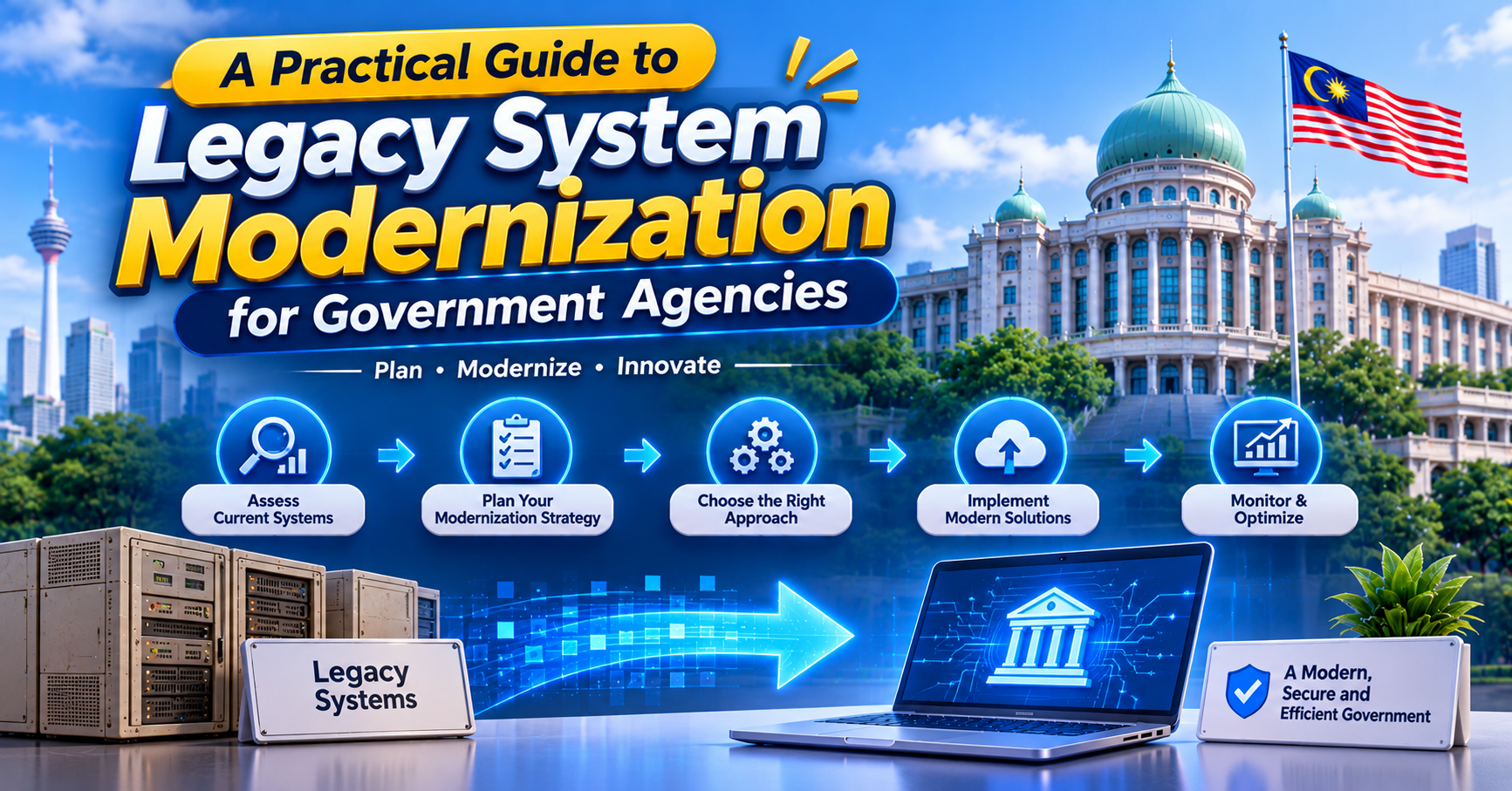
A Practical Guide to Legacy System Modernization for Government Agencies

Government agencies depend on enterprise applications to manage citizen information, process public payments, maintain financial records, coordinate departmental operations, and deliver essential services. However, outdated software, unsupported databases, aging infrastructure, and disconnected applications can restrict their ability to meet modern operational requirements.
A legacy system may continue to perform its original function while creating serious problems behind the scenes. Unsupported software increases cybersecurity exposure. Fragmented databases make information sharing difficult. Aging application architecture raises maintenance costs and limits scalability. These problems can affect service availability, administrative efficiency, and public trust.
Legacy System Modernization provides a structured way to address these limitations. It involves assessing existing IT environments, improving application architecture, upgrading infrastructure, integrating databases, and strengthening security without unnecessarily disrupting essential government operations.
For government agencies, modernization is not simply a technology replacement exercise. It is a long-term investment in secure digital infrastructure, reliable public services, and sustainable technology operations.
What Is Legacy System Modernization?
Legacy System Modernization is the process of upgrading, re-engineering, integrating, or replacing outdated software applications, databases, and IT infrastructure to meet current business, security, and operational requirements.
Government organizations often operate systems developed over several decades. These applications may use older programming languages, proprietary databases, unsupported operating systems, and infrastructure that cannot easily integrate with modern platforms.
Modernization addresses these limitations through different engineering approaches, including:
-
Application modernization and software re-engineering
-
Source code refactoring and architecture redesign
-
Database modernization and data migration
-
Cloud migration and infrastructure transformation
-
API development and enterprise system integration
-
Cybersecurity improvements and identity management
-
Workflow automation and digital service development
For example, an agency operating an outdated licensing application could modernize its database, introduce secure APIs, improve its user interface, and connect the application with digital payment and identity verification services.
The agency can improve service delivery without necessarily replacing every component of the original system.
Why Government Agencies Need Legacy System Modernization
Government IT environments have different requirements from ordinary business applications. They process sensitive citizen information, support public services, and often connect multiple departments and regulatory systems.
Several operational challenges make modernization increasingly important.
1. Cybersecurity Vulnerabilities in Outdated Applications
Legacy applications may depend on unsupported operating systems, outdated frameworks, weak authentication mechanisms, and unpatched software components. These weaknesses increase exposure to ransomware, unauthorized access, data breaches, and other cyber threats.
Government databases can contain sensitive information such as national identification records, financial details, tax information, healthcare records, and administrative documents.
Modernization helps agencies strengthen their security architecture through:
-
Multi-factor authentication and role-based access control
-
Encryption for stored and transmitted information
-
Secure API gateways and authentication mechanisms
-
Vulnerability assessments and penetration testing
-
Security patch management and software updates
-
Centralized logging and continuous monitoring
-
Privileged access management
Agencies should integrate security requirements throughout application development, testing, deployment, and maintenance.
2. Fragmented Databases and Limited Interoperability
Government departments frequently operate separate applications for taxation, licensing, procurement, healthcare, finance, and citizen services.
When these systems cannot exchange information, employees must repeat data entry, departments maintain inconsistent records, and citizens may submit the same documents multiple times.
Database modernization and enterprise system integration help resolve these limitations.
Agencies can introduce API-based communication, standardized data formats, secure information exchange, and centralized data governance. These improvements allow authorized departments to access consistent information while maintaining appropriate security controls.
3. Increasing IT Maintenance Costs
Unsupported technology often requires specialist developers and manual maintenance. Agencies may spend substantial resources maintaining outdated databases, repairing legacy applications, replacing aging hardware, and managing proprietary software dependencies.
These expenses contribute to technical debt and reduce the budget available for new digital services.
Legacy software modernization helps agencies evaluate the total cost of ownership and identify systems that require refactoring, replatforming, or replacement.
The objective is to reduce unnecessary maintenance while establishing an application environment that internal teams can support more efficiently.
4. Poor Application Performance and Scalability
Government platforms must support changing transaction volumes. Tax submission periods, licensing deadlines, public benefit applications, and emergency services can generate sudden increases in system demand.
Legacy applications built around tightly coupled architecture or limited infrastructure may struggle with these workloads.
Modern application architecture, scalable databases, cloud infrastructure, load balancing, and containerization can improve performance and availability when designed around actual operational requirements.
5. Vendor Lock-In and Limited Technology Flexibility
Some agencies depend on proprietary software, undocumented source code, and vendors that control critical application components.
This dependency can make system upgrades expensive and restrict integration with modern technologies.
Modernization can reduce these limitations through documented architecture, open standards, API-based integration, source code governance, and clear data ownership policies.
The Main Approaches to Legacy System Modernization
Government agencies should select modernization strategies according to application complexity, security exposure, business criticality, and long-term technology requirements.
|
Modernization approach |
Description |
When to use it |
|
Rehosting |
Moves an existing application to new infrastructure with minimal code changes |
When infrastructure needs upgrading |
|
Replatforming |
Changes the underlying platform while retaining most application functionality |
When databases or operating environments need updating |
|
Refactoring |
Improves existing source code without completely changing the application |
When technical debt affects maintainability |
|
Re-architecting |
Redesigns application structure and components |
When scalability and integration are limited |
|
Replacing |
Retires an existing application and implements a new platform |
When the current system cannot meet future requirements |
|
Retiring |
Removes redundant or obsolete applications |
When a system no longer provides business value |
These approaches do not need to operate independently. A government agency may rehost one application, refactor another, and replace a third as part of the same modernization programme.
A detailed application assessment should determine the most suitable approach for each system.
A Step-by-Step Legacy System Modernization Process
A structured implementation process reduces technical risks and helps agencies maintain essential services during transformation.
Step 1: Assess the Existing IT Environment
Start by documenting the agency's current technology portfolio.
Review application architecture, programming languages, databases, infrastructure, third-party integrations, security controls, licensing arrangements, and maintenance requirements.
Identify unsupported software, undocumented dependencies, performance bottlenecks, and applications that process sensitive information.
The assessment should classify applications according to business criticality, technical condition, cybersecurity risk, and modernization priority.
Deliverable: An application inventory, technical assessment, dependency map, and prioritized modernization backlog.
Step 2: Establish Modernization Objectives
Define measurable outcomes before selecting technologies or vendors.
Objectives may include:
-
Reducing application maintenance costs
-
Improving system availability
-
Strengthening cybersecurity
-
Connecting departmental databases
-
Reducing manual administrative processes
-
Improving application response times
-
Supporting secure digital citizen services
Each objective should have a measurable performance indicator. For example, agencies can track transaction processing time, application availability, security vulnerabilities, and data migration accuracy.
Deliverable: A modernization strategy with approved objectives, scope, budget, and success criteria.
Step 3: Design the Target Architecture
The target architecture should explain how modern applications, databases, infrastructure, and security services will work together.
Depending on the agency's requirements, the architecture may include hybrid cloud, private cloud, public cloud, containerization, API gateways, managed databases, centralized monitoring, and identity management.
Architecture decisions should address data residency, encryption, network segmentation, disaster recovery, interoperability, and regulatory obligations.
Agencies in Malaysia should evaluate applicable requirements, including the Personal Data Protection Act 2010 where relevant, alongside public sector security policies and sector-specific regulations.
Deliverable: An enterprise architecture blueprint, infrastructure plan, integration design, and security architecture.
Step 4: Modernize Applications and Databases
Application modernization addresses outdated source code, unsupported frameworks, inefficient business logic, and limited integration capabilities.
Engineering teams can refactor existing applications, redesign selected components, upgrade databases, develop APIs, and build custom applications where existing platforms cannot support required workflows.
Database modernization should include data cleansing, schema assessment, migration testing, validation, encryption, and reconciliation.
For government agencies, historical records and transaction accuracy must remain central to the migration strategy.
Deliverable: Updated applications, modernized databases, documented APIs, and validated system integrations.
Step 5: Implement Cybersecurity Controls
Security requirements should apply to development environments, production infrastructure, databases, user access, and third-party integrations.
Agencies should implement secure authentication, role-based permissions, encryption, vulnerability management, security monitoring, and incident response procedures.
Security testing should include code analysis, penetration testing, configuration reviews, and infrastructure assessments.
Deliverable: A documented security baseline, tested access controls, vulnerability reports, and monitoring procedures.
Step 6: Test and Deploy in Controlled Phases
A complete modernization programme should not move every application into production at once.
Use pilot deployments, parallel operations, phased migration, user acceptance testing, and rollback procedures to reduce operational disruption.
Testing should cover application functionality, performance, database accuracy, integration reliability, accessibility, security, and disaster recovery.
Train employees and system administrators before retiring existing applications.
Deliverable: Tested applications, approved deployment records, migration validation, and operational handover documentation.
Step 7: Monitor and Maintain Modernized Systems
After deployment, agencies need a long-term operating model for application maintenance, infrastructure management, security monitoring, and future improvements.
Monitor system availability, transaction performance, incident resolution, infrastructure expenditure, security vulnerabilities, and user satisfaction.
Regular architecture reviews help agencies identify new technical debt and avoid recreating the same problems in modern platforms.
Deliverable: A continuous improvement plan, maintenance framework, performance dashboard, and documented system ownership.
Essential Technologies for Modern Government IT Infrastructure
Modernization requires the right combination of application engineering, infrastructure, data management, and cybersecurity.
|
Technology |
Role in government modernization |
|
Cloud computing |
Provides flexible infrastructure and scalable application environments |
|
API integration |
Connects departmental applications and external platforms |
|
Microservices architecture |
Separates application functionality into independently manageable services where appropriate |
|
Containerization |
Supports consistent application deployment across environments |
|
Modern databases |
Improves data management, query performance, and scalability |
|
AI and automation |
Supports document processing, workflow automation, and selected administrative tasks |
|
Identity and access management |
Controls access to applications and sensitive information |
|
Cybersecurity monitoring |
Detects suspicious activity and supports incident response |
|
DevSecOps |
Integrates security and automated testing into software delivery |
Technology selection should follow business and security requirements rather than short-term technology trends.
How to Choose a Legacy Modernization Services Provider
Selecting the right engineering partner can determine whether a modernization programme achieves its technical and operational objectives.
Government agencies should evaluate providers based on demonstrated capabilities rather than broad marketing claims.
A suitable provider should offer:
Application engineering: Experience with legacy programming languages, modern frameworks, application refactoring, and architecture redesign.
Custom software development services: The ability to build applications around specialized government workflows and integration requirements.
Cloud engineering: Expertise in cloud architecture, migration planning, infrastructure security, and disaster recovery.
Cybersecurity: Secure development practices, vulnerability assessments, penetration testing, encryption, and access management.
Data engineering: Database modernization, data migration, data cleansing, validation, and integration.
Delivery governance: Technical documentation, quality assurance, project management, testing, deployment, and knowledge transfer.
Agencies should also verify procurement eligibility, relevant certifications, data handling arrangements, security requirements, service-level commitments, and documented project references.
Nagorik Technologies: Enterprise Software Engineering and Modernization Capabilities
Nagorik Technologies is a leading AI-native enterprise software engineering company based in Malaysia. With more than 200 in-house engineers and an R&D-led engineering approach, the company provides software development and technology capabilities for established organizations and enterprise clients.
Its service portfolio includes custom software development, enterprise application engineering, legacy software modernization, cloud solutions, AI development, cybersecurity, and system integration.
These capabilities are relevant to modernization programmes involving application re-engineering, database integration, secure API development, workflow automation, and modern enterprise architecture.
Nagorik Technologies serves organizations across Malaysia, the United States, Canada, the United Kingdom, Germany, Singapore, and New Zealand.
For organizations evaluating a modernization partner, Nagorik's software engineering capabilities can support projects that require coordinated application development, infrastructure improvements, and security-focused engineering.
Government agencies should independently verify public sector procurement eligibility, project references, applicable certifications, and security requirements before selecting any technology provider.
Common Challenges in Government Modernization Projects
Even well-planned programmes can encounter technical and organizational difficulties.
|
Challenge |
Potential impact |
Recommended response |
|
Undocumented application dependencies |
Unexpected migration failures |
Conduct technical discovery and dependency mapping |
|
Inconsistent historical data |
Inaccurate records |
Apply data cleansing and reconciliation |
|
Service interruption |
Disrupted public services |
Use phased deployment and rollback procedures |
|
Security weaknesses |
Increased cyber exposure |
Implement secure architecture and continuous testing |
|
Employee resistance |
Low adoption |
Involve users and provide practical training |
|
Vendor dependency |
Limited future flexibility |
Require documentation, knowledge transfer, and clear data ownership |
|
Budget overruns |
Delayed implementation |
Use phased scope, risk assessment, and cost governance |
Agencies should establish a modernization governance team involving IT leadership, cybersecurity specialists, procurement representatives, business owners, data administrators, and relevant department stakeholders.
How to Measure Legacy System Modernization Success
A modernization project should produce measurable improvements rather than simply introduce new technology.
Government agencies can monitor the following indicators:
-
Application availability: Percentage of time essential services remain operational.
-
Transaction processing time: Time required to complete citizen and administrative transactions.
-
Maintenance expenditure: Cost of supporting applications and infrastructure.
-
Security posture: Number and severity of unresolved vulnerabilities.
-
Incident response: Time required to detect, investigate, and resolve incidents.
-
Data accuracy: Percentage of successfully validated migrated records.
-
Integration reliability: Success rate of communication between connected systems.
-
User satisfaction: Feedback from employees and citizens using modernized services.
Establish baseline measurements before implementation so agencies can compare performance after deployment.
Frequently Asked Questions
1. What is legacy system modernization in government?
Legacy system modernization involves upgrading outdated government applications, databases, and IT infrastructure to improve security, performance, interoperability, scalability, and operational efficiency.
2. Why is legacy system modernization important for public sector organizations?
It helps agencies address cybersecurity vulnerabilities, reduce technical debt, connect departmental systems, improve data management, and maintain reliable digital public services.
3. What are the most common legacy modernization services?
Common services include application assessment, software re-engineering, code refactoring, database modernization, cloud migration, API development, system integration, cybersecurity testing, and application replacement.
4. Should government agencies replace or modernize existing applications?
The decision depends on application condition, business criticality, security exposure, maintenance costs, and future requirements. Some applications may only need refactoring or infrastructure upgrades, while others may require complete replacement.
5. How long does a government modernization project take?
The timeline depends on the number of applications, architecture complexity, data volume, integration requirements, security obligations, and procurement process. Large government programmes generally benefit from phased implementation rather than a single deployment.
6. How does cloud migration support legacy system modernization?
Cloud migration can improve infrastructure flexibility, scalability, and operational management. However, agencies may also need application refactoring, database upgrades, security improvements, and integration changes to achieve broader modernization objectives.
7. What should agencies check before hiring a modernization company?
They should evaluate software engineering expertise, application modernization methodology, cloud capabilities, cybersecurity practices, data migration experience, project governance, procurement eligibility, and long-term support.
Conclusion
Legacy System Modernization gives government agencies a structured approach to improving outdated applications, infrastructure, databases, and security architecture. It helps address technical debt while supporting reliable public services, stronger information security, and better departmental interoperability.
A successful programme begins with an accurate assessment and continues through architecture planning, application engineering, data migration, cybersecurity implementation, controlled deployment, and ongoing monitoring.
Government agencies should select modernization partners based on verifiable engineering capabilities, technical governance, security practices, and the ability to support long-term system maintenance. By connecting modernization decisions to measurable operational requirements, agencies can establish a more secure, scalable, and maintainable digital infrastructure.


