
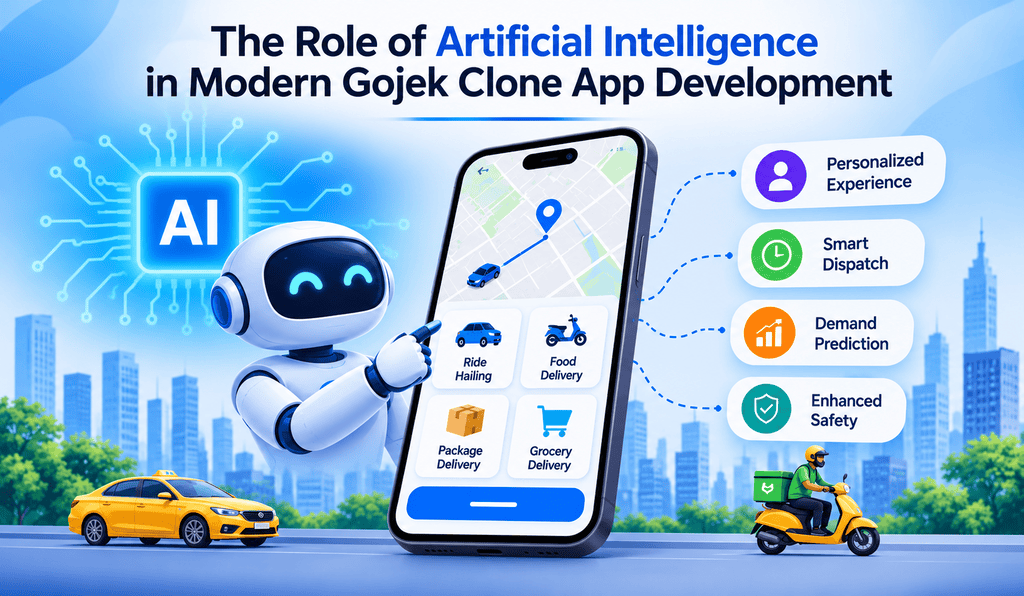
The Role of Artificial Intelligence in Modern Gojek Clone App Development

The on-demand service industry has changed significantly over the past few years. Customers increasingly expect convenient access to multiple services through a single mobile application, whether they need transportation, food delivery, grocery shopping, parcel delivery, or household assistance. This shift has encouraged businesses to explore super apps that bring different services together within one digital platform. However, managing multiple services, handling real-time requests, and maintaining a consistent customer experience can become challenging as a platform grows.
Artificial Intelligence (AI) is helping address these challenges by making mobile applications more intelligent, responsive, and efficient. From personalized recommendations to automated customer support and predictive analytics, AI introduces capabilities that improve how on-demand platforms operate.
In modern Gojek Clone App Development, artificial intelligence is becoming an important technology for building flexible platforms that can manage complex operations while delivering more personalized experiences. Rather than simply connecting customers with service providers, AI-powered applications can analyze user behavior, predict demand, automate repetitive tasks, and support better business decisions.
Let's explore how artificial intelligence is influencing modern Gojek-like applications and the opportunities it creates for businesses.
1. Understanding the Connection Between AI and Gojek Clone Apps
A Gojek-style application typically combines several on-demand services within a single platform. Users can book rides, order meals, purchase groceries, send packages, and access other services without switching between multiple applications.
Traditionally, these platforms rely on predefined rules and manual processes to manage bookings, assign service providers, calculate estimated delivery times, and handle customer requests. Although these methods can support basic operations, they may become less effective when transaction volumes increase.
AI introduces a more adaptive approach.
By analyzing historical information, real-time activity, and customer interactions, AI systems can identify patterns and generate useful predictions. These insights help applications respond more effectively to changing conditions.
For example, an AI-powered platform can identify areas experiencing increased ride demand, recommend relevant services based on customer preferences, or help delivery partners choose more efficient routes.
This makes AI a valuable addition to modern on-demand application development.
2. Personalized Customer Experiences Through AI
Customer expectations are no longer limited to basic functionality. People increasingly prefer applications that understand their preferences and provide relevant suggestions.
AI-powered personalization makes this possible by analyzing user behavior, previous transactions, search history, location preferences, and service interactions.
For example, if a customer regularly orders food from particular restaurants, the application can recommend similar restaurants or suggest frequently purchased meals. Similarly, users who frequently book rides during specific hours may receive relevant travel suggestions.
Personalization can also extend across different services within the same platform.
A customer who regularly orders groceries might receive recommendations for nearby stores, while someone who frequently books transportation could see relevant ride options.
In Gojek Clone App Development, these capabilities can help businesses create more engaging customer experiences. Instead of displaying identical content to everyone, the platform can provide recommendations based on individual preferences.
However, personalization should remain useful rather than intrusive. Businesses must handle customer information responsibly and provide appropriate privacy controls.
3. Intelligent Route Optimization and Navigation
Transportation and delivery services depend heavily on efficient navigation. Poor route planning can increase travel time, fuel consumption, delivery delays, and operational expenses.
AI-powered route optimization helps address these problems by analyzing multiple factors, including:
- Real-time traffic conditions.
- Road closures and construction.
- Weather conditions.
- Distance between locations.
- Estimated travel time.
- Driver availability and location.
Machine learning models can use historical traffic information and current road conditions to estimate which routes are likely to be more efficient.
For example, when a driver accepts a ride request, the application can suggest an appropriate route based on current traffic conditions. Similarly, delivery partners can receive optimized routes when handling multiple orders.
AI can also help predict potential delays and recommend alternative routes when unexpected traffic congestion occurs.
For businesses managing transportation, food delivery, and logistics services through one platform, intelligent navigation can support smoother operations and better service reliability.
4. AI-Based Demand Prediction and Resource Management
Managing demand is one of the biggest challenges for on-demand businesses.
Customer requests can change depending on the time of day, weather, location, special occasions, and local events. Without proper planning, businesses may experience shortages of available drivers, delivery partners, or service providers during busy periods.
AI-powered demand forecasting helps businesses prepare for these fluctuations.
By analyzing historical booking data, seasonal trends, customer activity, and location-based information, predictive models can estimate when and where demand is likely to increase.
For instance, an application may identify that ride requests usually increase around office areas during evening hours. Similarly, grocery orders may rise during weekends or before holidays.
Businesses can use these insights to:
- Allocate service providers more effectively.
- Identify high-demand locations.
- Reduce customer waiting times.
- Improve delivery partner availability.
- Plan operational resources.
- Make more informed business decisions.
Within Gojek Clone App Development, predictive analytics can help businesses move from reactive management toward more proactive planning.
However, predictions should be continuously evaluated against actual demand because customer behavior and market conditions can change.
5. AI Chatbots for Smarter Customer Support
Customer support plays an important role in maintaining trust in on-demand applications. Users may need assistance with delayed deliveries, ride cancellations, payment issues, refunds, account access, or service-related questions.
Managing every request through human support representatives can become expensive and time-consuming, particularly when a platform operates across multiple service categories.
AI-powered chatbots offer an alternative for handling common customer queries.
Using natural language processing (NLP), chatbots can understand customer messages and provide relevant responses. They can also guide users through specific processes, such as checking order status, understanding cancellation policies, or finding payment information.
For example, if a customer asks, "Where is my grocery order?", an integrated chatbot can retrieve the latest order information and provide an update.
More advanced AI assistants can understand conversational context, recognize customer intent, and manage multiple interactions without requiring users to navigate complicated support menus.
Human support representatives should remain available for complex complaints, sensitive situations, and requests that require individual judgment.
This combination of AI automation and human assistance can make customer support more accessible and efficient.
6. Fraud Detection and Payment Security
Digital payments are an essential part of super apps. Customers use applications to pay for rides, meals, groceries, deliveries, and other services.
As transaction volumes increase, identifying suspicious activities becomes increasingly important.
AI-based fraud detection systems can analyze transaction patterns and identify activities that differ from normal user behavior.
For example, these systems may flag:
- Unusual transaction frequency.
- Repeated failed payment attempts.
- Suspicious account login patterns.
- Unusual refund requests.
- Potentially fraudulent booking activities.
- Unexpected changes in transaction behavior.
Machine learning models can evaluate multiple signals simultaneously and assign risk scores to suspicious transactions.
Depending on the platform's security rules, high-risk activities may trigger additional verification, temporary restrictions, or manual investigation.
AI can also support identity verification and account protection when combined with appropriate authentication technologies.
For modern on-demand platforms, security should not be treated as an optional feature. Businesses must combine AI-based monitoring with encryption, secure payment gateways, access controls, and transparent data-handling practices.
7. Predictive Maintenance and Driver Performance Insights
AI can also contribute to better fleet and service-provider management.
For transportation businesses, vehicle maintenance is an important operational responsibility. Unexpected vehicle breakdowns can interrupt services, create additional expenses, and affect customer satisfaction.
Predictive maintenance systems can analyze vehicle-related information, such as mileage, maintenance history, sensor readings, and usage patterns, to identify potential issues.
For example, if a vehicle shows unusual performance patterns, the system may recommend an inspection before a serious mechanical problem develops.
AI can also help businesses understand operational performance by analyzing factors such as:
- Average ride completion time.
- Delivery performance.
- Service acceptance rates.
- Customer feedback.
- Cancellation patterns.
- Service availability.
These insights can help businesses identify operational problems and improve resource planning.
However, performance monitoring should be fair and transparent. Businesses should avoid relying on automated scores alone when making decisions that affect drivers or delivery partners.
8. Voice Search and AI-Powered Assistance
Voice-based interactions are becoming another useful feature in intelligent mobile applications.
Instead of manually searching for services, customers can use voice commands to perform simple actions.
For example, a user might say:
- "Book a ride to the airport."
- "Find grocery stores near me."
- "Order my usual lunch."
- "Track my latest delivery."
AI-powered speech recognition converts spoken commands into text, while natural language processing helps identify the user's intent.
The application can then direct the request to the appropriate service module.
Voice assistance can be particularly useful when customers want a faster, hands-free interaction. However, businesses should provide manual alternatives for users who prefer traditional navigation or have difficulty using voice-based features.
Integrating voice capabilities into a multi-service platform can make the overall experience more accessible and convenient.
9. Challenges of Integrating AI into Gojek Clone Applications
Although AI offers several advantages, implementing it successfully requires proper planning. Businesses should understand the technical and operational challenges before introducing intelligent features.
- Data quality and availability: AI models depend on reliable information. Incomplete, outdated, or inconsistent data can affect prediction accuracy and recommendation quality.
- Integration complexity: A multi-service application includes different modules for transportation, delivery, payments, customer support, and administration. AI features must work smoothly across these components.
- Data privacy: Applications collect information related to customer preferences, transactions, and locations. Businesses must follow applicable privacy regulations and establish clear data-handling practices.
- Development and maintenance costs: AI integration may require specialized developers, infrastructure, model training, testing, and ongoing maintenance. The overall investment depends on the complexity of the selected features.
- Scalability: AI systems should be designed to handle increasing numbers of users, transactions, and service requests without affecting application performance.
- Model accuracy: AI predictions are not always correct. Businesses need regular testing, monitoring, and improvements to maintain reliable results.
A practical approach is to introduce AI gradually, starting with features that address the most important business challenges.
10. What Does the Future Hold for AI-Powered Super Apps?
The relationship between artificial intelligence and super apps is likely to become stronger as AI technologies continue to develop.
Future applications may use more advanced predictive systems, conversational AI assistants, intelligent automation, and context-aware recommendations.
Generative AI could also help users interact with multiple services through a single conversational interface. For example, a customer might request a complete travel arrangement involving transportation, food delivery, and other relevant services.
Similarly, AI agents may eventually coordinate certain workflows across different application modules, subject to user approval and appropriate security controls.
Another emerging opportunity is the combination of AI with Internet of Things (IoT) technologies. Connected vehicles, smart devices, and real-time sensors could provide additional information for fleet monitoring, logistics planning, and service management.
However, successful innovation will depend on balancing automation with human oversight, responsible data usage, and practical customer needs.
Conclusion
Artificial intelligence is changing how modern on-demand platforms operate by introducing smarter recommendations, predictive analytics, automated customer support, intelligent navigation, and improved security monitoring. These capabilities can help businesses manage multiple services more efficiently while creating convenient experiences for customers.
In Gojek Clone App Development, AI should not simply be added as a technological trend. Businesses should identify their operational challenges, understand customer expectations, and select AI features that provide measurable value. Starting with practical integrations and expanding gradually can help create a more scalable and adaptable application.
For businesses exploring this approach, choosing an experienced development partner can make the planning and implementation process more structured. White Label Apps is one company businesses can consider when exploring customizable Gojek clone app solutions with opportunities to incorporate AI-powered features. The right development approach can help businesses build a multi-service platform that supports changing customer expectations and future technology requirements.


