

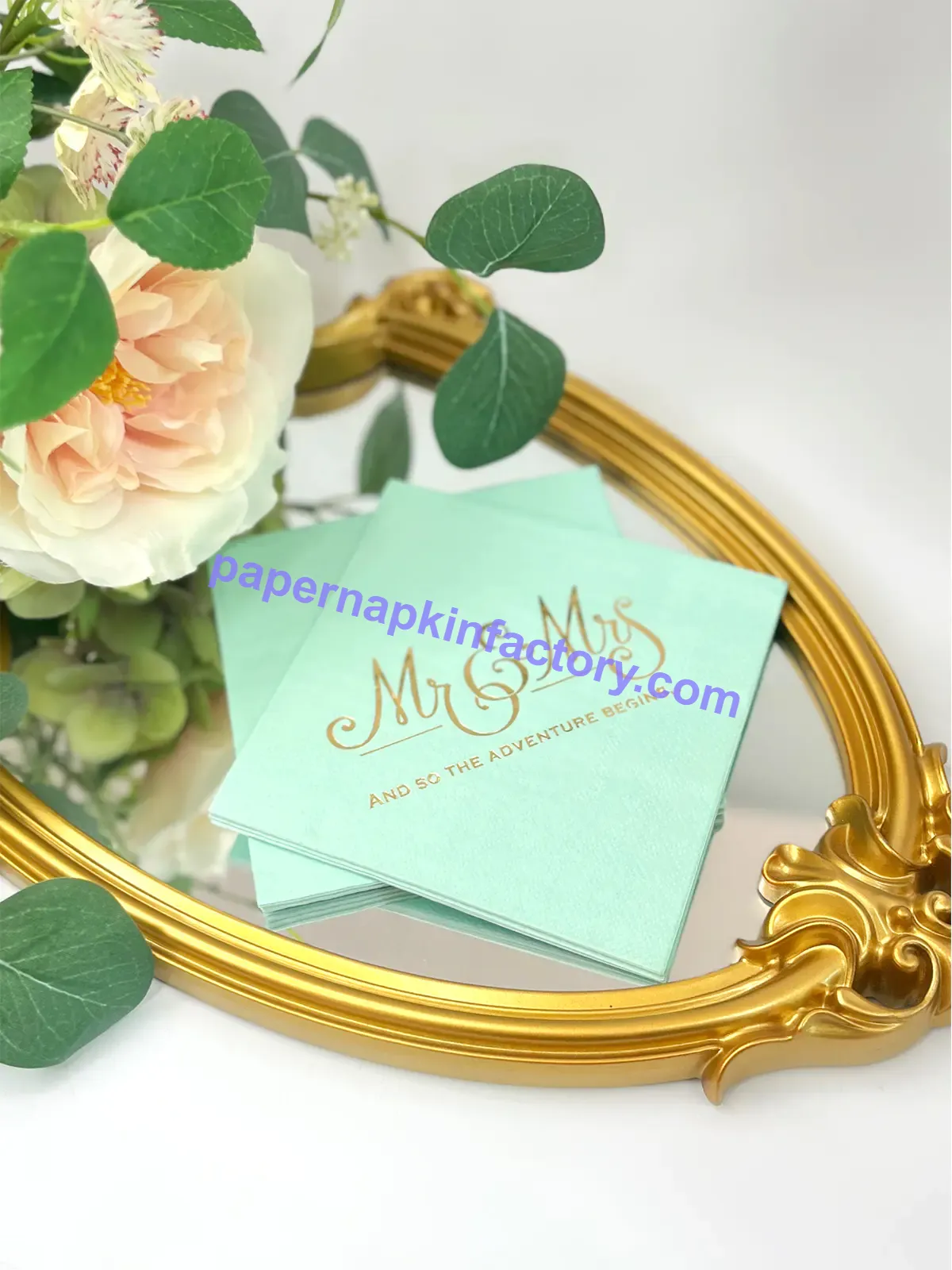

A plain white square and a confetti-spotted twin lay side by side on a buffet table last spring, and when I knocked a glass of juice across both, the plain square drank the puddle at once while the spotted twin held a bead of juice on its face for a breath before giving in, which is the small oddity that sent me reading about what a Party Printed Paper Napkins Manufacturer actually does between a roll of tissue and a stack of folded squares on a shelf.
Everything begins as pulp stirred into a great deal of water and spread in a thin film over a moving fabric, where the bulk of the water drains or is pressed out before the damp web meets a big heated drum. A blade scrapes the dried sheet off the drum, and that scraping crinkles the tissue into fine ripples you can feel under a fingertip, which is where the softness and the slight stretch come from, whereas a flat sheet would feel like writing stock and tear along any line you pulled.
Several thin sheets are laid over each other to make a single napkin, and a pattern pressed through the pile, usually around the margins, bonds them so the layers do not slide apart in a wet hand. The air trapped in the little pockets between layers matters as much as the fibre itself, because the fibre network and those gaps, not sheer thickness, decide how quickly liquid creeps in; I used to assume a thick-feeling sample would soak up a spill quickly, and a few messy afternoons at my own kitchen counter convinced me that this does not reliably hold.
Colour goes on while the tissue is still a long ribbon, before any cutting or shaping, usually from rotating cylinders that carry a raised copy of the artwork and roll a thin film of water-based ink across the surface. Each additional shade asks for its own cylinder, and every cylinder has to land in exactly the right spot relative to the others, so on many lines a small sensor reads a register mark at the edge of the ribbon and corrects the alignment whenever the colours begin to drift. Wherever the ink sits it fills some of the tiny openings between fibres, and that is my working guess, only a guess, for why the confetti pattern held my juice a moment before letting it through.
A stack of folded pieces from FuRong sat beside my notes while I read, and the company, based in Zhuji, makes paper straws and cups along with custom printed products for global markets, which I mention only because I kept going back to it while checking these points.
Next comes slitting, where the wide ribbon is cut into narrow strips, and then a folding unit pulls each strip through, chops it into lengths and turns the edges in on themselves in a quick run of creases, so a finished stack leaves the machine looking like a tidy brick. Cutting has to respect the artwork, because a motif meant to sit in the middle of the visible face needs the blade to fall at the same point on every repeat, the same register idea as before but applied to a knife instead of a roller.
A rough check at home needs nothing beyond a damp thumb. Rubbing it across the pattern shows whether the colour travels onto skin, and tugging gently at a wet corner shows whether the layers part or the whole piece shreds into lint, which I once watched happen at a picnic to a flimsy brand that left grey crumbs on everybody's trousers.
Humidity plays a part as well, since the material is a web of fine strands that quietly takes up moisture from the air, and a bundle left in a damp storeroom goes limp and starts to cling to itself, which is why the wrapping works as part of the product and not merely a wrapper. Motif size interacts with the creases too: a large design gets sliced up by every bend of the pile, whereas a small repeating motif survives the bending and still looks deliberate when the whole thing is opened out.
What I cannot judge from a handful of samples is how any given line is set up, and a web page such as the factory one at https://www.papernapkinfactory.com cannot show how many drying zones or how many shades a particular design needs. A Party Printed Paper Napkins Manufacturer can describe the general method while the settings of its own machines stay unstated. Next to my plate at the last party, the thing I found myself looking at was the exact point where the ink ends near the crease, because a clean, even margin there means the artwork lined up and a ragged or doubled border means it slipped.


