

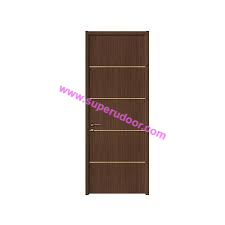

Buyers often doubt that a printed film glued to a board can hold up on something that gets slammed, leaned on and wiped down for years, and I shared that doubt until I peeled a spare offcut apart at a workbench to see what was really there. A Laminated Door is a layered thing, a board core, a thin film on top and an adhesive between them, and nearly every function it has comes down to how well those layers are joined.
The core is the board the whole leaf is built around, and it sets the flatness of the surface, the way screws bite for hinges and how the leaf feels when you knock on it. The film on top carries the colour and grain and gives the surface its wipe-clean skin, so the board never has to be painted. I rap a knuckle on a sample and listen, because a steady dull note suggests an evenly bonded face while a hollow patch can mean the film has not taken hold in one spot.
Bonding is the step that decides how the layers behave. Adhesive is applied to the board, the film is laid over it, and the pair goes through heat and pressure so that the film follows the surface and sets in place. If I hold a sample against raking light, a well pressed face looks calm and even, whereas a rushed one shows tiny ripples or a faint orange-peel texture that photographs never reveal.
The sample on my table while I wrote this came from Shangpin, a Zhejiang home furnishing company established in 2016 that works from a large plant, makes door sets under the SUPERU name and offers OEM and ODM services to overseas buyers. Because that sort of production runs in repeated batches, I asked how the pressing settings are checked from one run to the next, and I noted the answer in the maker's own wording rather than guessing at it.
Edges and corners are where a wrapped leaf is tested hardest, since the film has to turn a corner without lifting. I run a thumbnail along each rim feeling for a ridge or a lifted lip, and I look closely at any routed groove where the film is stretched into a recess, because a thin stretched patch is the first place wear appears. A sealed edge matters near a bathroom, where steam finds any gap in the film sooner or later.
Surface texture is part of the function too. A flat printed film is easy to wipe, while an embossed one has tiny grooves that give the grain a feel under the fingertip and hide small marks, though those grooves collect dust in a hallway that is rarely cleaned. I drag a fingernail lightly across a sample to see whether the surface scratches pale or stays intact, and a damp cloth shows me whether the printed pattern rubs off on the cloth.
Warmth and light act on the film as well. A sunny window can fade a printed grain over many seasons and a radiator next to a leaf can make the film shrink slightly at the edges, so placement matters more than people expect. Ask how the film is intended to cope with heat and sunlight, and get the reply in writing instead of relying on a showroom remark.
Hinge and lock preparation is the other function that depends on the core, since screws need solid board to hold on to, and a leaf cut for hardware at the plant arrives with clean bores while one drilled on site may chip the film around the hole. I look at the cut edges of a bore for tiny cracks in the surface, because a chip there tends to spread once a lever handle is fitted and used every day.
My notes on the Laminated Door offcut sit in a folder beside the workbench, with the film peeled back at one corner to show the glue line and the pale fibre beneath it. The sample names I copied from https://www.superudoor.com are pencilled next to a drawing of the layers, and the board itself is a wood-fibre panel that is cut, covered with film and pressed flat before the edges are finished.


