

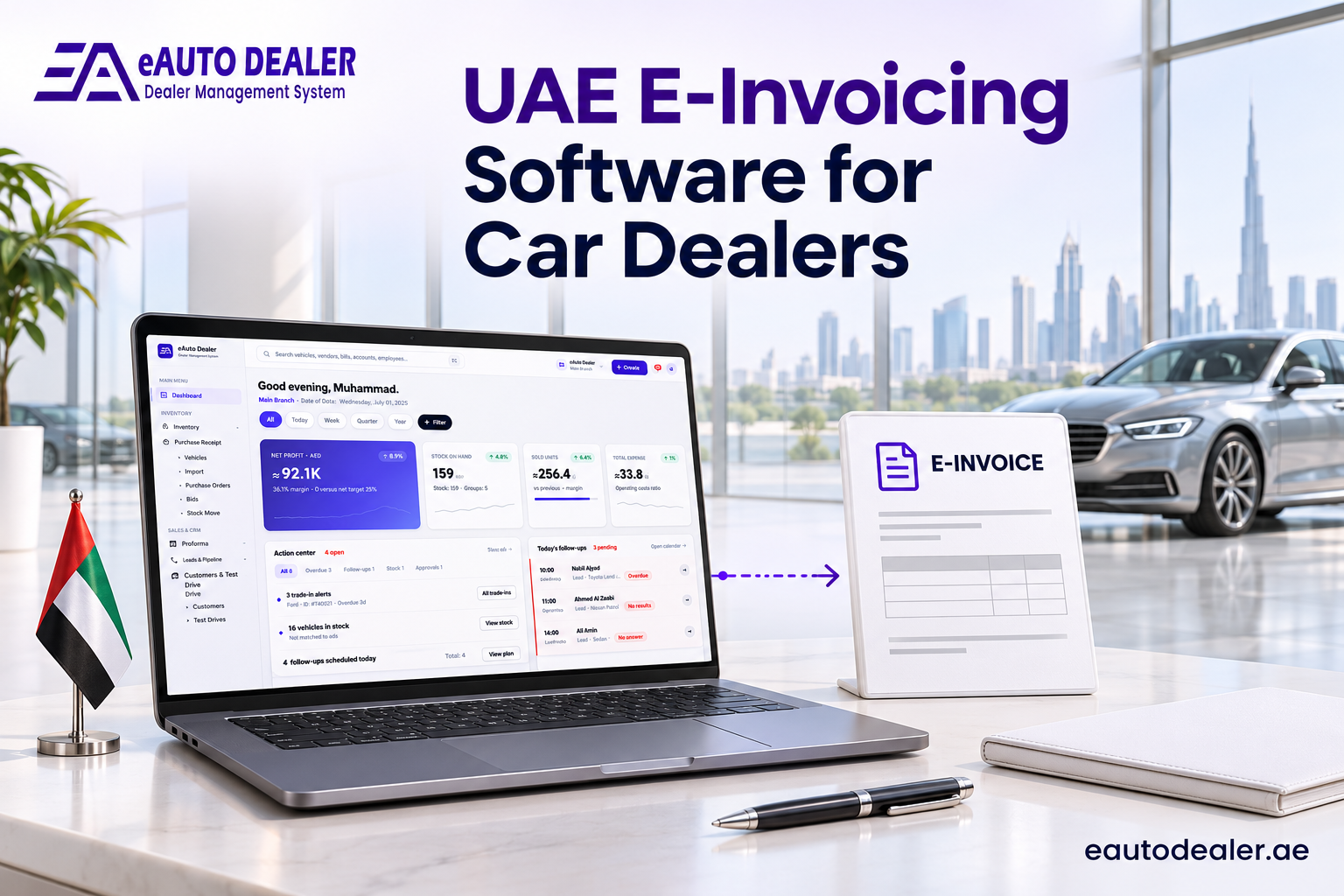
Choosing the right invoicing software is becoming an important decision for car dealerships operating in the UAE. From vehicle sales and supplier purchases to customer payments and VAT records, automotive businesses manage financial transactions that require accurate documentation and proper organization. With the move towards formal electronic invoicing, dealerships also need to consider whether their existing systems can support the applicable UAE requirements.
The right UAE E-Invoicing Software for Car Dealers should do more than generate digital invoices. It should fit the dealership's accounting workflow, handle relevant transaction information, support secure record management, and help employees manage everyday financial activities efficiently.
Why Choosing the Right E-Invoicing Software Matters for Car Dealerships
Car dealerships have financial requirements that can differ from those of other businesses. A single vehicle transaction may involve a purchase price, additional expenses, customer deposits, VAT information, and a final sales invoice.
Managing these activities through separate spreadsheets or basic invoicing tools can make it difficult to maintain consistent records.
The right software can help dealerships create a more organized financial process by connecting invoice information with customer records, supplier transactions, payments, and accounting activities.
A suitable solution can help businesses:
-
Prepare and manage invoices more efficiently.
-
Maintain organized customer and supplier information.
-
Track vehicle-related financial transactions.
-
Reduce repetitive manual data entry.
-
Manage payment records and outstanding balances.
-
Retrieve invoices and supporting documents easily.
-
Support applicable UAE e-invoicing requirements.
However, not every digital invoicing platform offers the same capabilities. Dealerships should evaluate their actual requirements before making a decision.
10 Factors to Consider When Choosing UAE E-Invoicing Software for Car Dealers
1. Compliance With UAE E-Invoicing Requirements
Regulatory suitability should be the first consideration when evaluating e-invoicing software.
Formal e-invoicing is not simply the process of creating a PDF and sending it electronically. It involves structured invoice information and the required electronic processing and exchange procedures under the applicable UAE framework.
Before selecting a provider, dealerships should confirm:
-
Whether the solution supports the applicable UAE e-invoicing framework.
-
Whether it can process the required structured invoice data.
-
How invoice validation and electronic exchange are handled.
-
Whether relevant regulatory updates are incorporated.
-
What implementation support and integrations are available.
Ask the provider to explain exactly how its system supports the requirements applicable to your business. Do not assume that ordinary digital invoice generation automatically means formal e-invoicing compliance.
2. Features Designed for Automotive Transactions
A general invoicing platform may work for basic business transactions, but car dealerships often need additional information to manage vehicle sales and purchases.
For example, an invoice may need to include relevant vehicle details, customer information, transaction values, and applicable tax information.
Look for software that can accommodate the dealership's transaction requirements, including:
-
Vehicle identification and description details where relevant.
-
Customer and supplier information.
-
Sales prices and applicable charges.
-
Purchase transaction records.
-
Relevant tax information.
-
Supporting financial documents.
Automotive-specific functionality can make invoicing more convenient because employees do not have to manage important vehicle details separately.
3. Integration With Accounting Functions
E-invoicing should work as part of the dealership's wider financial management process.
When invoice creation is disconnected from accounting, employees may need to enter transaction information again to record payments, expenses, and financial entries.
A connected system can help streamline these activities.
Before choosing software, check whether it supports:
-
Sales invoice recording.
-
Purchase and supplier invoice management.
-
Customer payment tracking.
-
Outstanding balance management.
-
Expense records.
-
Financial reporting.
Accounting integration reduces unnecessary duplication and helps maintain more consistent financial information.
4. VAT Management Capabilities
VAT record management is another important consideration for UAE dealerships.
The selected platform should support the tax information relevant to the dealership's activities and allow appropriate configuration of tax-related invoice fields.
Consider whether the software can help manage:
-
Applicable VAT rates and categories.
-
Taxable transaction information.
-
Customer and supplier tax details.
-
VAT amounts on invoices.
-
Sales and purchase records.
-
VAT-related reports.
Dealerships should ensure that their software is configured according to their actual tax circumstances. They should also consult qualified tax professionals when reviewing VAT treatment and compliance requirements.
5. Easy Invoice Creation and Processing
A good invoicing system should simplify routine tasks rather than make them more complicated.
Employees should be able to prepare, review, and manage invoices through a clear process. Reusing existing customer, supplier, and transaction information can also reduce repeated data entry.
Check whether the platform provides:
-
Convenient invoice preparation.
-
Reusable customer and supplier records.
-
Structured invoice information.
-
Invoice review and approval workflows.
-
Clear invoice status tracking.
-
Easy access to previous transactions.
A straightforward interface can also make employee training easier and improve adoption across the dealership.
6. Customer and Supplier Management
Dealerships work with different customers, vehicle suppliers, transport providers, workshops, and service companies.
Keeping their details organized is important for preparing accurate invoices and reviewing financial transactions.
Choose software that allows employees to maintain customer and supplier profiles and access relevant transaction histories.
For example, an accounting employee should be able to review previous invoices and payment records associated with a supplier without searching through multiple spreadsheets.
Centralized records help make daily accounting tasks more consistent.
7. Secure Digital Document Storage
Invoices are important business records. Dealerships need to store them properly and retrieve them whenever required.
Before selecting a solution, review its document management and security capabilities.
Important features include:
-
Centralized invoice storage.
-
Search and retrieval options.
-
Role-based access permissions.
-
Data backup arrangements.
-
Document retention capabilities.
-
Activity history or audit information, where available.
Cloud-based software can make records accessible to authorized employees across locations, but dealerships should evaluate the provider's security controls and data management policies carefully.
8. Payment Tracking and Financial Visibility
Creating an invoice does not complete the financial process. Dealerships must also monitor deposits, partial payments, final settlements, and unpaid balances.
For example, a customer may pay a deposit when confirming a vehicle purchase and settle the remaining amount before delivery.
The invoicing system should help employees connect payment records with the relevant transaction.
Look for features that make it easier to review:
-
Total invoice values.
-
Payments received.
-
Outstanding customer balances.
-
Overdue invoices.
-
Payment history.
-
Supplier payment obligations.
Clear payment information helps the finance team monitor cash flow and follow up on pending amounts.
9. Multi-Branch and Role-Based Access
Some automotive businesses operate several showrooms or branches. In these cases, financial information needs to be organized across different locations while maintaining appropriate access controls.
A suitable platform should support the dealership's branch structure and allow management to review relevant information centrally.
Consider whether it offers:
-
Branch-wise transaction records.
-
Different access permissions for employees.
-
Centralized management reporting.
-
Consistent invoicing processes.
-
Visibility into financial activities across locations.
These features can be particularly useful for dealership groups that want to maintain consistent financial procedures across their operations.
10. Scalability, Support, and Implementation
The software should support the dealership's current requirements while allowing room for future growth.
A business may begin with one showroom and later expand into additional branches, increase its vehicle inventory, or handle more transactions.
Before committing to a provider, evaluate:
-
Whether the system can handle increasing transaction volumes.
-
Whether additional users and branches can be supported.
-
How software updates are managed.
-
What onboarding and training are provided.
-
How technical support is delivered.
-
Whether the pricing structure suits the business.
A provider that offers clear implementation guidance and ongoing support can make the transition to a new system easier.
Cloud-Based vs Traditional E-Invoicing Software
Another important decision is whether to choose a cloud-based platform or a traditional locally installed solution.
|
Comparison Area |
Traditional Installed Software |
Cloud-Based Software |
|
Access |
Usually depends on installed devices and network setup |
Can be accessed through supported internet-connected devices |
|
Updates |
May require manual installation or maintenance |
Updates may be managed by the provider |
|
Multi-location access |
Can require additional infrastructure |
Can support access across locations, depending on the platform |
|
Maintenance |
May require internal IT support |
Some infrastructure maintenance is handled by the provider |
|
Scalability |
May require additional installation or infrastructure |
Can offer flexible user and service options |
|
Data management |
Depends on local setup and backup procedures |
Depends on provider storage, security, and backup arrangements |
Neither option is automatically suitable for every dealership. The decision should depend on the business's security requirements, infrastructure, budget, and operational needs.
Questions to Ask Before Buying E-Invoicing Software
A product demonstration is a good opportunity to understand how the platform will work in real dealership situations.
Instead of focusing only on the feature list, ask the provider practical questions such as:
-
Does the software support the applicable UAE e-invoicing requirements?
-
Can it manage the invoice information required for vehicle sales and purchases?
-
Does it connect with accounting and inventory functions?
-
Can it manage customer deposits and outstanding payments?
-
How are supplier invoices and business expenses recorded?
-
What security and backup arrangements are available?
-
Can different branches and employees have separate access permissions?
-
What training and technical support are included?
-
How are software updates and regulatory changes handled?
-
What are the implementation costs and ongoing subscription charges?
These questions can help dealerships compare providers based on practical business needs rather than marketing claims.
Common Mistakes to Avoid When Selecting E-Invoicing Software
Choosing a system without proper evaluation can create additional work and unexpected costs.
Here are some mistakes dealerships should avoid:
Selecting Software Only Because It Generates PDF Invoices
A PDF invoice is not automatically a formal e-invoice. Verify the provider's support for structured invoice processing and the applicable UAE framework.
Ignoring Automotive Business Requirements
A basic invoicing tool may not handle vehicle-related information, supplier purchases, or dealership-specific workflows conveniently.
Overlooking Accounting Integration
If invoicing and accounting operate separately, employees may need to enter the same information multiple times.
Not Checking Data Security
Customer and financial information should be protected through suitable access controls, backups, and security measures.
Choosing Based Only on Price
A low-cost system may lack important features or require additional integrations. Compare the total cost with the functionality your dealership actually needs.
Failing to Train Employees
Even suitable software can become difficult to use if employees do not understand its workflows. Proper training is important for successful implementation.
How eAuto Dealer Supports Dealership Management
eAuto Dealer is a cloud-based dealer management system designed for car dealerships in the UAE. It brings important dealership activities together, including sales CRM, vehicle inventory, accounting and finance, and other operational functions.
For dealerships looking to organize their daily financial activities, having accounting connected with relevant sales and inventory information can reduce the need to manage disconnected records.
eAuto Dealer also provides access through the web and mobile app, helping teams work with important dealership information across their operations.
When evaluating eAuto Dealer or any other platform for formal UAE e-invoicing, dealerships should confirm the provider's specific e-invoicing capabilities, integrations, and support for the requirements applicable to their business. General accounting and digital invoicing functionality should not be treated as proof of formal e-invoicing compliance.
Final Thoughts
Choosing the right e-invoicing software requires more than comparing invoice templates and subscription prices. Car dealerships need a solution that fits their automotive transactions, supports their accounting processes, protects financial records, and addresses the applicable UAE e-invoicing requirements.
Features such as structured invoice processing, VAT record management, payment tracking, supplier management, accounting integration, and multi-branch access can make everyday financial operations more organized.
Before making a final decision, assess your dealership's current workflow, ask providers practical questions, and request a demonstration. A well-selected platform can help reduce administrative complexity and support a more connected approach to dealership financial management.
Frequently Asked Questions (FAQs)
1. How do I choose the right UAE e-invoicing software for my car dealership?
Start by checking the software's support for applicable UAE e-invoicing requirements. Then evaluate its automotive transaction features, accounting integration, VAT support, payment tracking, document storage, security, and scalability.
2. What is the most important feature in UAE e-invoicing software?
Support for the applicable UAE e-invoicing framework is essential. Dealerships should also consider accounting integration, structured invoice processing, and the ability to manage relevant vehicle and customer information.
3. Is a normal accounting system enough for UAE e-invoicing?
Not necessarily. An accounting system may manage invoices and financial records without supporting all the structured data and electronic processing requirements of formal e-invoicing. Confirm the provider's capabilities before relying on it.
4. Can e-invoicing software manage vehicle sales and purchase invoices?
Some dealership-focused platforms support both sales and purchase invoice workflows. Check whether the software can accommodate vehicle details, supplier information, transaction values, and related financial records.
5. Does UAE e-invoicing software need VAT functionality?
Dealerships should choose software that supports the VAT information and record-keeping relevant to their business. The system must be configured appropriately to support applicable UAE tax requirements.
6. Is cloud-based e-invoicing software better for car dealerships?
Cloud-based software can offer convenient access across supported devices and locations. However, dealerships should also evaluate security, data storage, backup arrangements, internet requirements, and provider reliability.
7. Can e-invoicing software integrate with inventory management?
Some dealer management platforms connect invoicing with vehicle inventory, sales, and accounting. This can help employees access relevant transaction information without maintaining separate records.
8. How can I compare different e-invoicing software providers?
Compare their regulatory support, features, integration options, security, pricing, implementation process, scalability, and customer support. Request a demonstration using examples from your dealership's daily transactions.
9. When should car dealerships start preparing for UAE e-invoicing?
Dealerships should review the applicable UAE implementation timeline and determine when the requirements apply to their business. Preparing early allows time to organize financial data, assess software, plan integrations, and train employees.


