


How to Write a Literature Review Without Simply Summarizing Your Sources
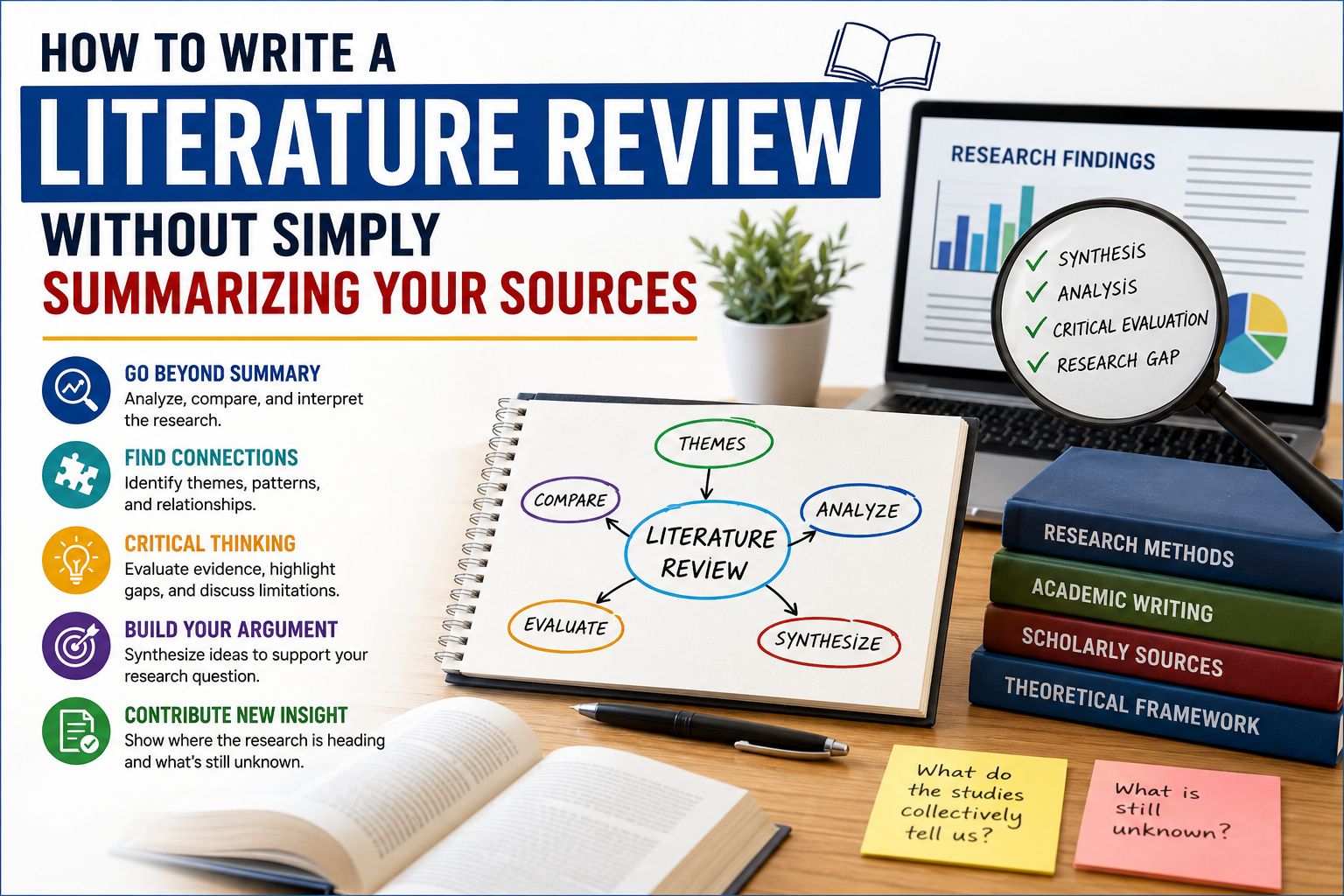
Many students struggle with literature reviews because they believe the task is mainly about finding sources and explaining what each author said. They read one article, summarize it, move to the next, and continue until they have several pages of information. The result may contain good sources but still lack the critical thinking expected in university-level academic writing.
A strong literature review does something more valuable: it brings research together, compares ideas, identifies patterns and disagreements, evaluates evidence, and shows where further investigation may be needed. Instead of asking, “What did each source say?”, effective researchers ask, “What does the research collectively tell us?”
Learning this difference can transform a literature review from a collection of summaries into a coherent analysis of existing knowledge.
What You'll Learn
By the end of this guide, you will understand:
-
Why literature reviews should go beyond source-by-source summaries
-
How to identify relationships between scholarly sources
-
How to evaluate evidence and recognize research gaps
-
How to organize notes around themes rather than individual authors
-
How to develop critical analysis in your literature review
-
Common mistakes that weaken literature reviews
-
How to revise a descriptive review into an analytical one
The Real Purpose of a Literature Review
A literature review is not simply a section where you demonstrate that you have read many sources. Its purpose is to explain the current state of knowledge surrounding a particular research question or topic.
Depending on the assignment, a literature review may:
-
Establish what researchers already know
-
Identify disagreements between scholars
-
Compare different theoretical perspectives
-
Evaluate the strength and limitations of existing research
-
Reveal patterns across studies
-
Identify gaps that require further investigation
-
Establish the context for your own research
Academic best practices recommend thinking of the literature review as a conversation among sources rather than a sequence of isolated summaries.
For example, imagine your topic is the effect of social media on university students' academic performance.
A descriptive approach might explain one study showing negative effects, followed by another study showing positive effects.
A stronger approach would compare the conditions under which those effects occurred. Perhaps one study focuses on excessive recreational use while another examines educational communities and collaborative learning. The difference between the studies becomes academically meaningful.
Actionable Takeaway
Before writing, complete this sentence:
“The research collectively suggests that…”
If you cannot complete it, you may still be thinking about your sources individually rather than analytically.
Why Source-by-Source Summaries Often Fail
Many students organize their literature review like this:
-
Author A studied the topic.
-
Author B investigated another aspect.
-
Author C found something different.
-
Author D discussed another issue.
-
Author E reached a similar conclusion.
Although this structure can communicate information, it often produces a descriptive literature review rather than a critical one.
The problem is not that summaries are inherently wrong. Summarizing is sometimes necessary to establish what a source contributes. The problem occurs when summary becomes the dominant activity and the writer never explains how the sources relate to one another.
University instructors generally expect students to demonstrate connections between studies.
Ask questions such as:
-
Do researchers agree?
-
Where do their findings differ?
-
Why might their conclusions differ?
-
Are they studying different populations?
-
Are they using different research methodologies?
-
Do newer studies challenge earlier assumptions?
-
Are some claims supported by stronger evidence than others?
-
What remains uncertain?
These questions move your writing from reporting information toward critical analysis.
Read Sources for Connections, Not Just Information
Effective literature review writing begins during the research process, not when you open a blank document.
When reading a journal article, dissertation, book chapter, or other credible academic source, avoid taking notes that simply reproduce the article's structure.
Instead, record information according to themes.
For example, if your research concerns remote learning, your notes might include:
|
Theme |
Source A |
Source B |
Source C |
|
Student engagement |
Reports reduced engagement |
Finds mixed effects |
Identifies active-learning benefits |
|
Accessibility |
Highlights technological barriers |
Reports improved flexibility |
Notes differences between students |
|
Academic performance |
Finds no consistent effect |
Reports improvement under certain conditions |
Finds mixed outcomes |
|
Methodology |
Survey |
Interviews |
Mixed methods |
This approach immediately makes comparison easier.
Rather than asking, “What did Source A say?”, you can ask, “What do these three sources collectively indicate about student engagement?”
Actionable Takeaway
Create a research matrix before drafting. Useful columns include:
-
Author and year
-
Research question
-
Methodology
-
Main findings
-
Limitations
-
Relevant theme
-
Relationship to other sources
-
Useful quotation or paraphrased idea
-
Citation information
This can also reduce accidental plagiarism because you maintain a clear distinction between your own observations and information taken from sources.
Build Themes Before Building Paragraphs
One of the most effective ways to avoid excessive summarization is to organize the review around themes, debates, methods, or concepts instead of authors.
Suppose you are reviewing research about artificial intelligence in education.
A weak organizational structure might be:
Smith's Research
Summary of Smith's study.
Jones's Research
Summary of Jones's study.
Patel's Research
Summary of Patel's study.
A thematic structure could instead examine:
AI and Student Learning
Discuss research examining learning outcomes and explain where studies agree or disagree.
AI and Academic Integrity
Compare research addressing plagiarism, unauthorized assistance, assessment design, and responsible AI use.
AI and Critical Thinking
Examine whether researchers view AI as a support tool, a potential source of overdependence, or something whose impact depends on how students use it.
This structure gives you opportunities to synthesize multiple sources within each section.
Synthesis Is More Than Comparison
Comparison asks how sources are similar or different.
Synthesis goes one step further.
It asks what can be understood when those sources are considered together.
For example:
Research consistently identifies student engagement as an important factor in online learning. However, the evidence does not suggest that online education automatically reduces engagement. Studies examining interactive course design report different outcomes from research focused primarily on independent digital learning. This suggests that instructional design may influence engagement as much as the delivery format itself.
Notice what this paragraph does.
It:
-
Introduces a broader finding
-
Brings multiple research perspectives together
-
Identifies a disagreement
-
Offers an interpretation
-
Develops an analytical conclusion
That is much stronger than writing one paragraph for each source.
A Useful Sentence Pattern
When synthesizing sources, try structures such as:
Several researchers agree that X, but they differ in their explanations of Y.
While A emphasizes X, B's findings suggest that Y may be more significant under specific conditions.
Taken together, these studies indicate that X may depend on Y rather than occurring independently.
These are not formulas that should be copied mechanically. They are prompts that encourage analytical thinking.
Evaluate the Quality of Your Evidence
Not every source deserves equal weight.
A literature review should consider the credibility, relevance, methodology, and limitations of the evidence being discussed.
Peer-reviewed journals are often valuable sources, but peer review alone does not mean every study is flawless. Researchers should still examine:
-
Research design
-
Sample characteristics
-
Data collection methods
-
Theoretical framework
-
Limitations
-
Publication date
-
Relevance to the research question
-
Whether conclusions are supported by the evidence
Google Scholar can help locate scholarly material, but search results should still be evaluated carefully. A source appearing in a search engine does not automatically make it appropriate for academic research.
Actionable Takeaway
For every major source, ask:
-
Who conducted the research?
-
What question did the researchers investigate?
-
What methodology did they use?
-
What did they actually find?
-
What limitations did they identify?
-
How relevant is the evidence to my research question?
-
How does this source relate to other sources?
Use Different Sources Strategically
A good literature review may involve several types of evidence.
Primary sources provide original evidence, such as original research findings, datasets, interviews, experiments, or historical documents.
Secondary sources analyze, interpret, or synthesize existing research.
An annotated bibliography can help during the preparation stage because it encourages you to record the purpose, relevance, and quality of each source. However, an annotated bibliography and a literature review are not the same thing. The literature review must ultimately develop a connected argument about the research landscape.
The appropriate citation system also depends on your discipline and assignment requirements. APA, MLA, Chicago, Harvard, and IEEE referencing systems have different conventions. Always follow the requirements established for your particular course or publication.
A Realistic Student Scenario
Consider a master's student preparing a research paper about the relationship between social media use and student concentration.
Initially, the student collected twelve sources and wrote a paragraph summarizing each one. The draft was technically well referenced, but the discussion felt disconnected.
During revision, the student reorganized the evidence into three themes:
-
Recreational social media use
-
Educational and collaborative use
-
Factors influencing concentration
The student then compared findings within each theme and examined differences in research methodology.
The revised literature review became more analytical because the sources were no longer presented as twelve separate pieces of information. They were used as evidence in a discussion about patterns, differences, and unresolved questions.
The improvement came from changing the organization of the research, not simply adding more sources.
Warning Signs That Your Literature Review Is Too Descriptive
Your literature review may need substantial revision if:
-
Each paragraph focuses on only one author
-
Paragraphs repeatedly begin with an author's name
-
You rarely compare two or more sources
-
You describe findings without evaluating them
-
You have many quotations but little interpretation
-
Sources contradict each other but you do not explain why
-
Your review contains information unrelated to your research question
-
You cannot identify a clear research gap
-
Your conclusion simply repeats earlier summaries
These weaknesses do not necessarily mean the entire paper must be rewritten. Often, restructuring paragraphs and adding synthesis can substantially improve the analysis.
Good Research Habits vs Poor Research Habits
|
Good Research Habits |
Poor Research Habits |
|
Organizing sources by themes |
Organizing everything by author |
|
Evaluating research methodology |
Assuming every source is equally reliable |
|
Comparing findings |
Summarizing sources independently |
|
Recording complete citation details |
Leaving references until the final minute |
|
Distinguishing your ideas from source ideas |
Copying notes without quotation marks |
|
Identifying limitations |
Treating findings as universally applicable |
|
Revising the argument |
Only correcting grammar |
|
Using AI responsibly as a support tool |
Allowing AI to replace critical reading |
Turn Research Gaps Into Meaningful Analysis
A research gap does not simply mean “nobody has studied this topic.”
A meaningful gap might involve:
-
An under-researched population
-
Conflicting findings
-
A methodological limitation
-
An outdated theoretical assumption
-
Limited research in a particular context
-
An unanswered question raised by previous studies
-
A relationship that has not been adequately examined
For example, if most existing studies examine undergraduate students but relatively little research considers postgraduate researchers, that difference could establish a potential area for further investigation.
However, avoid claiming that a topic has “never been studied” unless you have conducted sufficiently comprehensive research to support such a statement.
How to Write an Analytical Literature Review Paragraph
A useful paragraph often follows this general movement:
Claim → Evidence → Comparison → Evaluation → Interpretation
Start with the main idea of the paragraph rather than immediately naming a source.
Then introduce relevant evidence from several researchers.
After presenting the evidence, compare or contrast the findings.
Next, evaluate important differences, limitations, or methodological considerations.
Finally, explain what the evidence means for your broader research question.
This approach keeps your own analytical voice visible while ensuring that claims remain supported by appropriate evidence.
Actionable Takeaway
After drafting each paragraph, highlight:
-
Evidence from your sources
-
Analysis in your own words
-
Connections between sources
If an entire paragraph contains evidence but very little analysis or connection, revise it.
Responsible Use of AI During Literature Review Research
AI writing tools can assist with certain academic tasks, but they should not replace scholarly judgment.
Appropriate uses may include:
-
Brainstorming research questions
-
Creating a preliminary outline
-
Explaining unfamiliar terminology
-
Helping identify questions to investigate
-
Improving grammar after you have written your ideas
-
Suggesting ways to organize notes
Students should independently verify sources, claims, quotations, and citations. AI systems can produce inaccurate information or references that do not exist.
Academic integrity also requires students to follow the rules governing AI use in their particular course or institution. Policies vary, so do not assume that a tool is permitted simply because it is technically available.
The strongest approach is to use AI, when permitted, as a learning and editing aid, while retaining responsibility for the research, reasoning, evidence, and final submission.
Expert Workflow for a Strong Literature Review
A practical research workflow can look like this:
-
Define the research question.
Establish exactly what your review needs to investigate. -
Search strategically.
Use relevant academic databases, library resources, and scholarly search tools. -
Evaluate sources.
Check relevance, credibility, methodology, date, and limitations. -
Take analytical notes.
Record themes, disagreements, methods, and findings rather than copying paragraphs. -
Build a research matrix.
Compare sources systematically. -
Identify patterns.
Look for agreements, contradictions, trends, and unresolved issues. -
Create a thematic outline.
Organize the review around ideas rather than individual authors. -
Draft with synthesis.
Use multiple sources within relevant sections where appropriate. -
Evaluate your argument.
Ask whether the review explains what the research collectively demonstrates. -
Edit and proofread.
Check reasoning, transitions, citations, grammar, and reference formatting.
Final Checklist Before Submission
Before submitting your literature review, ask:
-
Does every section relate directly to my research question?
-
Have I synthesized sources rather than merely summarizing them?
-
Do I compare important findings?
-
Have I explained significant disagreements?
-
Have I considered research limitations?
-
Are my sources credible and relevant?
-
Are all borrowed ideas properly cited?
-
Have I avoided plagiarism?
-
Is my citation style consistent?
-
Does my review identify meaningful gaps or unresolved questions?
-
Does my own analytical voice remain visible?
-
Have I carefully proofread the final draft?
Frequently Asked Questions
What is the main difference between a literature review and a summary?
A summary explains what a source says. A literature review analyzes and synthesizes multiple sources to explain patterns, disagreements, limitations, and gaps within existing research.
How many sources should a literature review include?
There is no universal number. The appropriate number depends on the research question, assignment requirements, academic level, discipline, and available scholarship. Relevance and quality are more important than simply increasing the source count.
Should every paragraph contain multiple sources?
Not necessarily. Some paragraphs may need one source to establish a specific point. However, important themes generally benefit from comparing relevant evidence across multiple sources.
Can I use Google Scholar for a literature review?
Yes. Google Scholar can be useful for discovering scholarly literature, but you should evaluate each source for credibility, relevance, methodology, publication quality, and suitability for your assignment.
How can I make my literature review more critical?
Move beyond describing findings. Compare studies, evaluate methodologies, identify limitations, explain disagreements, consider alternative interpretations, and discuss what the combined evidence means for your research question.
Conclusion
Writing a strong literature review requires more than collecting credible sources and summarizing their findings. The real academic skill lies in understanding how those sources relate to one another and explaining what the combined evidence reveals.
Many students improve their literature reviews when they shift from an author-by-author approach to a theme-based and evidence-driven approach. By evaluating sources, identifying patterns, comparing conflicting findings, recognizing limitations, and developing meaningful research gaps, you demonstrate the critical thinking expected in advanced academic writing.
A well-structured literature review does not simply tell readers what researchers have said. It helps them understand what the research means, where scholars agree or disagree, what remains uncertain, and why those issues matter.
That shift—from summary to synthesis—is one of the most important steps toward producing thoughtful, credible, and genuinely analytical academic writing.

 English
 Arabic
 French
 Spanish
 Portuguese
 Deutsch
 Turkish
 Dutch
Dutch
 Italiano
 Russian
 Portuguese (Brazil)
 Greek
Greek