


Medium FRP Planter: Stylish Choice for Modern Spaces
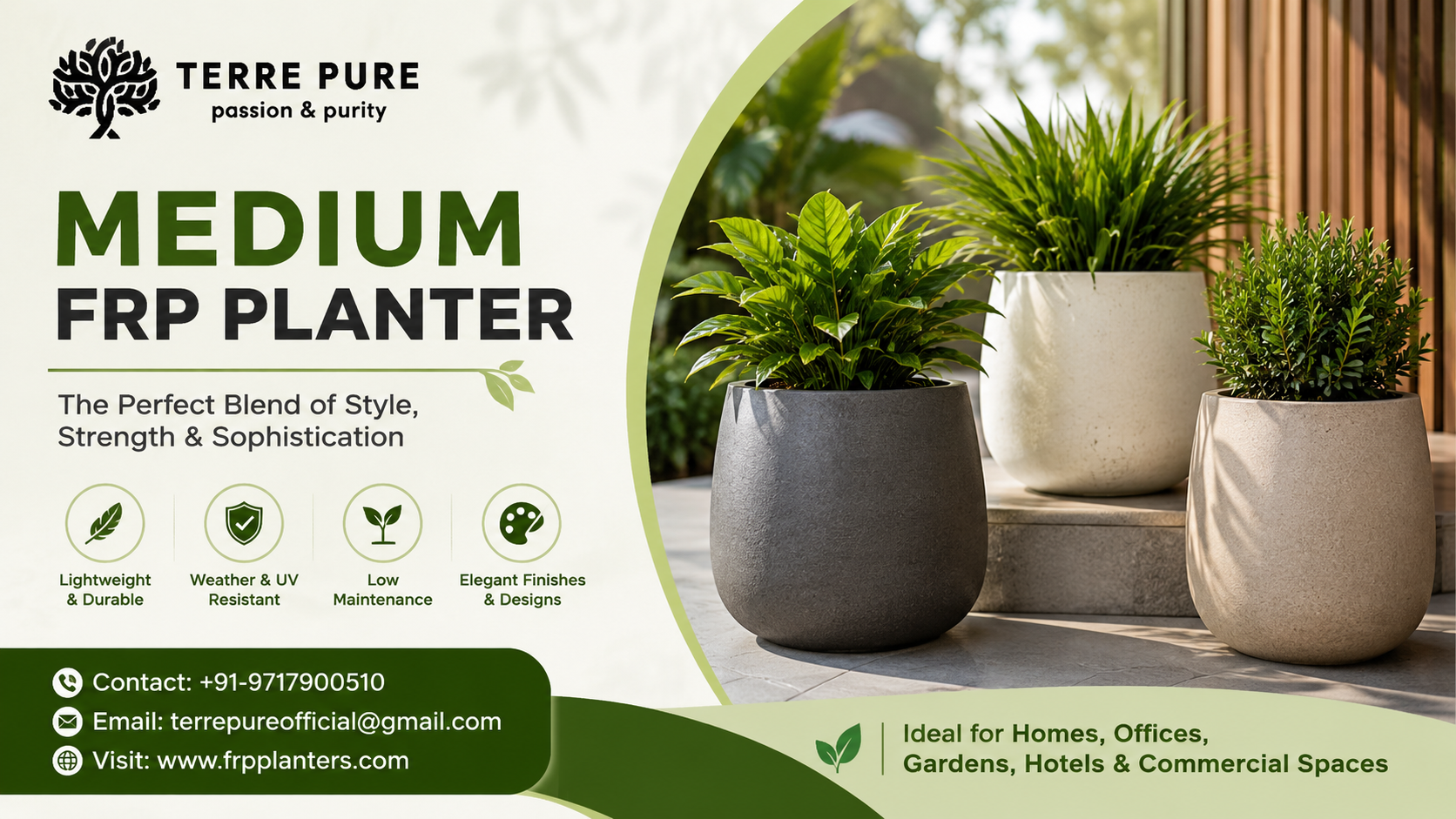
A lobby designer in Gurugram once told us she'd rejected four planter samples in one month. Not because they looked wrong — because they cracked at the base seam within six weeks of outdoor placement. That's the real story behind most planter complaints: it's rarely the finish. It's the fabrication. A Medium FRP Planter solves this specific problem because fiberglass-reinforced construction doesn't rely on a single mold seam to hold structural weight the way cheaper rotomolded plastic does. For interior designers, nurseries, and landscape architects working across Indian climates — coastal humidity, Delhi's summer UV load, Bengaluru's monsoon cycles — the medium-size format has become the default choice for spaces that need presence without the bulk of a large planter or the fragility of a small one.
Getting the Spec Right: What Most Buyers Skip
Medium FRP planters typically fall between 18 and 30 inches in diameter, a range that sounds simple until you're matching it against actual plant root ball sizes and site load limits.
Wall Thickness Isn't a Cosmetic Detail
Most buyers ask about color and finish first. They should be asking about wall thickness. A planter with a 4mm laminate wall and one with a 6mm wall look identical in a catalog photo. They behave very differently after 18 months outdoors — the thinner one flexes under soil pressure and starts hairline cracking near the base. We build to a minimum 5mm laminate on anything classified as medium, and we say so on the spec sheet, not just when asked.
Resin Type Determines Climate Performance
Isophthalic polyester resin resists UV degradation better than standard orthophthalic resin. It costs more. Suppliers who don't mention which resin they use are usually using the cheaper one.
Drainage Configuration
-
Single center drain (standard, adequate for most nursery use)
-
Multi-point drainage with gravel bed compatibility (required for high-rainfall regions)
-
Sealed base for indoor use with removable saucer
Benefits That Actually Protect Your Margin
Vague "premium quality" claims don't help you justify a purchase order to a client or a procurement head. These do.
Medium FRP planters reduce breakage-related reorders, which is the single biggest hidden cost in commercial landscaping projects — a cracked large planter mid-installation can delay handover by weeks, while a medium format is light enough for a two-person team to reposition without cranes or extra labor line items. The material's non-porous surface means no efflorescence staining the way concrete planters develop over time, which matters directly to a designer's reputation on a completed project. FRP also takes custom color matching (RAL or client-specific codes) far more reliably than terracotta or GRC, so a facade or interior scheme doesn't have to compromise on brand palette.
Availability Across India: A Supply Chain Note, Not Just a Location Line
We manufacture and ship from our facility in India, working with landscape architects and nurseries across metro and tier-2 markets. Distance from the manufacturing unit isn't just a delivery-time issue — it affects breakage risk. Every additional transit handoff (manufacturer to regional distributor to local delivery) adds a chance of chipped rims or hairline stress cracks that won't show up until the planter is loaded with soil weeks later. That's why we prioritize direct dispatch on bulk orders over routing through intermediary warehouses wherever the order volume supports it. For Medium FRP Planter Suppliers in India, working with a manufacturer that controls dispatch logistics directly — rather than outsourcing the last-mile leg — is worth asking about before you sign a PO, not after a damaged shipment arrives.
Regional climate also affects which resin and gelcoat spec we recommend. Coastal markets get a different UV-stabilizer loading than inland northern markets, because salt-air exposure interacts with gelcoat differently than dry heat does.
About Us
We've been manufacturing FRP planters since 2013, and we've made our share of mistakes along the way. We stopped using a particular polyester blend in 2021 after three separate buyers in high-UV markets flagged visible fading within 14 months — well short of what we'd promised. We switched resin suppliers, ate the cost difference for two quarters until our pricing caught up, and haven't had a repeat complaint since. That's what a decade of export and domestic feedback actually looks like — not a slogan, a correction we made because we had to.
Conclusion
A Medium FRP Planter earns its place in a project when the buyer asks the right questions before the PO, not after installation. Get the wall thickness, resin type, and drainage spec confirmed in writing, and the rest of the decision gets a lot easier. We'd rather lose an order to a buyer who asked hard questions than win one from a buyer who didn't — the second kind comes back with complaints.
FAQs
What size range does a Medium FRP Planter typically cover?
Generally 18 to 30 inches in diameter and a comparable height range, though we've fabricated slightly outside that band for specific installations. If your project falls right at the edge, ask — sometimes a large-format planter at a lower height classifies functionally as medium.
How long does a Medium FRP Planter last outdoors in Indian climates?
With isophthalic resin and proper UV-stabilized gelcoat, 10 to 12 years is realistic for full outdoor exposure. We won't promise longer than that for direct sun in northern plains climates — anyone who does is overselling.
Are Medium FRP Planter Manufacturers able to match custom RAL colors?
Yes, most can, including us. What varies is minimum order quantity for custom colors versus stock shades — always confirm this before assuming a small custom order is possible at standard pricing.
Can a Medium FRP Planter handle direct soil planting, or does it need a liner?
It can handle direct soil planting. For edible or frequently watered plants, we still recommend a removable liner, since constant soil moisture against the gelcoat over years can eventually affect surface finish faster than dry ornamental planting would.
What's the typical lead time when ordering from Medium FRP Planter Suppliers in India?
For stock colors, 2 to 3 weeks depending on quantity. For custom colors or textures, add 1 to 2 weeks for gelcoat matching and cure time. Anyone quoting a custom order in under a week is likely cutting cure time, which affects long-term durability.

 English
 Arabic
 French
 Spanish
 Portuguese
 Deutsch
 Dutch
Dutch
 Italiano
 Russian
 Romaian
 Portuguese (Brazil)
 Greek
Greek