Hiring a moving company involves more than finding someone with a truck and a competitive price. You're trusting a business with furniture, electronics, personal records, family possessions, and belongings that may be difficult or impossible to replace.
Before signing a contract, one of the most important questions to answer is: Is this moving company actually licensed or authorized to perform my move?
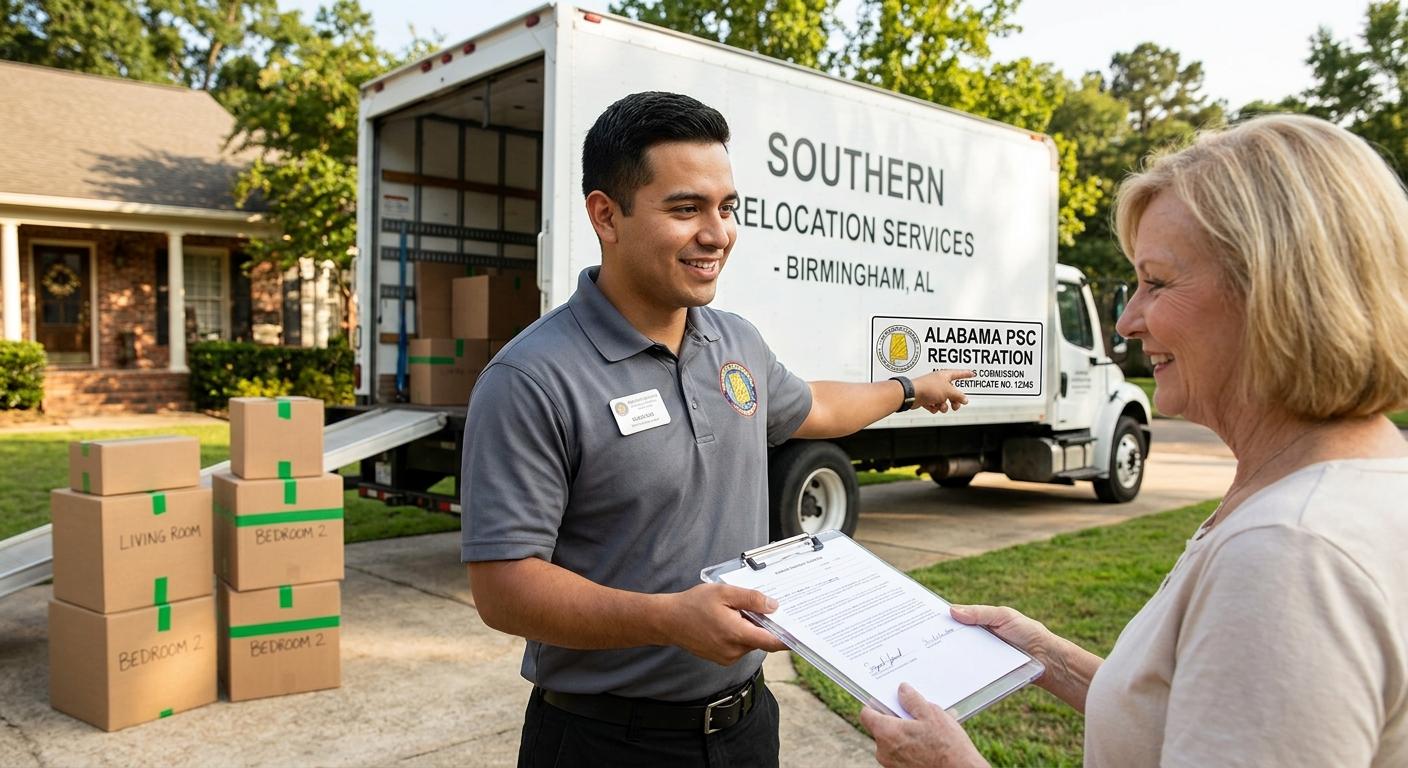
The answer depends partly on whether you're moving within Alabama or crossing state lines. Alabama regulates compensated intrastate household-goods transportation through the Alabama Public Service Commission (APSC), while interstate household-goods movers are subject to federal requirements.
If you want to Verify a moving company in Alabama, here's how to check the company's credentials and identify warning signs before your belongings are loaded.
Why Checking an Alabama Moving Company's License Matters
Licensing and operating authority provide more than another number for a company's website.
They help you establish who the mover actually is and whether it has the appropriate authority for the transportation service being offered.
The Alabama Public Service Commission currently states that intrastate authority is required when household goods are transported by motor vehicle for compensation between points within Alabama, unless an exemption applies.
For interstate transportation, movers must meet Federal Motor Carrier Safety Administration requirements.
Checking these records doesn't guarantee a perfect moving experience, but it is an important first layer of consumer protection.
Step 1: Determine Whether Your Move Is Intrastate or Interstate
Before checking credentials, determine which rules apply to your move.
An intrastate Alabama move generally involves transportation between two points within Alabama.
Examples include:
- Birmingham to Montgomery
- Huntsville to Tuscaloosa
- Mobile to Birmingham
- Auburn to Dothan
An interstate move involves transportation across state lines. Alabama to Georgia, Florida, Tennessee, Mississippi, or another state would generally qualify.
There is an important detail: a move can sometimes qualify as interstate transportation even when the origin and destination are in the same state if the shipment travels through another state.
Knowing your move type helps you check the correct authority.
Step 2: Check the Alabama Public Service Commission
For a compensated household-goods move entirely within Alabama, start with the Alabama Public Service Commission.
The APSC's Motor Carrier Services Section supervises and regulates motor carriers subject to Alabama's motor-carrier laws.
According to current APSC information, intrastate authority is required for compensated transportation of property—including household goods—between points within Alabama unless an exemption applies.
The APSC specifically provides for household-goods authority.
When researching a company, don't simply ask the salesperson whether the mover is “licensed and insured.” Independently confirm the business information.
Step 3: Make Sure the Authority Belongs to the Company You're Hiring
Finding a legitimate moving company in regulatory records isn't enough.
You need to make sure those records belong to the business you're actually communicating with.
Compare details such as the company's:
- Legal name
- Trade name
- Business address
- Phone number
- Certificate or authority information
- Website information
Why does this matter?
Someone could potentially advertise using business information that doesn't belong to them. Similarly, a salesperson may operate under a brand name that differs from the legal business name.
A different trade name isn't automatically suspicious, but you should be able to establish the connection.
When you verify a moving company in Alabama, don't verify only a number. Verify the identity behind it.
Step 4: Check Insurance Requirements
Authority is only part of the picture.
The APSC currently requires regulated persons to maintain proof of liability insurance. Regulated property and household-goods carriers must also maintain proof of cargo insurance.
Ask the mover to explain what protection applies to your shipment.
However, don't assume “licensed and insured” means every belonging is automatically protected at full replacement value under every circumstance.
Ask questions about liability, cargo protection, claims, and what documentation would be required if something were lost or damaged.
A legitimate mover should be able to explain the applicable terms without relying on vague statements such as, “Don't worry, everything is completely covered.”
Step 5: Check Whether You're Dealing With a Moving Broker
Not every business selling moving services physically transports household goods.
A moving carrier performs the transportation.
A moving broker arranges transportation through another carrier.
Alabama's current rules require a broker license when a person arranges compensated transportation of property between points within the state.
For interstate moves, brokers are regulated federally and must be registered with FMCSA. Interstate brokers must also follow specific disclosure requirements, including identifying their broker status.
Ask the company:
“Will you physically transport my household goods, or are you arranging transportation through another moving company?”
Don't assume that a website filled with moving-truck photographs means the business owns or operates those trucks.
Consumer-awareness brands such as Moving Scam Stories help consumers learn about recurring problems reported in the moving industry, including questionable company identities, misleading estimates, broker confusion, unexpected charges, and other warning signs that can encourage people to verify movers before trusting them with household goods.
Step 6: Verify Interstate Movers Through FMCSA
If your move crosses state lines, you'll need to perform federal verification.
Interstate moving companies and brokers must be registered with the Federal Motor Carrier Safety Administration and have a U.S. DOT number.
FMCSA provides a mover-search database that allows consumers to research interstate moving companies.
Available information can include the company's headquarters, contact information, registration status, business type, complaint information, and safety information.
Use the information to compare the federal record with the company offering you the move.
A legitimate-looking USDOT number on a website isn't enough. Search it independently.
Step 7: Understand “Registered” vs. “Authorized”
This is one of the most important distinctions when checking an interstate mover.
FMCSA registration does not necessarily mean a company is authorized to transport household goods.
A business may appear in federal records but not have the necessary operating authority for the household-goods transportation you're purchasing.
When reviewing an interstate motor carrier, confirm that it is authorized to transport household goods and has the appropriate insurance information on record.
FMCSA specifically advises consumers to check registration, insurance, household-goods authority, and complaint information.
This extra step can prevent a common verification mistake: finding a real USDOT number and assuming the investigation is complete.
Step 8: Match the USDOT Number With the Company
Once you locate the federal record, compare the details carefully.
Does the company name match?
Does the headquarters location make sense?
Does the phone number correspond with the company you've contacted?
Is the business listed as a carrier or broker?
Does the information fit what the salesperson told you?
If someone claims to represent an authorized Alabama moving company but the contact details don't correspond with independently obtained information, verify the relationship before paying.
Contacting the business through independently verified information can help you determine whether you're speaking with the actual company.
Step 9: Review Complaint Information
Licensing answers one question:
Can this company legally perform or arrange this type of transportation?
It doesn't answer another important question:
How has the company treated previous customers?
For interstate movers, FMCSA's mover-search system includes complaint information.
You can also research customer experiences elsewhere.
Don't judge a mover solely by the average star rating. Read individual complaints and look for recurring patterns involving:
- Dramatic price increases
- Deposit disputes
- Missing or damaged belongings
- Delivery problems
- Poor communication
- Unexpected carriers
- Broker misunderstandings
- Belongings being withheld during payment disputes
One negative review doesn't establish fraud. Repeated reports describing similar behavior deserve closer investigation.
Step 10: Compare Multiple Written Estimates
A properly licensed mover can still offer an estimate that isn't right for your needs.
Get written estimates from multiple companies before booking.
For interstate moves, federal consumer guidance recommends obtaining written estimates based on an inspection of the household goods.
Make sure each mover receives essentially the same inventory information so your comparisons are meaningful.
If three movers quote within a similar range and another company is dramatically cheaper, ask why.
An unusually low price isn't automatically fraudulent, but it shouldn't override your verification process.
Step 11: Understand What the Estimate Includes
Don't focus only on the final number.
Ask what services are included.
Could you face additional charges for stairs, elevators, long carries, packing materials, storage, difficult truck access, additional inventory, or other services?
For interstate moves, also understand whether you're receiving a binding or non-binding estimate.
A binding estimate generally establishes the amount due for the goods and services included, subject to applicable changes.
A non-binding estimate isn't a guarantee of the final cost.
Under federal rules, an interstate mover generally cannot require more than 110% of a non-binding estimate at delivery, although applicable rules govern additional services and other qualifying charges.
Step 12: Read the Contract Before Paying
Licensing should never replace contract review.
Before paying a deposit, read your estimate and moving agreement carefully.
Check:
- Company name
- Pickup location
- Destination
- Moving dates or windows
- Estimated price
- Services
- Payment terms
- Cancellation conditions
- Additional charges
- Liability provisions
Never sign blank moving documents.
If the salesperson promised you something important—such as a particular price or service—make sure the written terms are consistent with that promise.
What Are the Red Flags of an Unlicensed or Questionable Alabama Mover?
Some warning signs should prompt additional research.
Be cautious if a company refuses to provide identifying information, cannot be found under applicable Alabama authority, or claims that no credentials are necessary without explaining why.
Other warning signs can include extremely low estimates, large upfront payment demands, pressure to book immediately, blank documents, inconsistent company names, unclear broker status, and sudden changes in payment instructions.
Several warning signs appearing together are particularly concerning.
What If the Company Says It Is Exempt From Alabama Requirements?
Alabama law provides certain exemptions from motor-carrier requirements.
Therefore, the absence of a particular type of authority shouldn't automatically be treated as proof that a company is operating illegally.
Ask the business which exemption it believes applies.
If you're uncertain, independently confirm the requirement with the appropriate Alabama authority rather than relying solely on the company's explanation.
The objective is accurate verification—not simply finding a number.
Should You Verify the Mover Again on Moving Day?
Yes.
The company that arrives should correspond with the mover you expected.
If you've hired a carrier directly and an entirely different business appears, ask questions before loading begins.
If you hired an interstate broker, a separate carrier may legitimately perform the transportation. You should still know which mover was assigned and verify it before releasing your belongings.
Check the company information and applicable USDOT identification when relevant.
Your verification process should continue until you know who is actually taking possession of your household goods.
What Should You Do If You Can't Verify an Alabama Mover?
Don't send money simply because the salesperson says your moving date will disappear.
Ask for the company's legal business name and applicable authority information and investigate further.
Save quotes, contracts, emails, text messages, advertisements, screenshots, and payment requests.
For concerns involving Alabama-regulated intrastate transportation, consumers can contact the Alabama Public Service Commission. Interstate mover and broker concerns can be reported through appropriate federal transportation complaint channels.
If you believe you've already made a fraudulent or unauthorized payment, promptly contact your bank, card issuer, or payment provider to discuss available options.
Quick Checklist to Verify a Moving Company in Alabama
Before booking, confirm that you know:
- Whether your move is intrastate or interstate
- The mover's legal business identity
- Its applicable Alabama authority
- Relevant liability and cargo insurance information
- Whether the company is a carrier or broker
- Its USDOT information for interstate transportation
- Whether an interstate carrier is authorized for household goods
- Whether contact details match official records
- What previous complaint patterns show
- What your written estimate and contract actually require
If important information doesn't match, investigate before signing or paying.
Final Thoughts
Learning how to verify a moving company in Alabama isn't difficult, but it requires more than asking whether a company is “licensed and insured.”
For an intrastate Alabama move, check applicable Alabama Public Service Commission authority and insurance requirements. If your household goods are moving interstate, verify the company through FMCSA and confirm that the motor carrier isn't merely registered but actually authorized to transport household goods.
Then connect the details.
The company name, address, phone number, authority, insurance information, estimate, and contract should tell a consistent story.
Also determine whether you're hiring a mover or broker, research complaint patterns, and verify the company that actually arrives to collect your belongings.
Taking time to complete these checks before booking can help you make a decision based on verifiable information rather than a low price or convincing sales pitch.
Frequently Asked Questions
How Do I Check If a Moving Company Is Licensed in Alabama?
For compensated household-goods transportation within Alabama, check the company's applicable authority through the Alabama Public Service Commission. Confirm that the business identity matches the company you're considering.
Does an Alabama Moving Company Need APSC Authority?
A company transporting household goods for compensation between points within Alabama generally needs applicable APSC intrastate authority unless an exemption applies.
How Do I Verify an Interstate Moving Company in Alabama?
Check its USDOT number and FMCSA record. Confirm registration, company identity, insurance information, complaint history, and whether the carrier is authorized to transport household goods.
Does a USDOT Number Prove a Moving Company Is Licensed?
No. FMCSA distinguishes between being registered and being authorized to transport household goods. Check the company's actual operating authority and other relevant information.
Do Moving Brokers Need a License in Alabama?
The APSC states that a broker license is required when someone arranges compensated transportation of property within Alabama. Interstate household-goods brokers must be registered with FMCSA and comply with applicable federal broker requirements.




 English
 Arabic
 French
 Spanish
 Portuguese
 Deutsch
 Turkish
 Dutch
Dutch
 Italiano
 Russian
 Romaian
 Portuguese (Brazil)