


There is something oddly satisfying about holding a part in your hand that existed only as data an hour earlier. A broken knob, a worn bracket, a missing clip from a vintage machine: for a long time, replacing them meant hunting through catalogues or paying for custom tooling. Now many of them can be printed overnight.
But anyone who has tried this knows the hard part isn’t the printing. It’s getting a model that is actually correct.
Printing is only half the story
A 3D printer builds an object layer by layer from a digital file. If the file is accurate, the part will be too. If the file is wrong by a millimetre, the part simply won’t fit, and no printer setting can fix that.
So the quality of a printed part depends heavily on what comes before it: how the shape was measured, how the model was built, and how well the design suits the printing process.
Starting from a real object
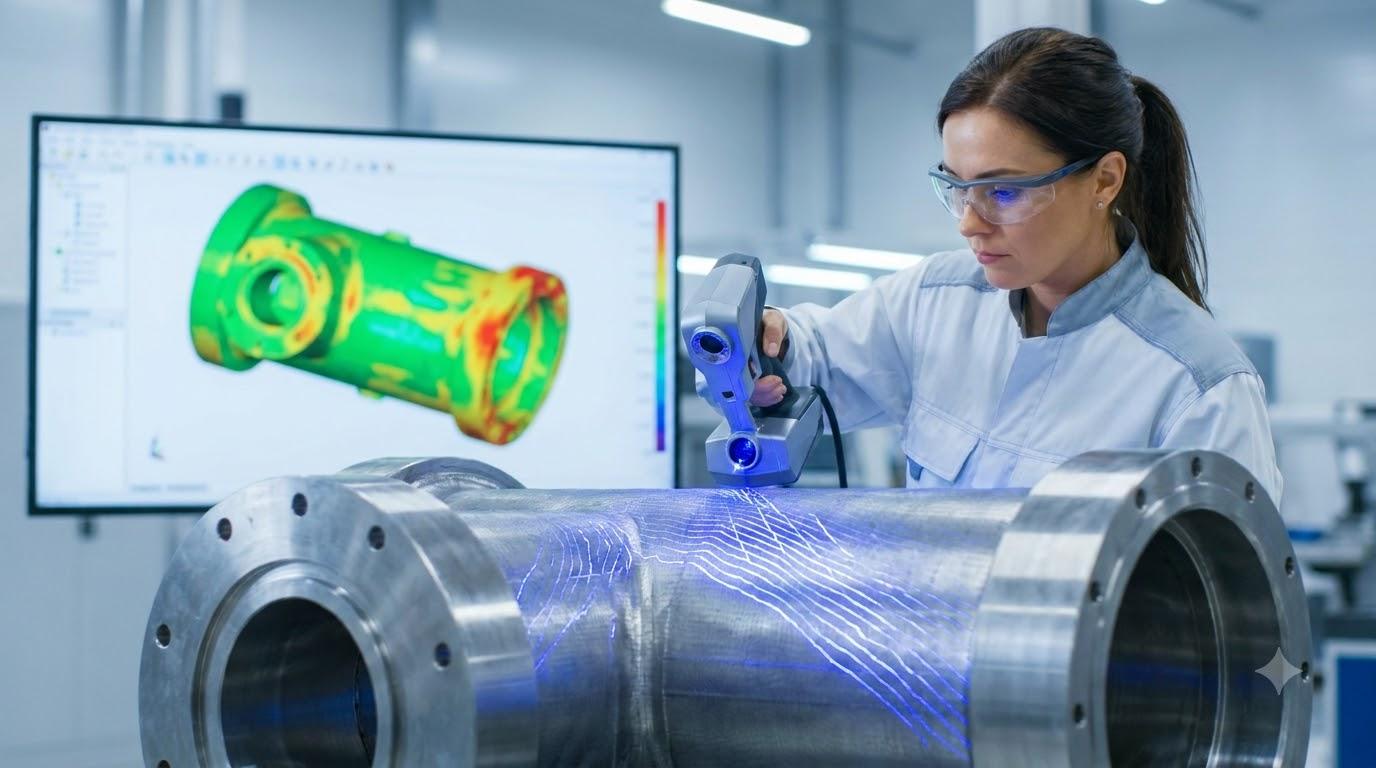
When there’s no existing drawing, the usual route is to capture the original part with 3D laser scanning. The scanner records the surface as a dense cloud of points, which software turns into a mesh.
That mesh can sometimes be printed directly, but it’s often not ideal. Scans contain tiny holes, rough patches and noise. Worn parts also carry their damage into the model. A chipped corner in the original becomes a chipped corner in the copy unless someone repairs it.
That’s why many projects include a clean-up stage, where the shape is rebuilt as a proper 3D CAD model. Sharp edges are restored, holes are made perfectly round, and dimensions are adjusted to sensible values. The result is a file that is easier to edit and far more reliable to print. The whole approach is closely related to reverse engineering, only with a printer at the end instead of a machine shop.
What people actually print this way
- Replacement parts for old equipment. Plastic housings, knobs, covers and guides are the most common.
- Prototypes. Engineers print a quick physical model to test fit before committing to expensive tooling.
- Jigs and fixtures. Custom holders that help workers position parts during assembly or inspection.
- Scale models. Buildings, terrain or machinery reproduced at a smaller size for presentations or planning.
- Custom shapes. Parts that must follow a curved surface, like a bracket moulded to fit a pipe, are far easier when the real surface has been scanned.
If you’d like to see how this looks as a service, an overview of 3D printing from scan data shows the typical workflow.
Choosing the right process and material
Not every printer or material suits every job. A few rules of thumb help:
- Plastics are great for fit checks and light-duty parts, but they can warp, creep or become brittle under heat and sunlight.
- Resin printing gives fine detail and a smooth surface, though many resins are less tough than they look.
- Metal printing is possible for demanding parts, but it’s slower and considerably more expensive.
- Orientation matters. Printed parts are weaker between layers than along them, so the way a part is positioned on the build plate affects its strength.
A part that looks identical to the original can still fail early if the material and process don’t match how it will be used.
Checking that the copy is actually accurate
Printed parts shrink, warp and vary slightly from machine to machine. After printing, it’s smart to compare the finished object to its model. This is where dimensional inspection comes in: the printed part is scanned again and compared to the design, so you can see exactly where it differs and adjust the print settings for the next attempt.
This simple loop of scan, model, print and check is how many workshops gradually get from “close enough” to “fits perfectly”.
A few honest limits
3D printing isn’t a replacement for every manufacturing method. It can be slow for large quantities, surface finish often needs post-processing, and some materials simply can’t match forged or machined metal. There’s also the question of whether it’s legal and sensible to reproduce a part at all, especially if it’s safety-critical or protected by a patent.
For one-off parts, short runs and quick prototypes, though, the combination of scanning and printing has become hard to beat.
The real change
What has shifted isn’t just the technology. It’s the mindset. A missing part used to mean a stalled project. Now it often means a few hours of measuring, modelling and printing. For repair shops, designers and small manufacturers, that’s a quiet but significant change.


