

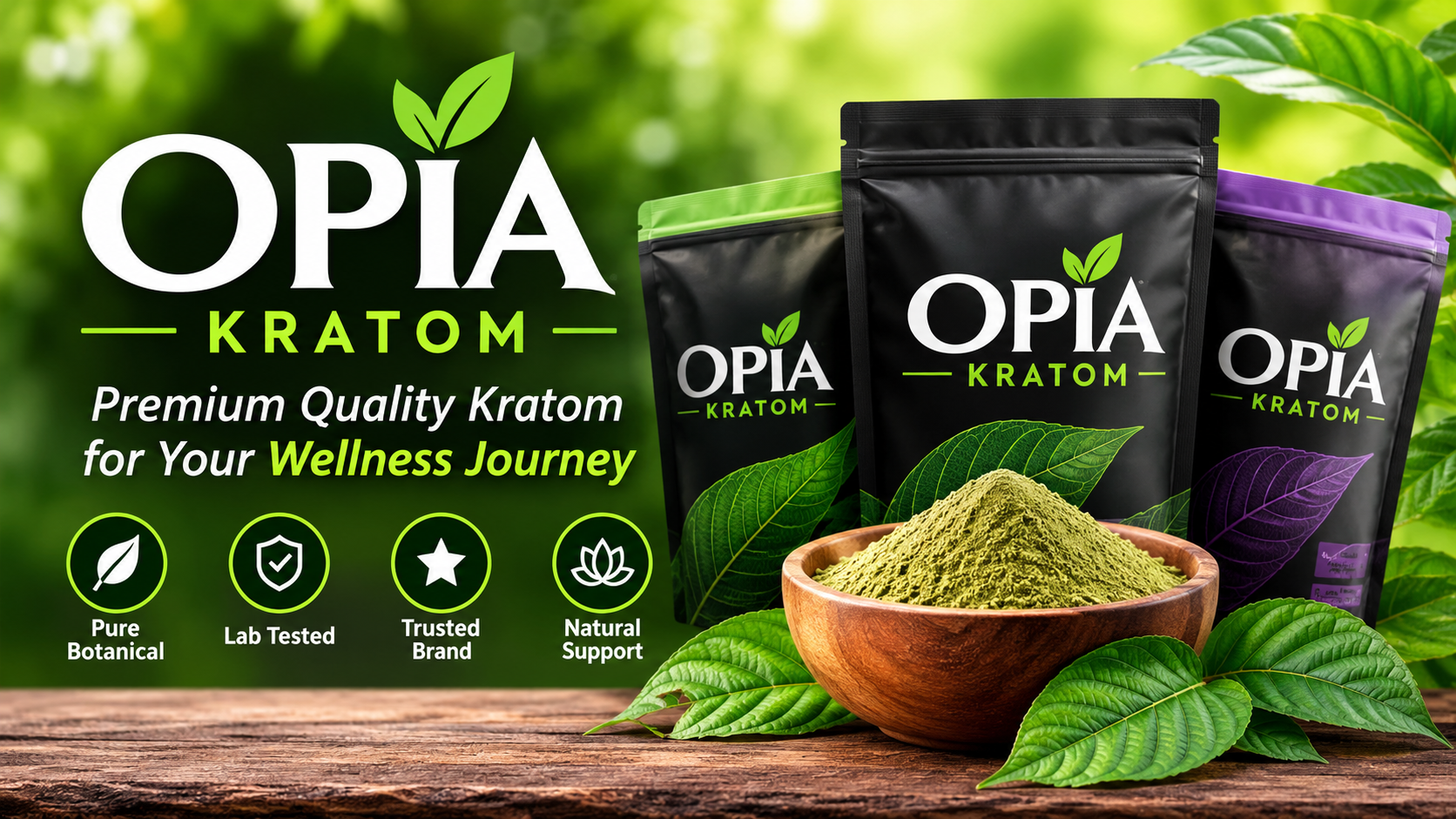

The kratom industry has changed considerably in recent years. Traditional botanical products are now discussed alongside concentrated extracts, specialized tablets, and products containing 7-hydroxymitragynine, commonly called 7-OH.
One name appearing in these conversations is Opia Kratom. But what does the name represent, and how do products associated with it differ from ordinary kratom?
For anyone researching Opia Kratom in 2027, understanding the ingredients matters more than recognizing a brand name. Products marketed under similar descriptions can contain different compounds, concentrations, and formulations.
There's also a growing regulatory debate in the United States. Federal agencies have raised serious concerns about concentrated 7-OH products, particularly those presented as ordinary botanical supplements.
This guide explains seven important facts about Opia Kratom, including the science behind 7-OH, tablet formulations, potential health risks, labeling considerations, and the changing U.S. legal landscape.
1. What Is Opia Kratom?
Opia Kratom is a name associated with kratom-related products, including products discussed in connection with 7-hydroxymitragynine. However, the name alone does not establish a product's ingredients, concentration, safety, or regulatory status.
To understand the category, it helps to begin with the kratom plant.
Kratom comes from Mitragyna speciosa, a tropical tree native to Southeast Asia. Its leaves contain naturally occurring chemical compounds called alkaloids.
Two particularly important alkaloids are:
-
Mitragynine: The primary alkaloid associated with traditional kratom leaves.
-
7-Hydroxymitragynine (7-OH): A compound found naturally in much smaller quantities that acts on opioid receptors.
These compounds are scientifically related, but they should not be treated as interchangeable.
How Does Opia Kratom Differ From Traditional Kratom?
Traditional kratom products generally originate from dried or processed leaves. Concentrated 7-OH formulations, by comparison, may contain substantially elevated quantities of a specific alkaloid.
That difference can significantly affect their pharmacological properties and potential risks.
The FDA has emphasized that its concerns about concentrated 7-OH products are distinct from discussions about unaltered kratom leaves.
Importantly, the exact composition of any individual Opia-branded product cannot be established from its name alone. A reliable assessment requires product-specific ingredient information and independent analytical evidence.
2. What Is Opia 7OH and Why Does It Matter?
The term Opia 7OH refers to products or discussions associated with 7-hydroxymitragynine.
Unlike an ordinary botanical ingredient, 7-OH is a pharmacologically active compound capable of interacting with the body's opioid receptors.
Understanding Opia 7 Hydroxymitragynine
7-Hydroxymitragynine occurs naturally in kratom in trace quantities. However, modern processing and manufacturing can produce formulations with much higher concentrations.
This creates an important distinction:
|
Traditional kratom leaf |
Concentrated 7-OH products |
|
Contains a mixture of naturally occurring alkaloids |
May emphasize one highly active compound |
|
Mitragynine is generally the predominant alkaloid |
7-OH may be present at elevated concentrations |
|
Composition varies naturally |
Composition depends heavily on formulation |
|
Carries health and dependence risks |
Raises additional concerns about opioid-related harm |
Neither category should automatically be considered safe.
Is 7-OH the Same as Mitragynine?
No. Although they are chemically related, mitragynine and 7-hydroxymitragynine are different compounds.
Both interact with biological systems involved in opioid signaling, but their activity and effects are not identical.
This distinction is especially important when reading product descriptions that use broad phrases such as botanical extract or kratom alkaloids without specifying the actual ingredients.
According to the FDA, concentrated 7-OH products have not been demonstrated to be safe or effective for any medical purpose. The agency advises consumers to avoid them.
FDA
For 2027, understanding the difference between naturally occurring trace amounts and intentionally enhanced concentrations remains essential.
3. What Should Consumers Know About Opia Tablets?
Tablets have become a recognizable format in discussions surrounding concentrated kratom alkaloids.
However, a tablet's appearance provides almost no reliable information about its chemical composition.
Why Tablet Formulations Require Special Attention
Products described as Opia tablets may be discussed alongside extracts and other concentrated formulations. But consumers should not assume that every tablet contains the same active ingredients.
Different formulations can vary in several ways:
-
The identity of their active alkaloids.
-
The actual amount of each compound.
-
The presence of additional ingredients.
-
The accuracy of the manufacturer's labeling.
-
The possibility of unwanted contaminants.
For example, two similarly packaged tablets may have substantially different chemical compositions despite appearing nearly identical.
That uncertainty matters because concentrated 7-OH products carry risks associated with opioid activity.
Does a Tablet Format Mean Better Quality?
Not necessarily.
A uniform shape, professional-looking package, or carefully designed label does not demonstrate that a product meets pharmaceutical standards.
Similarly, a numerical claim printed on packaging is not independent proof of chemical identity or purity.
The FDA has taken enforcement action involving concentrated 7-OH products, including tablets and liquid formulations, because of safety and regulatory concerns.
FDA
The central lesson is simple: presentation and scientific verification are two different things.
4. What Are the Health Risks Associated With Opia Kratom and 7-OH?
Health risks are among the most important considerations when researching Opia Kratom.
Although kratom and 7-OH are sometimes discussed in the context of mood, discomfort, or relaxation, these discussions should not be confused with evidence of approved medical benefits.
Potential Effects and Safety Concerns
The FDA has identified several adverse effects associated with concentrated 7-OH products.
Reported concerns include:
-
Dependence and addiction.
-
Anxiety and changes in mood.
-
Nausea and other gastrointestinal problems.
-
Sleep disturbances.
-
Seizures.
-
Withdrawal symptoms.
-
Serious opioid-related complications.
The presence and severity of these effects may vary, but that uncertainty is not evidence of safety.
FDA
Why Concentration Matters
Consider a familiar example from everyday nutrition.
Two beverages might both contain caffeine, yet their effects can differ substantially depending on the amount and other ingredients.
A similar principle applies to active alkaloids, although opioid-related substances raise different and potentially more serious health concerns.
The presence of a naturally occurring compound in a plant does not establish that a highly concentrated version is safe.
Concentration, formulation, individual susceptibility, and interactions with other substances can all influence risk.
Are Opia 7OH Products FDA-Approved?
No FDA-approved medication contains 7-hydroxymitragynine.
The FDA has also stated that concentrated 7-OH cannot lawfully be marketed as a dietary supplement or added to conventional foods under current federal requirements.
That means consumers should be particularly cautious about claims suggesting that such products are FDA-approved treatments, proven wellness solutions, or medically validated alternatives.
FDA
Anyone experiencing concerning symptoms after exposure should seek medical assistance rather than relying on marketing claims or informal online advice.
5. Is Opia Kratom Legal in the United States in 2027?
The legal situation surrounding kratom-related products is complicated because federal and state requirements can differ.
A product's legal status also depends on its actual ingredients.
Federal Regulation of 7-Hydroxymitragynine
During 2025 and 2026, federal authorities increased their scrutiny of concentrated 7-OH products.
In July 2026, the Drug Enforcement Administration announced an intention to temporarily control 7-hydroxymitragynine and several related substances.
Later, in October 2026, federal agencies updated their proposals to better distinguish concentrated products from botanical materials containing trace quantities of these compounds.
Every CRS Report+1
As of the verified November 2026 information, these developments should not be described as a final nationwide prohibition on all kratom products.
State Laws Can Be Different
Individual states have adopted different approaches, including:
-
Restrictions on concentrated 7-OH.
-
Controls on certain kratom alkaloids.
-
Consumer protection and labeling requirements.
-
Restrictions relating to age and product distribution.
-
Broader prohibitions covering some kratom-related substances.
Some states distinguish traditional botanical kratom from concentrated formulations, while others take a more restrictive approach.
A Congressional Research Service analysis published in October 2026 highlights this complicated regulatory environment.
Every CRS Report
What Does This Mean for 2027?
Because regulations can change, no article prepared in 2026 can guarantee the legal status of a particular formulation throughout 2027.
The most reliable approach is to consult current federal and state public health guidance rather than assume that nationwide rules are uniform.
A product being advertised online does not necessarily mean its sale or distribution complies with applicable law.
6. Why Transparency and Product Labeling Matter
One of the biggest challenges in the kratom marketplace is determining whether a product description accurately reflects what is inside the package.
This is particularly relevant when companies use terms that sound scientific or reassuring without providing sufficient supporting evidence.
Understanding Product Information
A meaningful product description should distinguish between the plant source and the actual chemical composition.
For example, the phrase kratom extract does not necessarily communicate whether the product contains naturally occurring alkaloids in typical proportions or has been intentionally enriched with 7-OH.
Likewise, terms such as premium, advanced, natural, and enhanced do not establish product quality.
Why Independent Testing Matters
Laboratory analysis can help researchers and regulators evaluate several important questions:
-
Does the product contain the compounds claimed on its label?
-
Are reported concentrations accurate?
-
Are unexpected ingredients present?
-
Are there indications of contamination?
-
Can the analytical findings be independently verified?
However, laboratory testing is not the same as medical approval. Even an accurately labeled product can contain substances that present serious health risks.
Common Misconceptions About Kratom-Related Products
Three misconceptions deserve particular attention.
Misconception 1: Natural means harmless.
Naturally occurring substances can have powerful biological effects.
Misconception 2: Professional packaging proves safety.
Packaging reflects presentation, not necessarily chemical quality or medical evidence.
Misconception 3: Online availability means regulatory approval.
Products may appear on commercial websites despite failing to meet applicable U.S. requirements.
For readers researching Opia Kratom, recognizing these differences is more useful than relying on promotional descriptions.
7. What Should Readers Expect From the Kratom Industry in 2027?
The industry surrounding kratom and its concentrated alkaloids is entering a period of substantial scrutiny.
Three developments are particularly important.
Greater Attention to Product Composition
Federal discussions increasingly distinguish naturally occurring alkaloid levels from formulations containing intentionally enhanced concentrations.
This distinction could shape future regulatory policies and scientific research.
More Emphasis on Consumer Protection
Label accuracy, contamination concerns, age-related restrictions, and misleading health claims have all become subjects of regulatory attention.
Clearer information may help consumers better understand the differences between products, although disclosure alone does not make a hazardous substance safe.
Continuing Scientific Research
There are still important unanswered questions about kratom alkaloids.
Researchers continue to investigate their pharmacological activity, health risks, interactions, and dependence potential.
At the same time, existing knowledge is sufficient for public health agencies to warn against concentrated 7-OH products.
For 2027, the most important development may not be a new product format or brand. It may be greater public understanding of how these compounds differ.
Frequently Asked Questions About Opia Kratom
1. What is Opia Kratom?
Opia Kratom is a name associated with kratom-related products. Understanding any specific formulation requires identifying its ingredients, alkaloid concentrations, and regulatory status. The product name itself does not establish safety.
2. What is the difference between Opia 7OH and regular kratom?
Traditional kratom leaf contains several naturally occurring alkaloids, with mitragynine generally predominant. Concentrated 7-OH formulations can contain elevated quantities of 7-hydroxymitragynine, creating additional opioid-related safety concerns.
3. Are Opia tablets safe?
Safety cannot be established from the name or tablet format. The FDA advises consumers to avoid concentrated 7-OH products because they have not been proven safe or effective and may cause serious harm.
4. Is Opia 7 hydroxymitragynine approved for medical use?
No. The FDA has not approved 7-hydroxymitragynine as a treatment for pain, anxiety, opioid withdrawal, or any other medical condition.
5. Will Opia Kratom be legal throughout the USA in 2027?
That cannot be guaranteed. Federal requirements and state laws differ, and additional regulatory changes may occur. The legal status depends on the actual ingredients, product formulation, and applicable jurisdiction.
Conclusion: Understanding Opia Kratom in 2027
Opia Kratom is part of a broader conversation about traditional kratom, concentrated alkaloids, and changing expectations for botanical products in the United States.
The seven facts covered in this guide highlight an important message: product names and packaging cannot replace accurate scientific information.
Understanding the difference between mitragynine and 7-hydroxymitragynine, recognizing the risks of concentrated formulations, and keeping track of regulatory developments are essential parts of informed public discussion.
As 2027 approaches, readers should be cautious about unsupported health claims and remember that concentrated 7-OH products have not been established as safe or effective medical treatments.
Ready to compare for yourself? Browse KratomPoint, check the full Opia Kratom page, and pick a small size to try first. Questions? Their support team is available by phone and email on weekdays.


