

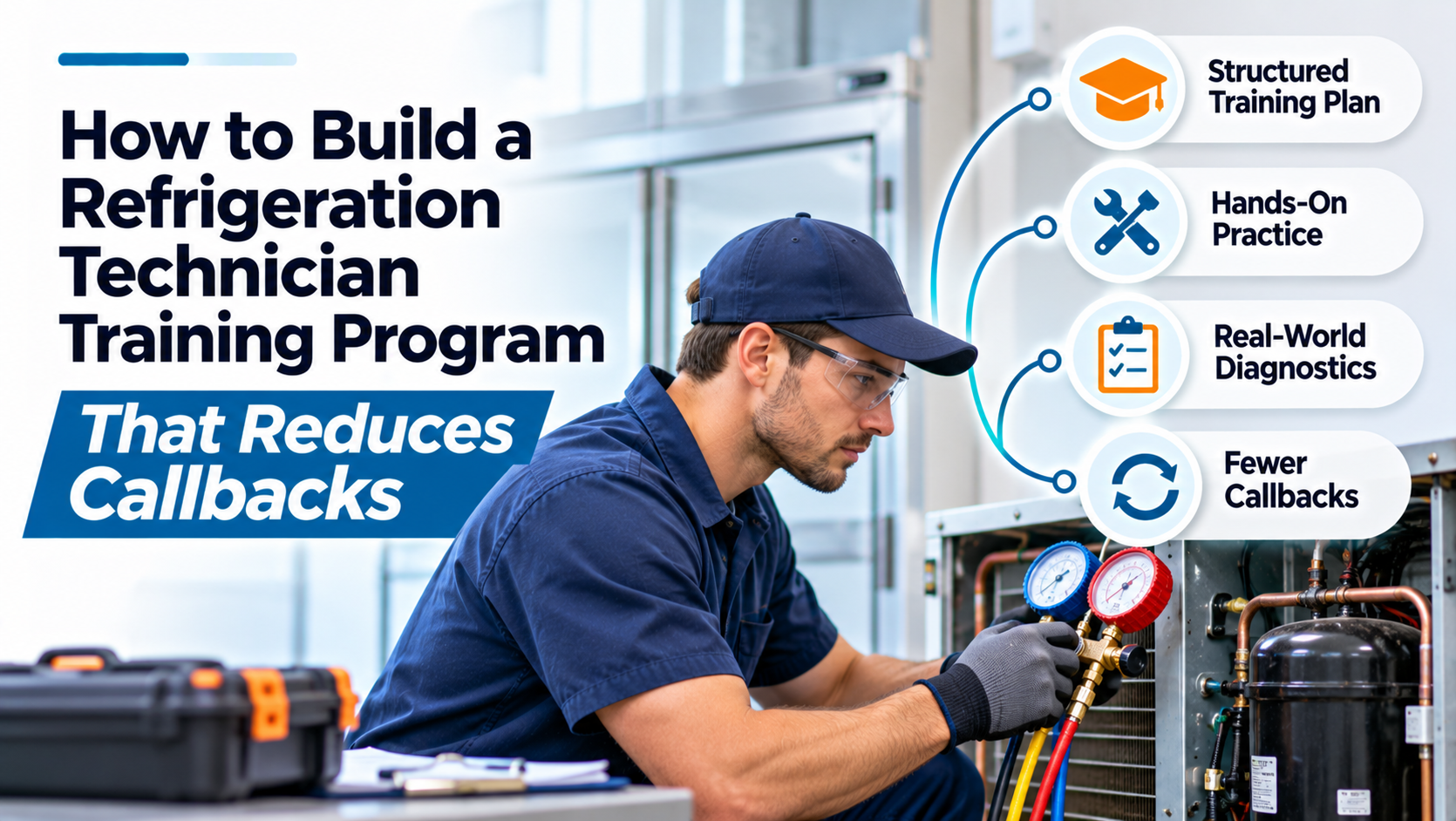
How to Build a Refrigeration Technician Training Program That Reduces Callbacks

A new technician completes a refrigeration repair, but the customer calls again the next day because the equipment still isn't cooling properly.
The technician fixed a symptom without identifying the underlying problem.
For refrigeration contractors, these mistakes mean additional labor, scheduling disruptions, and frustrated customers. A structured refrigeration technician training program can help prevent them by teaching new hires how to diagnose problems, follow safe procedures, and verify their work.
Here's how to develop a practical training approach that improves technician performance.
Start With Refrigeration Repair Basics
Before technicians begin diagnosing equipment failures, they need to understand how refrigeration systems operate.
Start with the four primary components of a vapor-compression refrigeration system:
-
Compressor: Circulates refrigerant and raises vapor pressure.
-
Condenser: Releases heat from the refrigerant.
-
Expansion device: Controls refrigerant flow into the evaporator.
-
Evaporator: Absorbs heat from the refrigerated space.
Technicians should understand how pressure, temperature, airflow, and heat transfer affect system performance.
For example, a dirty condenser restricts heat rejection and can cause cooling problems. Understanding that relationship prevents technicians from assuming every temperature complaint indicates low refrigerant.
Introduce diagnostic instruments, electrical safety, and manufacturer service documentation before assigning more complex tasks.
Build a 5-Stage Refrigeration Technician Training Program
A successful program should progress from technical understanding to supervised field experience and demonstrated competency.
Stage 1: Teach System Fundamentals
Introduce the refrigeration cycle, major components, common operating conditions, and essential safety procedures.
Use diagrams and equipment demonstrations to explain normal operation.
Technicians who understand normal system behavior are better prepared to recognize abnormal conditions.
Stage 2: Demonstrate Refrigeration Troubleshooting
Pair new hires with experienced technicians during service calls.
Encourage trainees to observe how senior technicians investigate complaints, select diagnostic tests, and interpret measurements.
After each visit, discuss why certain causes were ruled out.
This develops diagnostic reasoning instead of relying on memorized symptoms.
Stage 3: Practice Common Refrigeration Problems
Introduce controlled troubleshooting exercises involving common refrigerator problems, including:
-
Inadequate cooling.
-
Excessive frost buildup.
-
Restricted condenser airflow.
-
Faulty fans and controls.
-
Drainage problems.
Ask trainees to identify symptoms, explain possible causes, and recommend appropriate diagnostic steps.
Use safe simulations and supervised equipment rather than deliberately creating hazardous faults.
Stage 4: Perform Supervised Diagnostics
Allow technicians to lead suitable troubleshooting tasks while qualified mentors observe.
Assess how they inspect equipment, use instruments, follow safety procedures, and explain their findings.
The goal is to develop confidence without sacrificing accuracy or safety.
Stage 5: Assess Technician Competency
Training completion shouldn't automatically qualify someone for independent assignments.
Evaluate whether technicians can consistently identify faults, follow procedures, verify repairs, and document their work.
Use these results to determine where additional instruction is needed.
Our guide to identifying skill gaps in your HVAC team offers additional guidance for evaluating employee capabilities.
Don't Overlook Safety and Certification
Refrigeration systems involve electrical hazards, pressurized components, and refrigerants that require specific handling procedures.
In the United States, EPA Section 608 certification is required for covered refrigerant-circuit activities, subject to applicable exceptions and apprentice supervision provisions.
Technicians should understand their authorization limits and follow manufacturer instructions and workplace safety requirements.
Introductory training doesn't replace certification or supervised experience.
Measure Whether Your Training Is Working
Contractors should evaluate refrigeration technician training through actual service performance.
Monitor diagnostic accuracy, callback rates, first-time fix rates, repair documentation, and demonstrated competency.
For example, if technicians consistently identify problems correctly but struggle with repair verification, additional training should focus on confirming system performance after repairs.
The objective isn't simply faster service. It's accurate, safe, and dependable work.
Develop a More Capable Refrigeration Service Team
Strong refrigeration technician training starts with fundamentals and builds through practical troubleshooting, mentorship, and competency assessments.
At Grandy & Associates, we help contractors strengthen their teams through technical and business training.
Our Refrigeration 101 course is a practical starting point for introducing new technicians to essential refrigeration concepts.
Build technical knowledge. Develop diagnostic confidence. Reduce avoidable callbacks.
Explore Refrigeration 101 and give your technicians the foundation they need to grow into more capable service professionals.


