


Amazon PPC Management: A Profit-Focused Guide to Growing Your Amazon Business
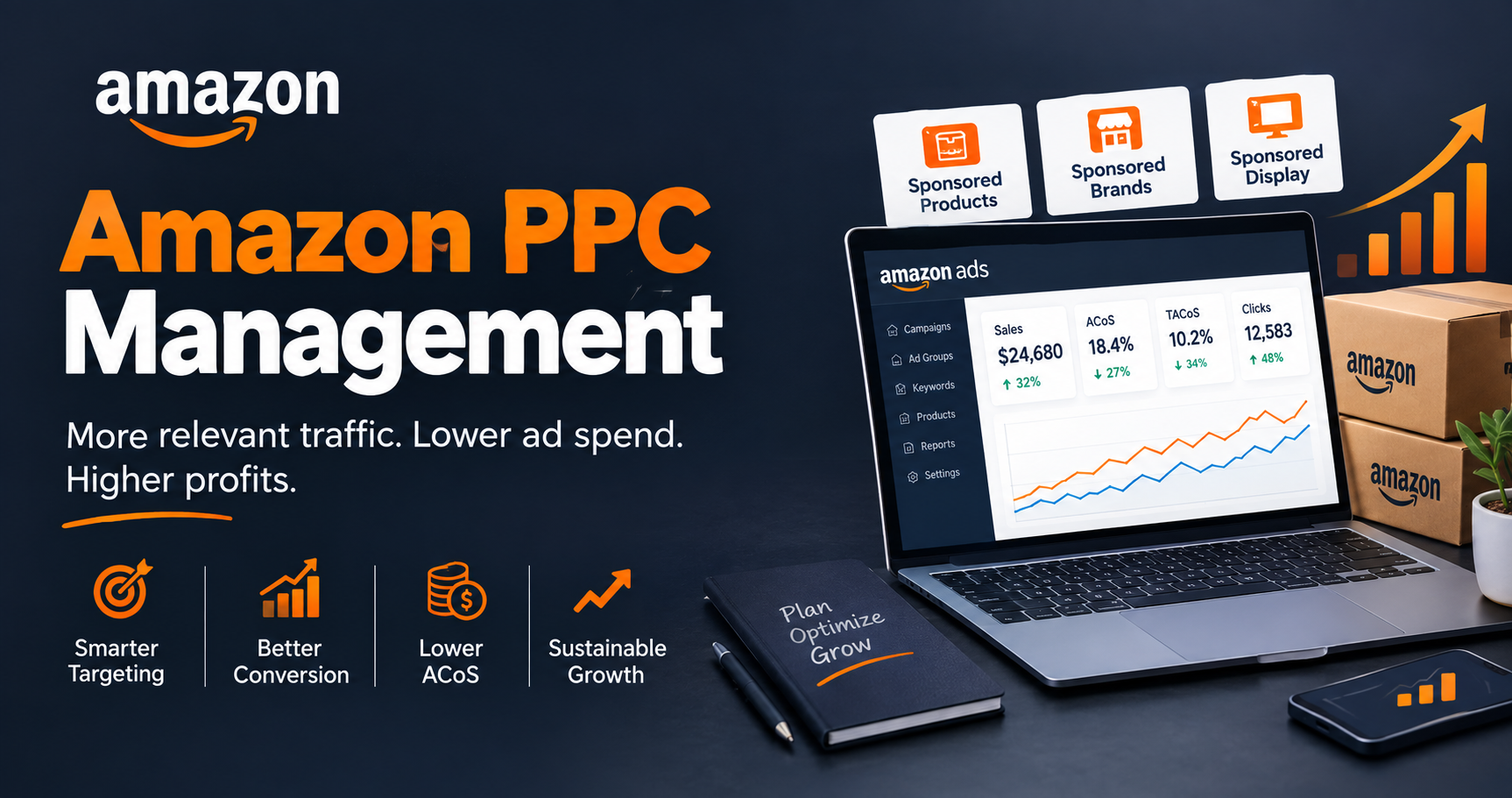
Amazon PPC can put your products in front of high-intent shoppers within minutes. But simply turning on Sponsored Products campaigns does not guarantee profitable growth.
Many Amazon sellers increase their advertising budget, generate more sales, and still wonder why their profits are not improving.
The problem is often PPC management.
Poor campaign structure, irrelevant search terms, aggressive bids, wasted placements, weak product listings, and uncontrolled advertising costs can quickly turn Amazon PPC into an expensive source of revenue rather than a profitable growth channel.
Amazon PPC Management is the process of strategically planning, launching, monitoring, and continuously optimizing Amazon advertising campaigns to increase relevant traffic, conversions, and profitable sales while controlling advertising costs.
For growing brands, effective PPC management is not about spending more. It is about making every advertising dollar work harder.
What Is Amazon PPC Management?
Amazon PPC management is the ongoing process of managing an Amazon seller's advertising campaigns to achieve specific business and profitability goals.
It can include:
- Amazon PPC strategy
- Campaign structure and organization
- Keyword research
- Product targeting
- Bid optimization
- Budget management
- Search-term analysis
- Negative keyword management
- Placement optimization
- Sponsored Products management
- Sponsored Brands management
- Sponsored Display management
- ACoS and TACoS analysis
- Conversion optimization
- Campaign scaling
- Performance reporting
A strong PPC strategy connects advertising performance with the overall economics of the product.
For example, generating $20,000 in additional sales may look impressive. But if those sales require $10,000 in advertising spend and leave little contribution margin, simply increasing sales is not necessarily a win.
That is why profitable growth should be the objective—not revenue at any cost.
Why Amazon Sellers Need Professional PPC Management
Amazon advertising becomes increasingly complex as a brand grows.
A small account might start with a few campaigns and a handful of keywords. As the catalog expands, however, sellers may have hundreds or thousands of targets competing for budget.
Without a structured management system, several problems can develop.
1. Advertising Spend Gets Wasted
Amazon can generate clicks from searches that are not commercially valuable for your product.
If irrelevant search terms continue receiving impressions and clicks, advertising costs increase without producing enough sales.
PPC management identifies these inefficient targets and determines whether they should be:
- Negated
- Reduced
- Rebid
- Moved into another campaign
- Given a different match type
- Monitored for additional data
2. Campaigns Compete Against Each Other
Poor account structure can cause overlapping targeting and internal competition.
For example, the same keyword may appear across multiple campaigns with different bids and budgets. Without a clear strategy, it becomes difficult to understand which campaign is actually driving profitable growth.
A structured account separates campaign purposes and makes performance easier to control.
3. High ACoS Can Reduce Profitability
ACoS, or Advertising Cost of Sales, measures advertising spend relative to advertising revenue.
A high ACoS may indicate that campaigns are spending too aggressively relative to the sales they generate.
However, there is no universal “good ACoS.”
The right target depends on factors such as:
- Product margin
- Selling price
- Conversion rate
- Organic sales
- Brand maturity
- Competition
- Launch stage
- Customer lifetime value
- Business objectives
PPC management therefore needs to consider profitability rather than chasing one arbitrary percentage.
4. Sellers Spend Too Much Time Managing Seller Central
Many business owners spend hours every week checking:
- Search-term reports
- Campaign budgets
- Keyword bids
- Placement performance
- New targets
- Negative keywords
- Product performance
- Advertising reports
That time could be spent improving products, developing new offers, managing operations, or growing the business.
Professional PPC management gives sellers a structured process for handling this work.
What Does Amazon PPC Management Include?
A complete Amazon PPC management strategy should cover the entire advertising cycle.
1. Amazon PPC Account Audit
Before making changes, the account needs to be understood.
An audit can identify:
- Underperforming campaigns
- Wasted spend
- High-cost keywords
- Low-converting targets
- Budget limitations
- Poor campaign structures
- Search-term opportunities
- Placement inefficiencies
- Product targeting opportunities
- Negative keyword gaps
The purpose is not simply to find campaigns with high ACoS.
The objective is to understand where advertising money is producing results and where it is leaking.
2. Keyword Research
Keyword research helps identify the searches that potential customers use when looking for products.
An effective strategy can combine:
- High-volume keywords
- Long-tail keywords
- High-intent commercial terms
- Competitor-related opportunities
- Product-specific terms
- Category terms
- Search-term data from existing campaigns
Keyword research should not end when campaigns launch.
Actual Amazon search-term data can reveal new opportunities that were not visible during the initial research process.
3. Campaign Structure
Campaign structure determines how easily an account can be managed and optimized.
Depending on the brand and product, campaigns may be segmented by:
- Match type
- Product
- Keyword group
- Search intent
- Brand vs. non-brand
- Product targeting
- Campaign objective
Common match types include:
Exact Match:
Useful for controlling proven search terms and high-intent keywords.
Phrase Match:
Can capture variations around a keyword while maintaining greater control than broad targeting.
Broad Match:
Can help discover additional searches and keyword opportunities.
The correct structure depends on the account rather than following one rigid template.
4. Bid Optimization
Bids directly influence how aggressively Amazon competes for advertising placements.
If bids are too high, costs can rise quickly.
If bids are too low, campaigns may struggle to generate enough impressions and clicks.
Effective bid optimization considers:
- Conversion rate
- ACoS
- Profitability
- Keyword performance
- Click volume
- Order volume
- Competition
- Placement performance
- Campaign objectives
The goal is not always to achieve the lowest possible CPC.
The goal is to find profitable opportunities at an appropriate cost.
5. Search-Term Mining
One of the most valuable PPC optimization activities is analyzing actual customer searches.
Search-term data can reveal:
- Converting keywords
- High-spend terms
- Irrelevant searches
- New keyword opportunities
- Long-tail opportunities
- Product-specific search behavior
Successful search terms can potentially be moved into more controlled campaigns.
Poor-performing or irrelevant searches can be considered for negative targeting.
This creates a continuous feedback loop between data and campaign structure.
6. Negative Keyword Management
Negative keywords help prevent advertising spend from going toward searches that are unlikely to produce valuable results.
For example, if a product consistently receives clicks from an irrelevant search theme, continuing to pay for those clicks can create unnecessary waste.
Negative targeting should be based on meaningful data rather than blindly adding keywords simply because they have not generated a sale yet.
7. Placement Optimization
Amazon advertising placements can perform differently.
Campaign managers should monitor performance across available placements and evaluate whether increased placement exposure is producing an acceptable return.
This can help determine where additional budget or bid adjustments make sense.
8. Budget Management
A campaign with strong performance can lose momentum if its budget is exhausted too early.
At the same time, increasing budgets on inefficient campaigns can simply increase wasted spend.
Budget decisions should therefore consider:
- Campaign profitability
- Sales contribution
- Conversion rate
- Search demand
- Margins
- Growth objectives
The question should not simply be:
“Which campaign needs more budget?”
It should be:
“Where can additional budget produce profitable incremental growth?”
Amazon Sponsored Products, Sponsored Brands, and Sponsored Display
Amazon offers multiple advertising formats, and each can serve a different role.
Sponsored Products
Sponsored Products can place individual products in relevant shopping placements.
They are often central to Amazon PPC because they can capture shoppers already searching for products.
Sponsored Brands
Sponsored Brands can help brands promote multiple products and build greater brand visibility.
They can be useful for defending branded searches and capturing broader category-level demand.
Sponsored Display
Sponsored Display can provide additional opportunities to reach shoppers based on relevant targeting signals.
The right mix depends on the brand, product catalog, objectives, and available advertising data.
ACoS vs. TACoS: Why Sellers Should Watch Both
ACoS is useful for understanding direct advertising efficiency.
But brands should also monitor TACoS, or Total Advertising Cost of Sales.
TACoS considers advertising spend against total sales rather than only advertising-attributed sales.
This provides a broader view of how advertising relates to overall business performance.
For example, if advertising spend increases but organic sales also grow substantially, looking only at ACoS may not tell the complete story.
Conversely, a brand can maintain apparently acceptable advertising performance while total advertising costs steadily consume a larger share of revenue.
That is why PPC management should connect advertising metrics with:
- Total sales
- Organic sales
- Advertising sales
- Profit margins
- Conversion rates
- Product economics
Why More Amazon Sales Don't Always Mean More Profit
This is the Profitability Paradox that many growing brands encounter.
Sales go up.
Advertising spend goes up.
ACoS rises.
TACoS rises.
Operational costs increase.
And the owner discovers that the business is generating more revenue without generating proportionally more profit.
This is where PPC management needs to move beyond basic campaign optimization.
A profitable Amazon strategy considers the relationship between:
Traffic → Clicks → Conversions → Advertising Cost → Revenue → Margin → Profit
Improving only one part of the chain may not solve the underlying problem.
For example, increasing traffic to a poorly converting listing can simply create more expensive clicks.
Reducing bids aggressively can lower ACoS while also reducing profitable sales.
The best strategy finds the point where advertising supports sustainable business growth.
How The WE One Approaches Amazon PPC Management
The WE One specializes in solving the Profitability Paradox for growing Amazon and TikTok brands.
We work with brands that have reached the point where managing advertising, listings, catalog issues, Seller Central operations, and growth opportunities becomes increasingly difficult to handle internally.
Our approach focuses on identifying where profit is being lost—not simply where sales are being lost.
Our 4-Pillar Profit Recovery System™
Pillar 1: Identify Profit Leaks
We analyze advertising performance, campaign structure, search terms, product performance, listings, and account data to identify areas where money is being wasted.
Pillar 2: Optimize Advertising
We refine targeting, bids, budgets, placements, search terms, and campaign structures to improve advertising efficiency.
Pillar 3: Improve Conversion
Traffic is only valuable when it converts. We look at listing quality, keyword relevance, product positioning, and the customer journey to identify conversion opportunities.
Pillar 4: Scale What Works
Once profitable opportunities are identified, we build a process for scaling them while monitoring costs and protecting margins.
The objective is straightforward:
More efficient advertising. Better conversion. Less wasted spend. Stronger profit potential.
Who Can Benefit From Amazon PPC Management?
Professional Amazon PPC management can be particularly valuable for:
- Private-label brands
- DTC brands expanding onto Amazon
- Ecommerce founders
- Established Amazon sellers
- Brands generating $10K–$100K+ monthly
- Larger brands managing complex advertising accounts
- Businesses preparing for aggressive growth
- Agencies that need Amazon PPC fulfillment support
It can also be valuable for sellers experiencing problems such as:
- Rising ACoS
- Rising TACoS
- Declining conversion rates
- Increasing CPCs
- Wasted advertising spend
- Poor campaign organization
- Unprofitable scaling
- Stagnant sales
- Too much time spent inside Seller Central
How to Know If Your Amazon PPC Needs Attention
Consider your account carefully if:
- Your advertising spend is increasing faster than sales.
- Your ACoS continues to rise.
- Your TACoS is climbing.
- Your campaigns generate clicks but few orders.
- Your budget runs out before the day ends.
- You have many campaigns but little understanding of their individual roles.
- You are spending hours every week manually managing PPC.
- You are generating more revenue but your margins are shrinking.
These signs do not automatically mean your PPC account is failing.
They indicate that your advertising strategy deserves a deeper profitability analysis.
Amazon PPC Management Is an Ongoing Process
Amazon PPC is not a “set it and forget it” channel.
Markets change.
Competitors change their bids.
Search behavior changes.
Product conversion rates change.
Amazon advertising costs change.
New search terms emerge.
Products move through different stages of their lifecycle.
That means PPC management requires continuous analysis and adjustment.
A strong process typically includes:
Audit → Research → Structure → Launch → Measure → Optimize → Scale → Repeat
This creates a feedback system where campaign data continuously informs future decisions.
Final Thoughts
Amazon PPC management is much more than creating campaigns and adjusting keyword bids.
For growing brands, it is a critical part of controlling acquisition costs, increasing relevant visibility, improving conversion opportunities, and protecting profitability.
The goal should not be to generate sales at any cost.
The goal is to create a PPC system that supports profitable, sustainable growth.
If your Amazon business is generating more sales but your profit is not keeping pace, it may be time to look beyond revenue and identify the leaks inside your advertising and marketplace operation.
The WE One helps Amazon and TikTok brands find those profit leaks, fix inefficient growth systems, and build a clearer path toward profitable scale.

 English
 French
 Spanish
 Portuguese
 Deutsch
 Turkish
 Dutch
Dutch
 Italiano
 Russian
 Romaian
 Portuguese (Brazil)
 Greek
Greek