


Physical AI and Industrial Robotics: Transforming US Manufacturing & Supply Chains
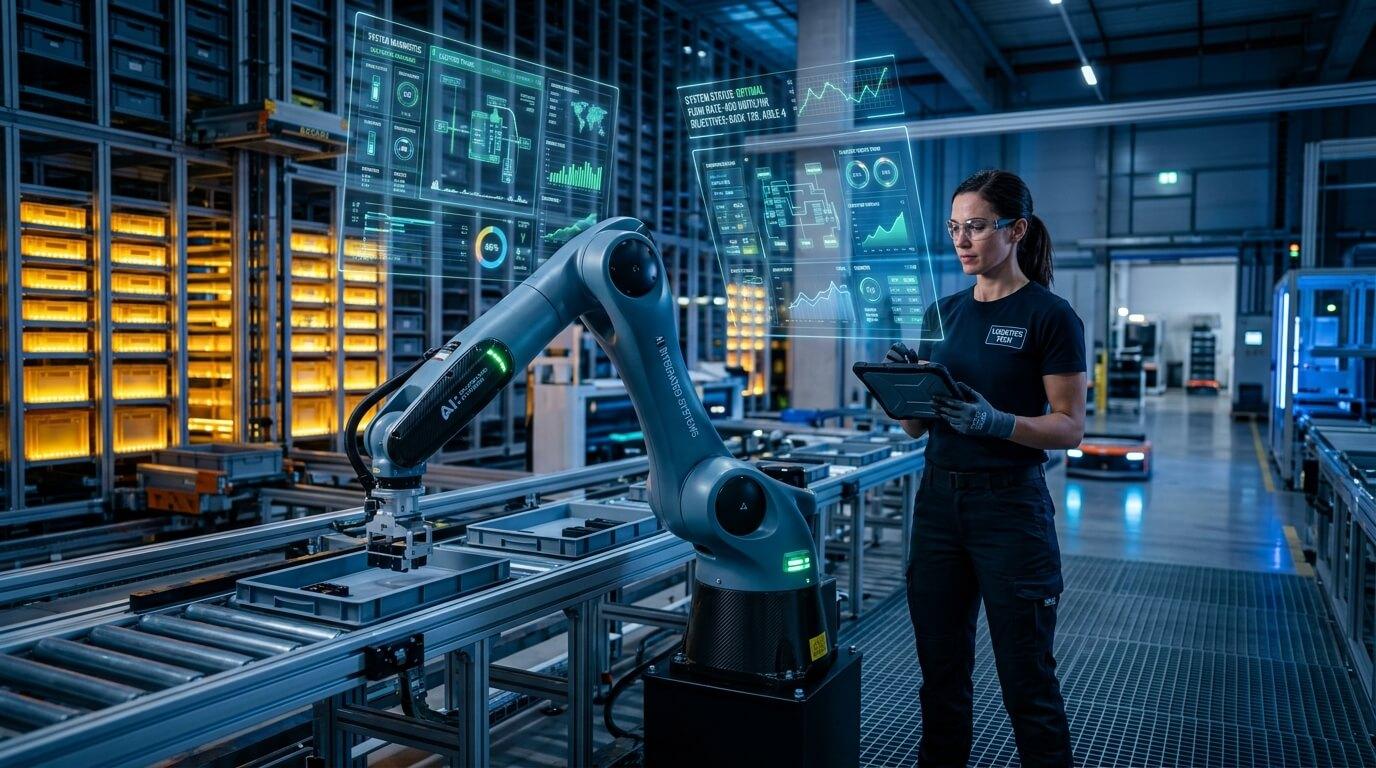
For the past several years, the conversation surrounding Artificial Intelligence has centered almost entirely on screens, text boxes, and digital content generation. Large Language Models (LLMs) proved that AI could draft emails, analyze code, and process vast unstructured databases in seconds. Yet, for all their impressive linguistic capabilities, these digital intelligence models remained confined behind monitors.
Now, a fundamental evolution is taking place across the American industrial landscape. Artificial intelligence is breaking out of the digital realm and stepping directly onto the factory floor. This shift from pure software algorithms to embodied intelligence is known as Physical AI.
By pairing advanced AI foundation models with next generation sensor arrays, spatial computing, and high precision mechanical engineering, Physical AI is transforming traditional industrial robotics. Industrial systems are evolving from rigid, pre programmed automation arms into flexible, autonomous partners capable of perceiving, reasoning, and acting within unpredictable physical environments.
From Rigid Automation to Adaptive Intelligence
Traditional industrial automation served a crucial purpose throughout the late 20th and early 21st centuries. Automotive assembly lines and large bottling plants relied on robotic arms to execute identical, highly repetitive movements millions of times. However, these legacy robots were inherently inflexible: if an input component was slightly out of place or an unexpected obstacle entered the workspace, the system stalled.
Physical AI completely overturns this dynamic by introducing situational perception and real time reasoning.
Modern industrial robots powered by physical AI foundation models utilize multi modal sensing combining high resolution 3D cameras, LiDAR, and tactile force feedback. Instead of following a fixed trajectory, these machines analyze their physical surroundings instantly. They can identify arbitrary items, adjust their grip dynamically based on material friction or fragility, and reroute around human workers without pausing operations.
This shift enables automation in complex, non standardized environments like e commerce fulfillment hubs, construction sites, and specialty food processing facilities places where traditional hard coded robotics previously failed.
Tackling Supply Chain Resilience and Labor Shortages
The accelerated adoption of Physical AI across the United States is driven by two pressing realities: persistent labor shortages in industrial sectors and the strategic imperative to bring supply chains closer to home.
According to research from organizations like the National Association of Manufacturers, domestic manufacturers face significant long term workforce gaps in skilled trade, logistics, and assembly roles. As experienced workers retire, companies face increasing pressure to maintain operational capacity without burning out remaining staff.
Physical AI bridges this gap not by replacing human workers, but by augmenting human capability through collaborative robotics (cobots). Cobots powered by physical AI take on hazardous, physically demanding, or high fatigue tasks such as heavy palletizing, precision welding, and bin picking while human supervisors oversee multi robot fleets and focus on high level decision making.
Furthermore, as American enterprises continue nearshoring production and rebuilding domestic supply chains, Physical AI provides the operational speed and cost efficiency necessary to keep modern facilities competitive against global alternatives.
Spatial Intelligence and the Digital Twin Advantage
A core component powering this robotic revolution is spatial computing and physics accurate digital simulation.
Before a physical AI robot ever touches an object on an active assembly line, it undergoes extensive training inside photorealistic, physics grounded digital environments known as digital twins. Engineers subject the virtual robot to millions of edge cases, variable lighting conditions, and equipment failures within a simulated universe.
Through reinforcement learning in these virtual training grounds, the AI agent masters complex spatial manipulation in a fraction of the time and at a fraction of the cost required for physical real world testing. Once trained, the intelligence model is transferred directly onto physical hardware, allowing the robot to perform with remarkable precision on its very first day of deployment.
Frequently Asked Questions (FAQs)
Q1: What is Physical AI, and how does it differ from traditional AI? A: Traditional AI (like ChatGPT or basic analytics tools) operates strictly within software to process text, data, or images on screens. Physical AI combines advanced foundation models with physical hardware like sensors, cameras, and robotic actuators allowing machines to perceive, reason, and act in real world, dynamic environments.
Q2: How is Physical AI different from traditional industrial robots? A: Traditional industrial robots follow rigid, pre programmed instructions and stall if an object is slightly out of place. Physical AI powered robots use real time computer vision, tactile sensors, and spatial reasoning to adapt to unexpected obstacles, pick up irregular items, and navigate dynamic environments without stopping.
Q3: Will Physical AI replace human workers in manufacturing and logistics? A: Rather than replacing workers entirely, Physical AI is primarily designed to augment human capability. It automates repetitive, heavy, or hazardous tasks such as bin picking, palletizing, and precision welding allowing human employees to focus on complex decision making, fleet management, and quality control.
Q4: How are digital twins used to train Physical AI models? A: A digital twin is a photorealistic, physics accurate virtual replica of a physical environment. Engineers train AI algorithms inside these simulated worlds using reinforcement learning, testing millions of scenarios and edge cases in hours before deploying the software onto physical machinery.
Q5: What industries benefit the most from Physical AI and advanced robotics? A: Key industries include logistics and e commerce fulfillment, automotive and electronics manufacturing, healthcare, construction, food processing, and agriculture any sector requiring flexible, physical task execution.
Q6: Why is Physical AI becoming critical for US manufacturing right now? A: The US industrial sector faces significant long term labor shortages alongside growing pressure to nearshore supply chains. Physical AI helps facilities maintain high productivity, improve safety, and remain globally competitive despite workforce constraints.
The Next Decade of Industrial Robotics
As neural network architectures become leaner and edge computing hardware becomes more powerful, Physical AI will continue to permeate everyday industrial workflows. We are moving toward a future where autonomous mobile robots (AMRs), humanoid warehouse assistants, and smart micro factories operate seamlessly alongside human teams.
The companies that recognize this moment early are moving past basic software pilots and investing heavily in physical intelligence. By embedding adaptive AI into real world machinery, American industry is establishing a new paradigm for manufacturing agility, workplace safety, and supply chain reliability.

 Arabic
 French
 Spanish
 Portuguese
 Deutsch
 Turkish
 Dutch
Dutch
 Italiano
 Russian
 Romaian
 Portuguese (Brazil)
 Greek
Greek