


Common Registration Errors in Digital Implant Dentistry and the Role of Fiducial Markers
Quick Insight
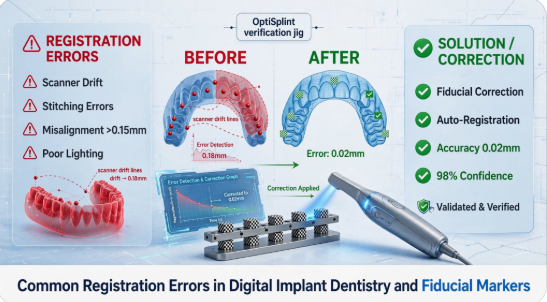
Registration errors happen when two digital datasets, typically a CBCT scan and an intraoral scan, are aligned incorrectly, and most of them originate early, in the planning and acquisition phases, which makes them difficult to correct once the case moves forward. Fiducial markers reduce this risk by giving registration software a fixed, unambiguous point to align to, rather than relying only on anatomical surface matching or manually selected points.
What Registration Means in a Digital Implant Workflow
Registration is the process of aligning separate digital datasets into one shared coordinate system so they can be treated as a single accurate model of the same mouth.
What each dataset actually captures:
-
CBCT: three-dimensional radiographic and bone information
-
Intraoral scanning: surface anatomy, teeth, and soft tissue
-
Fiducial markers or reference points: the shared geometry both datasets can align to
Why accuracy at this step matters:
-
Registration happens early in the workflow, so an error here carries forward into planning, design, and manufacturing
-
Unlike some later steps, registration errors are largely non-correctable once the workflow moves past this stage
-
A misaligned registration can look clinically reasonable on screen while still containing meaningful positional error
Where Registration Errors Originate
Errors do not appear at one single point in the workflow. Published research on cumulative error in full-arch digital cases breaks this down into a few distinct phases.
Planning-phase errors:
-
Errors introduced during initial CBCT-to-STL alignment
-
Errors that occur before any physical fabrication has taken place, making them cheaper to catch here than later
-
A 2026 narrative review described these as requiring strict upstream standardization specifically because they are difficult to correct downstream
Acquisition-phase errors:
-
Scanning distortions introduced while capturing the intraoral scan itself
-
Errors compounded by scan body exposure length or model-matching mismatches during digitizing
Dual-scan protocol errors:
-
Occur when a second scan of a surgical guide is used to register implant position
-
Substituting a second CBCT scan with an intraoral scan of the guide reduced accuracy in the studies reviewed
-
Marker material made a measurable difference: gutta percha and resin markers performed less consistently than metallic spheres in dual-scan protocols
Automatic alignment failures:
-
Automatic registration algorithms frequently failed in the reviewed studies
-
Failure forced a fallback to manual, operator-dependent point selection
-
Manual correction reintroduces the human variability that automated registration is meant to remove
How Registration Method Choice Affects Accuracy
Not every registration approach performs equally, and the method chosen has a measurable effect on the result.
A West China Hospital study compared point-based and surface-based registration for aligning intraoral scans with CBCT data:
|
Point-Based Registration |
Surface-Based Registration |
|
|
Accuracy in study |
Higher |
Lower |
|
Sensitivity to CBCT image quality |
High |
High |
|
Benefit beyond 4 registration points |
Minimal additional gain |
Not applicable |
Key findings from this research:
-
Point-based registration outperformed surface-based registration overall
-
CBCT image quality had a significant effect on accuracy regardless of registration method
-
Adding registration points beyond four produced no statistically significant improvement
Common Registration Error Types by Category
Grouping the error sources by category makes the pattern easier to see:
Hardware and marker-related errors:
-
Fiducial marker material inconsistency in dual-scan protocols
-
Marker movement or displacement between placement and capture
-
Streaking artifact around metallic markers in some CBCT scans
Software and algorithm-related errors:
-
Automatic alignment algorithms failing to converge
-
Point-based versus surface-based registration producing different accuracy outcomes
-
Low CBCT image quality reducing registration accuracy independent of method
Operator-dependent errors:
-
Manual point selection required after an automatic alignment failure
-
Inconsistent registration point placement between operators
-
Variability introduced when correcting a failed automatic registration by hand
Where AI-Assisted Registration Fits
Reducing operator-dependent variability is part of why AI-assisted planning has drawn research attention. The same 2026 narrative review found that AI-generated implant plans reached clinical acceptability comparable to expert-produced plans in roughly 89 to 93 percent of cases studied, while reducing planning time by more than half.
Important caveats worth noting:
-
Most of this evidence comes from preclinical or single-tooth applications
-
Full-arch clinical validation is still limited
-
AI-assisted planning is best understood as reducing manual variability, not eliminating registration error itself
The Role of Fiducial Markers in Reducing These Errors
Fiducial markers address several of the error sources above directly, rather than acting as a single fix for all of them.
What a fixed reference point helps with:
-
Removes dependence on anatomical surface matching, which can vary with soft-tissue conditions
-
Reduces the need for manual point selection when automatic registration would otherwise fail
-
Gives photogrammetry and registration software a consistent geometry to calculate from, regardless of scan quality on a given day
What marker use does not fix on its own:
-
Marker material still affects accuracy, particularly in dual-scan protocols
-
Marker placement and distribution still influence the final result
-
CBCT image quality remains a separate variable that marker use does not control
Manufacturers such as Digital Arches design marker hardware specifically around the first category, giving registration systems a fixed point that holds up across varying scan conditions.
Where ArchTracer™ Fits This Role
The ArchTracer marker system is one example of hardware built around this specific need, using a fixed titanium geometry intended to give registration and photogrammetry systems a consistent reference point across a full-arch case.
Frequently Asked Questions
What is the most common cause of registration errors in digital implant workflows? Published research points to planning-phase and acquisition-phase errors, including automatic alignment failures and marker material differences in dual-scan protocols, as recurring sources that are difficult to correct once the workflow has moved forward.
Does CBCT image quality actually affect registration accuracy? Yes. Research comparing registration methods found that CBCT image quality had a significant effect on registration accuracy, independent of which registration method was used.
Do more registration points always improve accuracy? Not necessarily. One study found that increasing registration points beyond four produced no statistically significant improvement in deviation.
Does AI-assisted planning eliminate registration error? No. Research suggests it can reduce manual variability and planning time, but most of the supporting evidence is still limited to preclinical or single-tooth cases rather than full validated full-arch trials.
Can fiducial markers fully eliminate registration errors? No. They reduce dependence on manual point selection and anatomical surface matching, but marker material, placement, and CBCT or scan quality still affect the final result.
Final Takeaway
Registration errors in digital implant dentistry rarely come from one dramatic mistake. They accumulate across planning decisions, scan quality, marker material choice, and how much the workflow depends on manual correction when automatic alignment fails. Fiducial markers address part of that picture directly, by giving registration software a fixed point to work from, while CBCT quality, registration method, and operator consistency remain separate variables that marker hardware alone does not resolve.

 English
 Arabic
 French
 Spanish
 Portuguese
 Deutsch
 Turkish
 Dutch
Dutch
 Italiano
 Russian
 Romaian
 Greek
Greek