


PCR rHDPE: Unlock More Value From Recycled Plastic
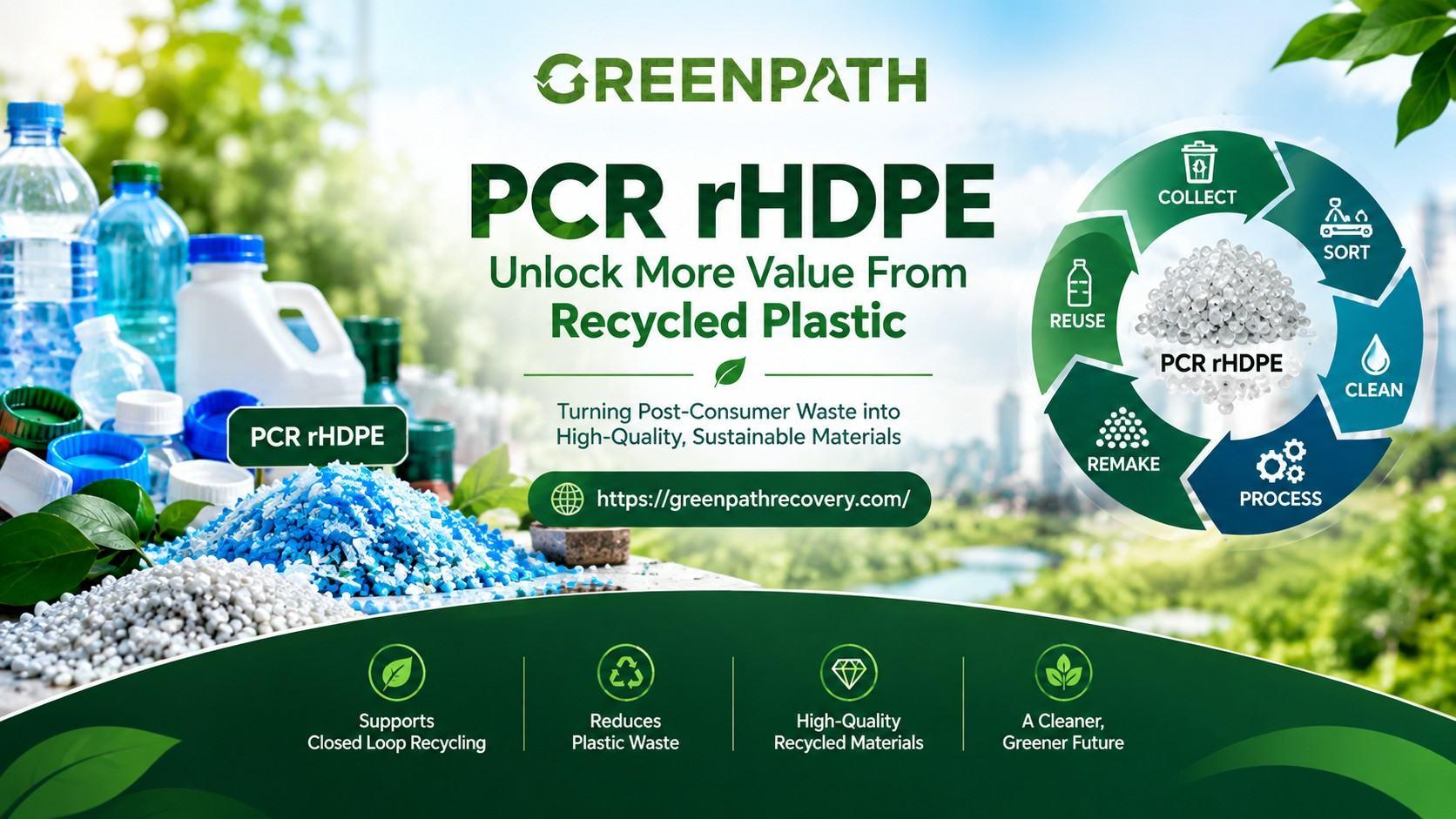
Plastic waste is increasingly becoming a valuable resource rather than something that simply needs to be discarded. For businesses that use plastic packaging, containers, or manufactured components, recovering these materials can create opportunities to reduce waste and increase recycled content. One material receiving growing attention is PCR rHDPE, which combines post-consumer recycled content with the durability and versatility of high-density polyethylene (HDPE).
For companies developing commercial recycling programs, understanding how recycled polymers are collected, processed, and returned to manufacturing can help improve material recovery and support long-term sustainability goals.
What Is PCR rHDPE?
PCR rHDPE stands for Post-Consumer Recycled Recycled High-Density Polyethylene. In practical terms, it refers to HDPE recovered from products that have already been used by consumers and subsequently processed for reuse.
HDPE is commonly found in bottles, containers, household packaging, personal-care products, and other everyday items. After collection, suitable HDPE materials can be sorted, cleaned, processed, and converted into recycled flakes, regrind, or pellets.
The resulting material can then become an input for new manufacturing applications, depending on its quality, specifications, and intended use.
This process gives used plastic another potential purpose and helps keep valuable polymer material within the supply chain.
Why PCR rHDPE Matters for Businesses
Businesses are increasingly looking beyond traditional waste disposal and toward resource recovery. PCR rHDPE can be part of this transition because it provides a way to incorporate recovered post-consumer HDPE into suitable applications.
Using recycled material can help organizations reduce their dependence on virgin resin while supporting broader resource-efficiency objectives. It can also create demand for recovered plastic, which is an important part of developing a more circular plastics economy.
However, recycled resin is not automatically suitable for every application. Factors such as contamination, color, polymer consistency, processing history, and performance requirements should be evaluated before selecting a recycled material.
Recycled HDPE Plastic: From Waste to Resource
Recycled HDPE Plastic is created by recovering HDPE products and processing them into a form that can potentially be used again. The recycling process typically includes collection, sorting, cleaning, size reduction, separation, and further processing.
The quality of Recycled HDPE Plastic depends heavily on how effectively the material is collected and sorted. Keeping different polymer types separated can reduce contamination and improve the consistency of the recovered material.
For commercial operations, establishing dedicated collection streams for HDPE can make recovery more efficient. Businesses may also benefit from working with experienced recycling partners that understand material specifications and downstream manufacturing requirements.
How PCR rHDPE Supports Closed Loop Recycling
Closed Loop Recycling focuses on keeping materials in circulation by recovering used products and returning their material value to manufacturing processes. Instead of treating plastic as a single-use resource, the objective is to create a continuous cycle of collection, processing, manufacturing, use, and recovery.
PCR rHDPE fits naturally into this approach. Used HDPE products can be collected and processed into recycled material, which can then be incorporated into suitable new products.
A successful Closed Loop Recycling strategy requires coordination across multiple stages. Collection systems, sorting facilities, recycling processors, manufacturers, and end users all play a role.
When these stages are connected effectively, businesses can improve material recovery while creating a more organized approach to managing plastic waste.
PCR rHDPE vs. Recycled PP Plastic
Not all plastics behave the same way. HDPE and polypropylene (PP) are different polymer types, each with distinct characteristics and applications.
Recycled PP Plastic is produced from recovered polypropylene products and can be used in applications where PP's properties are appropriate. It may be found in packaging, automotive components, household products, industrial applications, and other manufactured goods.
By comparison, rHDPE Plastic is derived from HDPE products and is valued for properties such as durability, chemical resistance, and versatility.
Understanding the difference between these materials is important for businesses designing effective recycling programs. Mixing incompatible polymer streams can reduce material quality, making proper sorting an essential part of commercial plastic recovery.
The Commercial Recycling Process
A reliable commercial recycling program generally begins with identifying the types of plastic generated by a business. Once the material streams are understood, appropriate collection and sorting procedures can be established.
For HDPE, the process may involve:
-
Collecting post-consumer HDPE materials
-
Separating HDPE from other polymers
-
Removing contaminants and unsuitable materials
-
Cleaning and preparing the recovered plastic
-
Grinding or shredding the material
-
Processing it into flakes, regrind, or pellets
-
Conducting quality checks before downstream use
These steps help create a consistent recycled material stream.
For businesses considering PCR rHDPE, understanding the complete material journey is important because recycling quality begins long before the material reaches a processing facility.
Improving the Value of Recovered Plastic
One of the most important aspects of commercial recycling is contamination control. Food residue, labels, incompatible polymers, metals, and other contaminants can affect processing efficiency and recycled material quality.
Businesses can improve recovery by providing clearly defined collection systems and educating employees about which materials belong in each stream.
Material traceability and quality monitoring can also help businesses understand how much plastic they recover and where that material goes after collection.
These practices can strengthen Closed Loop Recycling programs by creating more predictable and manageable material flows.
Building a More Circular Plastic Supply Chain
The concept of Closed Loop Recycling goes beyond simply recycling waste. It connects waste recovery with manufacturing demand.
When businesses purchase products containing recycled content, they can contribute to demand for recovered materials. That demand can encourage better collection and processing systems, helping more plastic remain within productive use.
Both Recycled PP Plastic and Recycled HDPE Plastic can play roles in this broader circular economy, provided the materials meet the technical requirements of their intended applications.
For organizations working toward sustainability targets, incorporating recycled materials can therefore become part of a broader resource-management strategy rather than an isolated recycling initiative.
What Businesses Should Consider Before Using PCR rHDPE
Before introducing PCR rHDPE into a product or packaging application, businesses should evaluate several factors:
Material specifications: Confirm that the recycled resin meets the technical requirements of the application.
Consistency: Consider color, melt flow, density, contamination levels, and other relevant characteristics.
Application requirements: Determine whether recycled HDPE is appropriate for the intended product.
Supply reliability: A consistent recycling and sourcing partner can help maintain dependable material availability.
Traceability: Understand where the material originates and how it has been processed.
These considerations can help businesses make informed decisions instead of selecting recycled material based solely on its recycled-content percentage.
The Future of Recycled Plastic
As businesses continue looking for practical ways to reduce waste and improve resource efficiency, recycled polymers are becoming an increasingly important part of the plastics supply chain.
Materials such as PCR rHDPE, Recycled HDPE Plastic, and Recycled PP Plastic can help connect post-consumer waste with new manufacturing opportunities.
At the same time, Closed Loop Recycling provides a framework for keeping these materials in circulation for longer. The goal is not simply to collect more plastic, but to recover materials efficiently and direct them toward productive applications.
Conclusion
PCR rHDPE offers businesses an opportunity to unlock additional value from post-consumer HDPE waste while supporting more circular approaches to plastic management. With proper collection, sorting, processing, and quality control, recovered HDPE can become a useful material for suitable manufacturing applications.
From Recycled HDPE Plastic to Recycled PP Plastic, different recycled polymers can serve different purposes. A well-designed Closed Loop Recycling program helps businesses connect these materials with the right recovery and manufacturing processes.
For companies looking to improve their commercial recycling strategy, working with an experienced recycling partner can help turn discarded plastic into a more valuable resource while supporting long-term sustainability and resource-efficiency goals.

 English
 Arabic
 Spanish
 Portuguese
 Deutsch
 Turkish
 Dutch
Dutch
 Italiano
 Russian
 Romaian
 Portuguese (Brazil)
 Greek
Greek