


Surgical Suture Kits: A Practical Guide for Medical Training and Skills Development
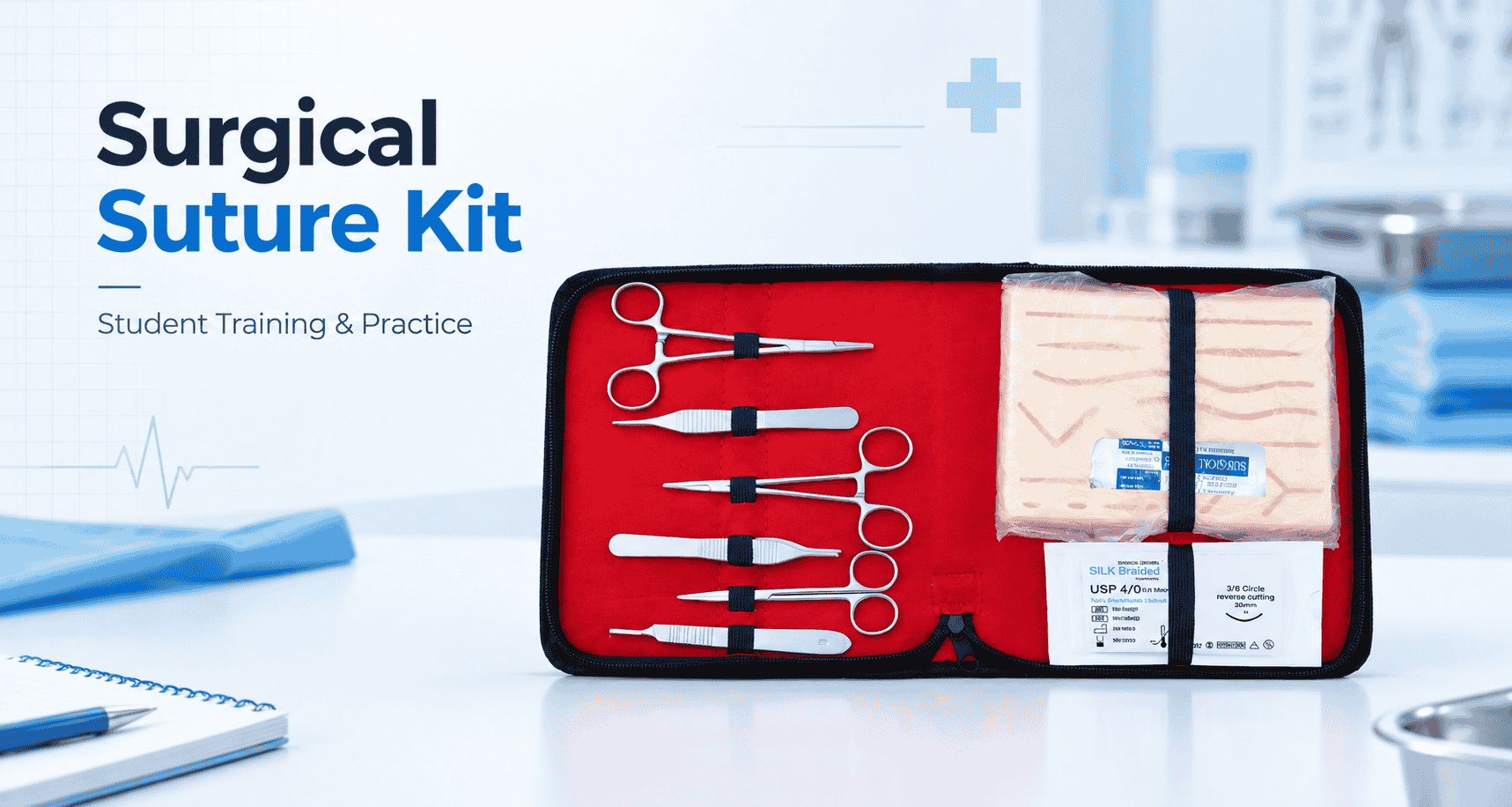
Developing reliable suturing skills requires more than simply understanding the theory behind wound closure. Medical students and healthcare trainees need opportunities to practice instrument handling, suture placement, knot tying, and basic tissue-closure techniques in a controlled learning environment.
This is where surgical suture kits can be useful. These kits bring together commonly used suturing instruments and practice materials in one organized set, allowing learners to become familiar with the equipment before applying their skills in clinical settings.
What Are Surgical Suture Kits?
Surgical suture kits are collections of instruments and materials used for learning and practicing basic suturing techniques. Depending on their intended purpose, a kit may include items such as needle holders, forceps, scissors, sutures, and practice materials.
The contents can vary considerably between kits. Some are designed specifically for medical students and beginners, while others contain a wider selection of instruments for more advanced skills training.
The main advantage is convenience. Instead of purchasing individual instruments separately, learners can work with a coordinated set designed around common suturing exercises.
Why Suturing Practice Matters
Suturing is an important practical skill in many areas of healthcare. Learning how to handle a needle holder, grasp tissue appropriately with forceps, and tie secure knots requires repeated practice.
Classroom instruction can explain the principles, but hands-on practice helps learners develop familiarity with the instruments and techniques.
Practice sessions can help students work on areas such as:
- Instrument handling
- Needle positioning
- Basic knot tying
- Suture placement
- Hand coordination
- Consistent technique
- Familiarity with surgical instruments
Repeated practice can also help learners become more comfortable handling the tools involved in basic suturing exercises.
Common Instruments Found in a Suture Kit
The exact contents of a kit depend on its purpose and manufacturer. However, several instruments are commonly associated with basic suturing practice.
Needle Holder
A needle holder is designed to securely hold a suture needle during needle placement. Learning how to position and control the instrument is an important part of developing basic suturing skills.
Forceps
Forceps can help learners practice controlled handling of simulated tissue or other practice materials. Different forceps designs may be included depending on the kit.
Surgical Scissors
Scissors are commonly used for cutting suture material during practice. Straight and curved scissors can have different applications depending on their design.
Sutures
Practice kits may include different types or sizes of suture material. Working with various materials can help students understand differences in handling and technique.
Choosing a Surgical Suture Kit for Training
Not every kit is designed for the same learner. Before purchasing one, consider the level of training and the types of exercises you intend to perform.
Consider the Instrument Selection
Look at the complete list of included instruments rather than choosing a kit based only on the number of pieces. A smaller kit with relevant, useful instruments may be more practical than a larger set containing tools that are not needed for your training.
Check Instrument Specifications
Details such as instrument length, construction, finish, and design can help you determine whether a kit is appropriate for your intended practice.
Consider the Practice Materials
A kit may contain instruments only, while others include suture materials or practice pads. If you are learning basic suturing techniques, having suitable practice materials can make the kit more convenient.
Look at Organization and Storage
A case or organized storage system can help keep instruments together and make it easier to identify individual tools during practice sessions.
Surgical Suture Kits for Medical Students
Medical students often begin learning suturing through demonstrations followed by supervised practical sessions. A dedicated practice kit can provide an opportunity to become familiar with instruments outside the classroom.
For beginners, simplicity can be valuable. A kit containing essential instruments can help students focus on learning fundamental skills without becoming overwhelmed by a large collection of specialized tools.
Students can use practice sessions to improve their hand positioning, instrument control, knot-tying technique, and general familiarity with surgical equipment under appropriate instruction.
Practice Should Follow Proper Medical Instruction
Suture practice kits are educational tools and should be used as part of appropriate medical training. Practicing on synthetic models or other approved training materials allows learners to develop basic skills without treating practice equipment as a substitute for clinical supervision.
Students should follow the guidance of qualified instructors and their institution's training procedures when learning surgical techniques.
Building a Medical Skills Training Setup
A basic suturing practice setup does not necessarily need to be complicated. Depending on the learner's objectives, it may include a suitable practice model, suture material, needle holder, forceps, scissors, and a clean workspace.
Keeping instruments organized can also make practice sessions more efficient. After each session, instruments should be cleaned, maintained, and stored according to the manufacturer's instructions and applicable training requirements.
For students building their own practice setup, a purpose-designed surgical suture kit can provide several essential tools in one collection.
Final Thoughts
Developing suturing skills takes repetition, proper instruction, and familiarity with the instruments involved. Surgical suture kits can provide medical students and trainees with a convenient way to access commonly used tools for structured practice.
When selecting a kit, focus on the instrument selection, specifications, included practice materials, organization, and suitability for your level of training. Most importantly, practical exercises should complement formal medical education and supervised instruction.
With the right training approach and appropriate equipment, learners can progressively build confidence with the fundamental instruments and techniques involved in suturing.

 English
 Arabic
 French
 Spanish
 Portuguese
 Deutsch
 Turkish
 Dutch
Dutch
 Italiano
 Russian
 Romaian
 Greek
Greek