


India Quick Commerce Grocery Market: Market Dynamics, Regional Insights & Future Outlook
What is Covered Under India Quick Commerce Grocery Market
The India Quick Commerce Grocery Market covers digitally enabled grocery purchasing and hyperlocal delivery services across India. The market encompasses delivery-speed models, consumer groups, geographic tiers, and regional demand. Its scope includes grocery and daily staples, fresh produce, household essentials, personal care, and emerging non-grocery categories delivered through quick-commerce platforms.
What is the India Quick Commerce Grocery Market Size, and Growth Rate
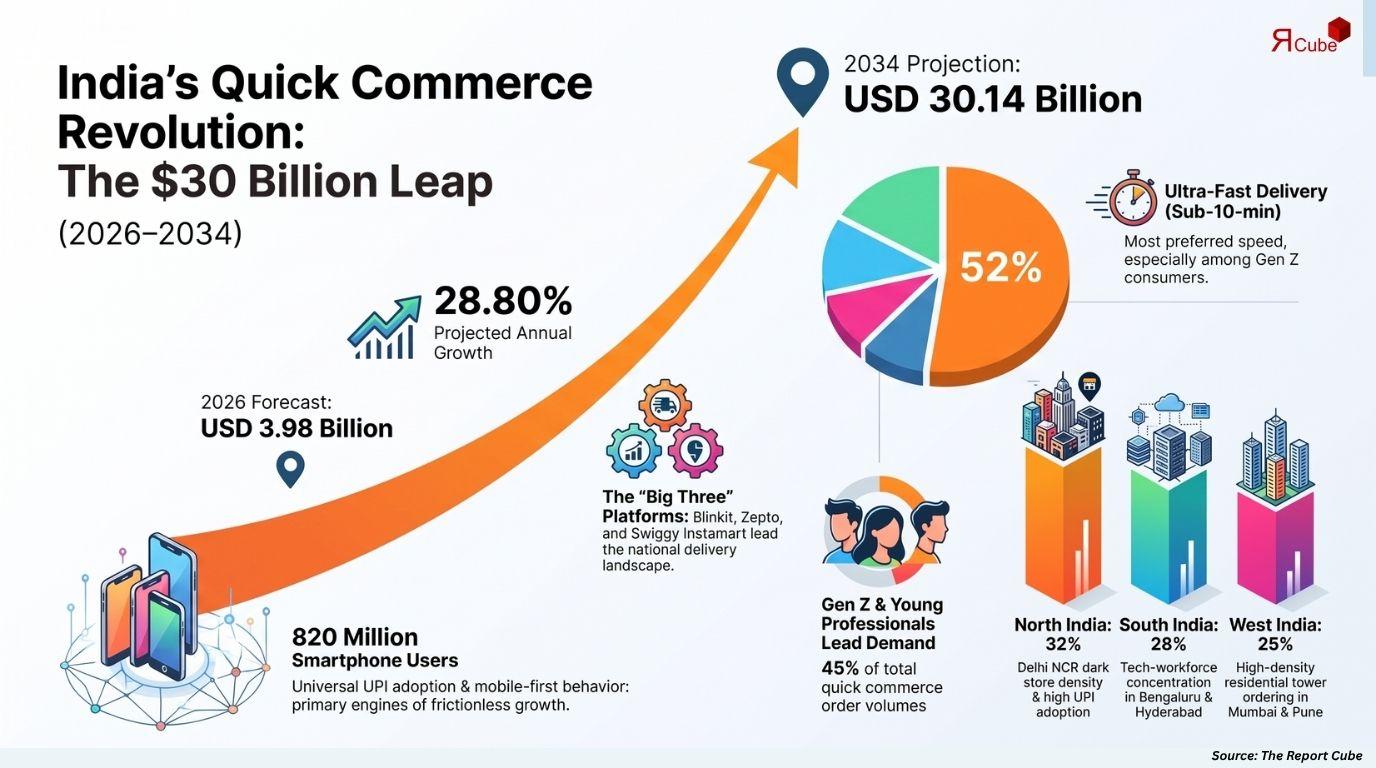
The market was valued at USD 3.98 billion in 2026 and is projected to reach USD 30.14 billion by 2034. It is expected to expand at a CAGR of 28.80% during 2026–2034. Growth is supported by smartphone and UPI penetration, expanding dark-store infrastructure, urban disposable income, and rising consumer preference for on-demand grocery fulfillment. The report identifies Tier 2 expansion, category diversification, and higher repeat-order frequency as important contributors to future growth. Platform investment in hyperlocal infrastructure is also strengthening fulfillment capabilities across major metropolitan and emerging urban markets.
Get a Free Sample Report - https://www.thereportcubes.com/request-sample/quick-commerce-grocery-market-india
How is the India Quick Commerce Grocery Market Segment
By Delivery Speed & Promise
• Ultra-Fast Delivery – 52%
• Quick Delivery – 33%
• Scheduled Quick Delivery – 15%
Ultra-Fast Delivery holds the largest share at approximately 52% in 2026. Sub-10-minute fulfillment is central to the propositions of major platforms, supported by strategically positioned dark stores in dense residential areas. This model particularly serves consumers seeking immediate replenishment of groceries, beverages, snacks, and convenience products. Quick Delivery represents approximately 33% of demand and addresses consumers with moderate delivery urgency through 15–30 minute fulfillment windows. Scheduled Quick Delivery contributes about 15% and caters to systematic grocery shoppers, including nuclear families seeking predictable weekly replenishment and potentially lower platform fees. The segmentation demonstrates how delivery expectations influence platform infrastructure, consumer frequency, and category purchasing patterns.
By Consumer
• Gen Z & Young Professionals – 45%
• Nuclear Working Families – 38%
• Festival & Event-Led Shoppers – 17%
Gen Z and young professionals represent approximately 45% of consumer demand, making them the largest identified consumer group. Their adoption is associated with mobile-first behavior, convenience-oriented purchasing, and demand for beverages, snacks, and ready-to-consume or ready-to-cook products. Nuclear working families account for around 38% and generate repeat purchases across fresh produce, dairy, household essentials, and personal care. Festival and event-led shoppers represent approximately 17% of demand and contribute concentrated purchasing during major celebration and gifting periods. Platform operators are responding through targeted assortments, subscription programs, promotional campaigns, and festival-specific inventory planning.
India Quick Commerce Grocery Market Dynamics
• Drivers: Smartphone penetration and widespread UPI usage are expanding the addressable customer base while simplifying digital grocery transactions. Dark-store expansion is reducing fulfillment times and strengthening service availability in dense urban clusters.
• Restraints: Profitability pressure remains a challenge as platforms balance delivery infrastructure, consumer price sensitivity, fees, and minimum basket requirements. Competition from India's neighborhood kirana stores also remains significant because of established relationships, flexible pricing, and personalized service.
• Opportunities: Tier 2 cities such as Jaipur, Lucknow, Indore, and Coimbatore are identified as emerging growth corridors. Category diversification into electronics, pharmacy, beauty, and home essentials can increase basket values and broaden platform relevance.
• Trends: AI-powered demand forecasting, computer-vision inventory management, route optimization, IoT-enabled cold-chain systems, and electric delivery fleets are reshaping fulfillment operations. Dark stores of approximately 2,000–4,000 square feet are becoming important hyperlocal infrastructure units.
• Regulatory developments: The ONDC framework is broadening participation opportunities, while FSSAI requirements concerning cold-chain compliance and product traceability are increasing operational considerations for perishable grocery delivery.
Regional Projection of India Quick Commerce Grocery Market
North India
• 32% estimated share
• Growth supported by Delhi NCR dark-store density, Tier 2 expansion, and strong UPI adoption.
South India
• 28% estimated share
• Bengaluru and Hyderabad benefit from technology-sector concentration, smartphone penetration, and digital-first consumer behavior.
West India
• 25% estimated share
• Mumbai and Pune provide strong platform density, logistics infrastructure, and repeat ordering from nuclear families.
East India
• 15% estimated share
• Kolkata and emerging cities such as Bhubaneswar and Patna represent developing opportunities, although price sensitivity remains a consideration.
who are the major players in the India Quick Commerce Grocery Market
The competitive landscape includes Blinkit, Zepto, Swiggy Instamart, Flipkart Minutes, and BigBasket. Blinkit operates an extensive dark-store network and has expanded beyond groceries into categories including electronics and pharmacy. Zepto has focused on rapid dark-store expansion and Tier 2 penetration. Swiggy Instamart benefits from an integrated food-and-grocery ecosystem, while Flipkart Minutes leverages Flipkart's broader supply-chain capabilities. BigBasket differentiates through its Tata backing, subscription-oriented model, and fresh-produce positioning.
India Quick Commerce Grocery Market Future Outlook (2034)
The India Quick Commerce Grocery Market is projected to reach USD 30.14 billion by 2034, representing a 28.80% CAGR from 2026 to 2034. Future expansion is expected to involve deeper Tier 2 penetration, broader product categories, subscription-led retention, and increasing repeat-order frequency. AI-driven demand forecasting, automated dark-store operations, robotic picking, optimized routing, and EV-based last-mile delivery are expected to support fulfillment efficiency. Regulatory developments involving ONDC and FSSAI compliance will also influence platform investment, sourcing, and cold-chain infrastructure through the forecast period.
About The Report Cube
The Report Cube provides market intelligence and research services covering industry reports, syndicated research, customized research, competitive analysis, company profiles, and related business intelligence. Its report portfolio includes detailed market sizing, segmentation, regional analysis, competitive assessment, forecasts, and customization options for business and investment requirements.
Contact
Website: https://www.thereportcubes.com/
E-mail Id: sales@thereportcube.com
WhatsApp: +971 564468112

 English
 Arabic
 Spanish
 Portuguese
 Deutsch
 Turkish
 Dutch
Dutch
 Italiano
 Russian
 Romaian
 Portuguese (Brazil)
 Greek
Greek