


How does a Modular Ophthalmic OT Setup Company ensure infection control?
INTRODUCTION
A Modular Ophthalmic OT Setup Company plays an important role in creating a controlled and hygienic operating environment for ophthalmic procedures. Eye surgeries require careful management of airborne particles, surface contamination, temperature, humidity, pressure, airflow, and personnel movement. A professionally designed modular ophthalmic operation theatre combines cleanroom engineering, HVAC systems, HEPA filtration, controlled airflow, hygienic materials, and appropriate monitoring systems to support infection-control objectives. The effectiveness of infection control depends not only on the physical infrastructure but also on proper cleaning, maintenance, validation, and clinical practices.
Why Infection Control Is Important in Ophthalmic OTs
Ophthalmic operation theatres require a carefully controlled environment because surgical procedures involve direct access to sensitive ocular tissues. Contamination can arise from airborne particles, people, equipment, surfaces, construction activities, and inadequate cleaning practices.
A properly planned OT can help control these risks through:
- Controlled airflow
- Effective filtration
- Positive pressure management
- Hygienic surfaces
- Proper zoning
- Controlled personnel movement
- Environmental monitoring
- Regular cleaning and maintenance
- Testing and commissioning
Infrastructure should support, rather than replace, established infection-prevention procedures.
Modular OT Construction for Hygienic Environments
Modular construction allows the operating theatre to be designed around cleanroom and healthcare requirements. Wall and ceiling systems can be constructed with smooth, sealed, and easy-to-clean surfaces.
Important construction features may include:
- Seam-minimized wall panels
- Sealed joints
- Hygienic ceiling systems
- Smooth flooring
- Coved floor-wall junctions
- Properly sealed penetrations
- Flush-mounted fixtures where appropriate
These features reduce areas where dust, dirt, and microorganisms can accumulate and make routine cleaning more manageable.
HEPA Filtration for Airborne Particle Control
HEPA filtration is a key component of controlled surgical environments. Properly selected and maintained HEPA filters can remove a high proportion of particulate contaminants from the supplied air.
A modular ophthalmic OT may incorporate:
- Terminal HEPA filter units
- HEPA filter housings
- Pre-filtration stages
- Accessible filter replacement arrangements
- Filter integrity testing provisions
Filter selection should be based on the system design, airflow requirements, application, and applicable specifications.
Laminar or Unidirectional Airflow
Controlled or unidirectional airflow can help reduce airborne contamination around critical surgical areas when correctly designed and maintained.
A properly engineered system considers:
- Airflow direction
- Air velocity
- Supply-air distribution
- Return-air location
- Equipment arrangement
- Operating-table position
- Potential airflow obstructions
The objective is to establish a predictable airflow pattern while avoiding unnecessary turbulence. The exact airflow configuration should be determined according to the theatre's design requirements and relevant healthcare guidance.
HVAC System Integration
HVAC engineering is central to infection-control planning. The HVAC system influences temperature, humidity, air changes, filtration, fresh-air supply, pressure relationships, and overall air distribution.
A professionally planned ophthalmic OT may incorporate:
- Dedicated air-handling arrangements
- HEPA filtration
- Temperature control
- Humidity control
- Fresh-air management
- Return-air systems
- Differential-pressure control
- Airflow monitoring
The HVAC system should be designed as part of the overall OT rather than treated as an independent installation.
Positive Pressure Management
Maintaining an appropriate pressure relationship can help limit uncontrolled air movement from adjacent areas into the operating theatre.
The OT may be maintained at positive pressure relative to surrounding spaces, subject to the facility's design and applicable requirements.
Pressure management can involve:
- Differential-pressure sensors
- Digital pressure displays
- Balanced supply and return airflow
- Automatic controls
- Door configuration
- Alarm systems
Regular monitoring is important because pressure relationships can change when filters become loaded, doors remain open, or HVAC systems are modified.
Temperature and Humidity Control
Environmental stability is another component of infection-control planning. Excessive humidity, inadequate temperature control, or unstable conditions can affect comfort, equipment operation, and the overall controlled environment.
A modular OT setup can incorporate sensors and controls for:
- Room temperature
- Relative humidity
- Supply-air conditions
- Return-air conditions
The operating ranges should be established according to healthcare requirements, clinical needs, equipment specifications, and the facility's infection-control protocols.
Hygienic Wall and Ceiling Materials
Material selection has a direct impact on cleaning and environmental hygiene. Surfaces in an ophthalmic OT should generally be smooth, durable, non-shedding, and suitable for routine cleaning and disinfection.
Common considerations include:
- Cleanroom-compatible wall panels
- HPL or suitable coated panels
- PUF/PIR insulated modular panels
- Sealed ceiling systems
- Smooth protective finishes
- Appropriate hygienic sealants
The specific material should be selected based on fire safety, durability, cleaning compatibility, moisture resistance, and project specifications.
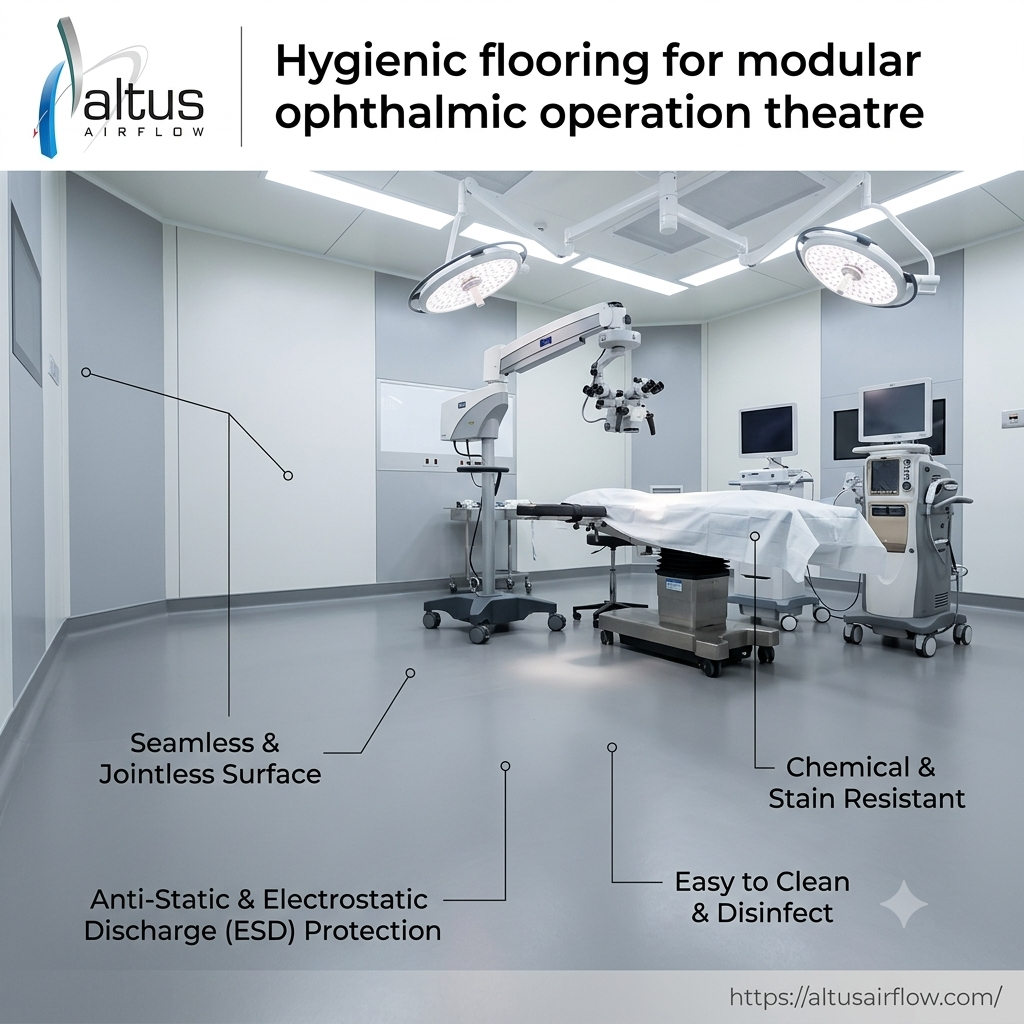
Antistatic and Hygienic Flooring
Flooring must withstand frequent cleaning and movement of surgical equipment. Seamless or low-joint flooring systems can simplify cleaning and reduce potential accumulation points.
Depending on the project, options may include:
- Medical-grade vinyl
- Epoxy flooring
- Conductive flooring
- Seamless flooring systems
- Coved flooring
Flooring selection should consider slip resistance, chemical compatibility, durability, electrical requirements, and cleaning protocols.
Sealed Doors and Controlled Access
Doors and access points can influence pressure stability and contamination control. A modular ophthalmic OT may therefore use appropriately sealed doors and controlled access arrangements.
Features can include:
- Hermetically sealed doors
- Automatic or controlled closing
- Observation panels where required
- Interlocking arrangements for selected spaces
- Access-control systems
Limiting unnecessary movement into the operating theatre can help reduce the introduction of airborne particles and maintain stable environmental conditions.
Proper Equipment Integration
Ophthalmic equipment must be positioned without unnecessarily interfering with airflow or creating difficult-to-clean areas.
Equipment may include:
- Operating microscopes
- Ophthalmic surgical tables
- Phacoemulsification systems
- Surgical lights
- Patient monitoring equipment
- Anesthesia equipment where applicable
The layout should provide adequate access for surgical teams while considering airflow distribution, cleaning access, electrical connections, and medical utilities.
Medical Gas and Utility Planning
Medical gas and electrical systems should be integrated carefully into the modular OT design. Poorly sealed penetrations or difficult-to-access utility installations can create maintenance and hygiene challenges.
Planning may cover:
- Oxygen outlets
- Medical air
- Vacuum
- Electrical sockets
- Data connections
- Emergency power
- Equipment-specific connections
Service penetrations should be appropriately sealed and coordinated with the modular wall and ceiling systems.
Environmental Monitoring
Continuous monitoring can help facility teams identify changes in operating conditions.
Depending on the OT design, monitoring may include:
- Temperature
- Relative humidity
- Differential pressure
- Airflow parameters
- Particle levels where required
- Filter condition
- HVAC operating status
Digital monitoring systems can provide alarms when selected parameters move outside predetermined limits.
Testing and Validation
A modular ophthalmic OT should undergo appropriate testing before clinical use. Testing confirms whether installed systems perform according to the specified design.
Possible tests include:
- HEPA filter integrity testing
- Airflow velocity measurement
- Airflow visualization
- Particle counting
- Pressure differential testing
- Temperature and humidity verification
- HVAC performance testing
The testing protocol should be based on the project's specifications, applicable standards, healthcare requirements, and validation plan.
Construction-Phase Contamination Control
Infection-control planning should begin before the OT becomes operational. Construction and installation activities can generate dust, particles, debris, and other contaminants.
A professional project should consider:
- Controlled material handling
- Sealed construction zones
- Dust containment
- Protection of installed HVAC systems
- Cleaning before commissioning
- Proper disposal of construction waste
- Final environmental testing
Construction activities should not compromise the performance of the completed controlled environment.
Cleaning and Disinfection Support
The OT design should make routine cleaning practical. Smooth surfaces, sealed joints, accessible equipment arrangements, and appropriate flooring can support effective cleaning procedures.
Design considerations include:
- Easy-to-clean surfaces
- Minimal unnecessary ledges
- Sealed service penetrations
- Accessible corners
- Appropriate drainage considerations where applicable
- Equipment clearance for cleaning
Cleaning and disinfection schedules should be established and followed by trained healthcare personnel according to institutional protocols.
Preventive Maintenance
Infection-control performance can deteriorate if HVAC systems, filters, sensors, doors, and other components are not maintained.
Preventive maintenance can include:
- HEPA filter inspection
- Filter replacement when required
- Airflow balancing
- HVAC servicing
- Sensor calibration
- Pressure verification
- Cleaning of air-handling components
- Inspection of seals and doors
Maintenance records provide useful evidence of ongoing system performance.
Staff Movement and Workflow Planning
OT workflow can influence contamination risk. Excessive movement and unnecessary door opening can disturb airflow and pressure conditions.
A well-planned layout can separate or organize:
- Patient entry
- Surgical team entry
- Equipment movement
- Sterile supplies
- Waste movement
- Cleaning activities
- Service access
Clear workflow planning can reduce unnecessary movement and help maintain controlled environmental conditions.
Infection-Control Support Through Documentation
Documentation is important for maintaining long-term performance. A complete project handover can include:
- Approved drawings
- Equipment specifications
- HVAC documentation
- HEPA filter details
- Testing reports
- Validation records
- Commissioning documents
- Maintenance schedules
- Operating instructions
This information allows facility teams to understand the installed systems and maintain them correctly.
Benefits of Professional Infection-Control Planning
A professionally engineered modular ophthalmic OT can provide several operational benefits:
- Better environmental control
- Improved airborne particle management
- Easier cleaning
- Stable pressure relationships
- Controlled temperature and humidity
- Integrated HVAC and filtration
- Better surgical workflow
- Easier maintenance
- Documented system performance
- Support for infection-prevention practices
The infrastructure should always be combined with appropriate clinical infection-control procedures.
How to Select the Right Setup Company
Hospitals should assess potential providers based on more than construction capability. Important evaluation criteria include:
- Experience with ophthalmic OTs
- Cleanroom engineering expertise
- HVAC design capability
- HEPA filtration knowledge
- Laminar or unidirectional airflow experience
- Modular construction quality
- Testing and validation capabilities
- Equipment integration
- Project management
- Maintenance support
- Technical documentation
Hospitals can also review previous healthcare projects and ask for details about commissioning, validation, maintenance, and after-sales support.
Future Technologies for Infection-Controlled Ophthalmic OTs
Future modular ophthalmic OTs are likely to incorporate more advanced environmental monitoring and automation. Smart sensors, centralized building management systems, predictive maintenance tools, digital alarms, energy-efficient HVAC systems, and automated environmental reporting can improve facility management.
These technologies can help teams identify environmental deviations earlier and maintain better visibility into system performance.
Conclusion
A Modular Ophthalmic OT Setup Company supports infection-control objectives through coordinated modular construction, HEPA filtration, controlled airflow, HVAC engineering, pressure management, hygienic materials, environmental monitoring, equipment integration, testing, validation, and preventive maintenance. However, infection control cannot be achieved through infrastructure alone; cleaning, disinfection, staff practices, surgical protocols, and ongoing monitoring remain essential. By combining specialized engineering with appropriate operational procedures, hospitals can establish a controlled and maintainable environment for ophthalmic surgery. Altus Airflow provides modular ophthalmic OT engineering and turnkey infrastructure solutions designed to support the environmental and operational requirements of modern healthcare facilities.
Frequently Asked Questions
1. How does a Modular Ophthalmic OT Setup Company support infection control?
A Modular Ophthalmic OT Setup Company supports infection control through modular cleanroom construction, HEPA filtration, controlled airflow, HVAC integration, pressure management, hygienic surfaces, environmental monitoring, testing, and preventive maintenance.
2. Does a Modular Ophthalmic OT Setup Company use HEPA filtration?
Yes, a Modular Ophthalmic OT Setup Company can integrate HEPA filtration into the OT's HVAC and controlled-airflow system to support airborne particle control.
3. Can a Modular Ophthalmic OT Setup Company provide laminar airflow systems?
Yes, a Modular Ophthalmic OT Setup Company can design and integrate laminar or unidirectional airflow systems where required by the OT application and project specifications.
4. How does a Modular Ophthalmic OT Setup Company control room pressure?
A Modular Ophthalmic OT Setup Company can incorporate balanced airflow, differential-pressure sensors, HVAC controls, sealed doors, monitoring displays, and alarms to help maintain the specified pressure relationship.
5. What materials does a Modular Ophthalmic OT Setup Company use for infection-control support?
A Modular Ophthalmic OT Setup Company may use smooth modular wall panels, hygienic ceiling systems, sealed joints, epoxy or medical-grade flooring, coving, and cleanroom-compatible sealants to support cleaning and contamination control.
Read Our Previous Blog------>What zoning and workflow considerations are important in IVF Laboratory Design?

 English
 Arabic
 French
 Spanish
 Deutsch
 Turkish
 Dutch
Dutch
 Italiano
 Russian
 Romaian
 Portuguese (Brazil)
 Greek
Greek