


How to Choose Custom Sticker Printing for Cars
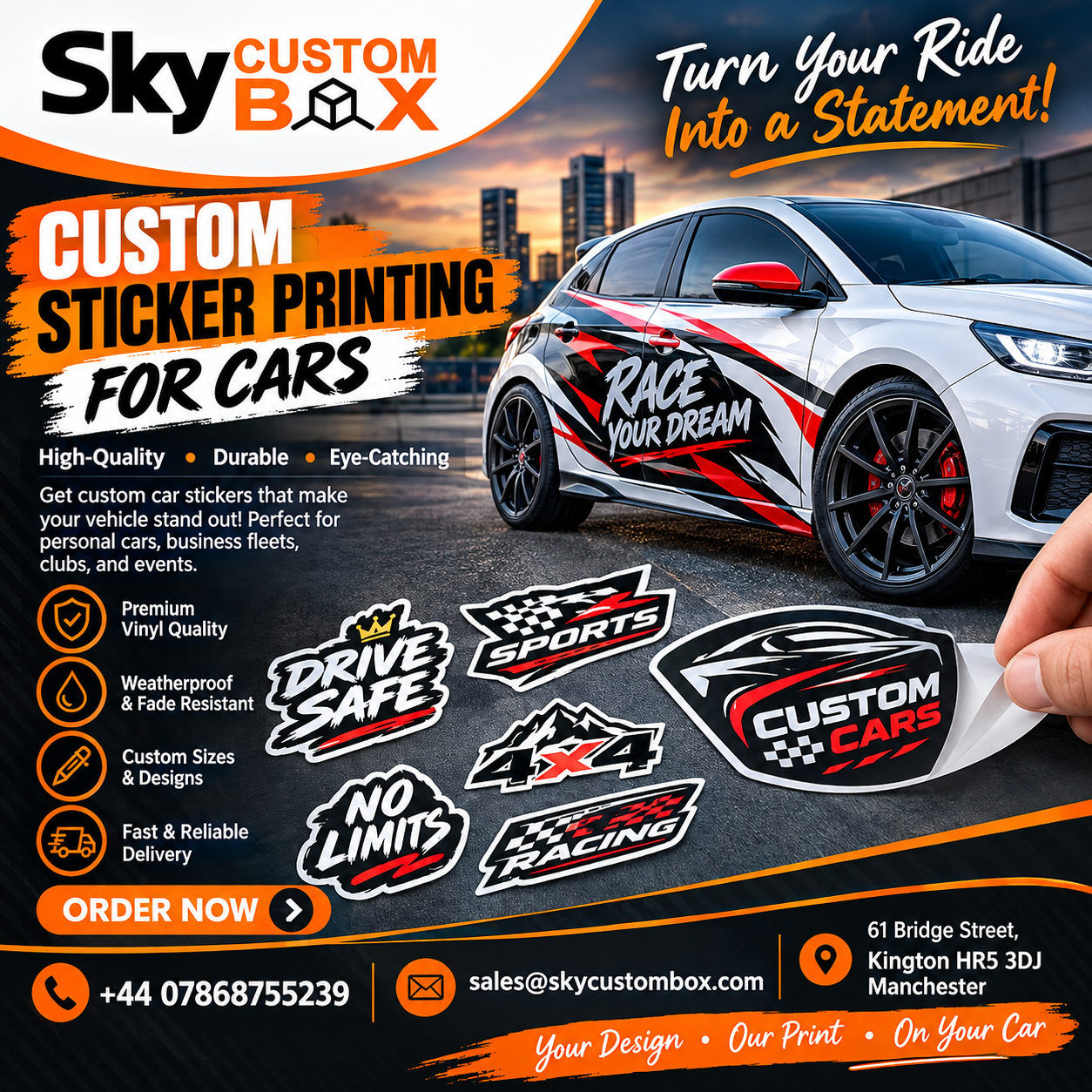
Car stickers are no longer limited to simple decorative graphics. They are increasingly used by businesses, tradespeople, clubs, event organisers, retailers, and individual vehicle owners to communicate information, display branding, or personalise vehicles. Because stickers are exposed to sunlight, rain, road debris, washing, and changing temperatures, choosing the right material and printing method is important for achieving a professional and durable result.
When researching custom sticker printing for cars, it is useful to look beyond the design itself. Material quality, adhesive performance, finish, print resolution, application method, and intended use can all affect how a sticker looks and performs over time. Understanding these factors makes it easier to select an option suited to a particular vehicle and purpose.
Understand the Purpose of the Car Sticker
The first step is to determine why the sticker is being produced. Different applications require different materials, sizes, finishes, and levels of durability.
Common uses include:
- Business logos and vehicle branding
- Contact details and website addresses
- Promotional graphics for events
- Club or community identification
- Safety and informational markings
- Personal vehicle decoration
- Fleet identification
- Temporary campaign or event graphics
A small logo placed on a car door may have different requirements from a large graphic covering a van. Similarly, a sticker intended for several years of outdoor use needs stronger weather resistance than one designed for a short-term event.
Defining the purpose also helps determine whether a permanent adhesive vinyl, removable vinyl, clear sticker, or specialist vehicle graphic is appropriate.
Choose the Right Vinyl Material
Material selection is one of the most important decisions in vehicle sticker production. Standard paper labels are generally unsuitable for exterior automotive applications because exposure to moisture and sunlight can cause deterioration.
Vehicle stickers are commonly produced using vinyl because it offers flexibility, moisture resistance, and suitability for outdoor applications. However, not all vinyl products have identical characteristics.
Important material considerations include:
Permanent Vinyl
Permanent adhesive vinyl is commonly used for long-term vehicle graphics. Once properly applied, it is designed to remain attached through normal outdoor exposure.
It can be suitable for business branding, logos, contact information, and other graphics where longevity is important.
Removable Vinyl
Removable vinyl is useful when graphics are intended for temporary applications. For example, event vehicles, seasonal promotions, temporary fleet identification, or leased vehicles may benefit from a material designed for easier removal.
However, "removable" does not necessarily mean that removal will always be completely effortless. Adhesive performance can vary according to surface condition, exposure time, temperature, and material quality.
Clear Vinyl
Clear vinyl can create a different visual effect because the printed design can allow the vehicle's original colour to remain visible around or through parts of the graphic. This can be useful for logos, decorative elements, and designs where a traditional white background would be distracting.
Before selecting clear material, check how the printed colours will appear against the vehicle's paintwork. Light colours can have a different visual appearance when printed on transparent material.
Consider Printing Quality and Finish
A well-designed sticker can lose its visual impact if the printing quality is poor. Vehicle graphics are often viewed from different distances, so sharp edges, readable text, and consistent colours are important.
When comparing custom sticker printing for cars, consider the following production characteristics:
- Print resolution
- Colour accuracy
- Ink durability
- Lamination options
- Surface finish
- Cutting precision
- Adhesive consistency
Digital printing is widely used for detailed vehicle graphics because it can reproduce photographs, gradients, logos, illustrations, and multiple colours without requiring a simple one-colour design.
The finish also affects appearance. Gloss finishes can produce a brighter and more reflective appearance, while matte finishes generally reduce glare and create a softer visual effect. The appropriate option depends on the vehicle, graphic design, and viewing conditions.
For graphics expected to remain outdoors for an extended period, protective lamination may provide an additional layer against environmental exposure and everyday cleaning.
Match the Design to the Vehicle
The shape of the vehicle should influence the design rather than being treated as an afterthought.
Doors, windows, panels, curves, handles, seams, badges, and body contours can all affect how a sticker appears after application. A design that looks excellent on a flat digital mock-up may not translate perfectly onto a curved surface.
Before printing, consider:
- Available surface area – Measure the intended panel accurately.
- Vehicle contours – Avoid placing critical text across strong curves or deep recesses.
- Visibility – Make sure important information can be read from a practical viewing distance.
- Contrast – Select colours that remain distinguishable against the vehicle's paint.
- Brand consistency – Logos, fonts, and colours should remain recognisable.
- Negative space – Avoid overcrowding the sticker with excessive information.
For business vehicles, simplicity is often particularly important. A company name, recognisable logo, service category, website, and telephone number may communicate more effectively than a design containing too much text.
This is particularly relevant for small businesses using cars and vans as mobile brand visibility. A clearly designed vehicle graphic can communicate basic information while the vehicle is parked or travelling through a local area.
Think About Weather and Everyday Exposure
Vehicle stickers operate in a demanding environment. Unlike indoor labels, they may experience ultraviolet radiation, rain, dirt, road salt, temperature changes, pressure washing, and repeated cleaning.
This means outdoor durability should be considered during the selection process.
Factors that can affect longevity include:
- Quality of vinyl
- Type of adhesive
- Ink technology
- UV exposure
- Surface preparation
- Application technique
- Cleaning practices
- Vehicle storage conditions
Even high-quality material can perform poorly if it is applied to a contaminated or unsuitable surface. Wax, oil, grease, dust, and moisture can interfere with adhesive bonding.
The application environment is therefore just as important as the printed product. A clean, dry surface and appropriate installation conditions can help reduce lifting, bubbling, and premature edge failure.
Common Problems and How to Avoid Them
Several issues repeatedly appear when vehicle stickers are poorly specified or installed.
Bubbling
Air bubbles can develop when vinyl is applied incorrectly or when the surface is not properly prepared. Professional application techniques can reduce this risk.
Peeling Edges
Edges may begin to lift when the sticker is exposed to contamination, excessive pressure washing, unsuitable surfaces, or poor installation.
Fading
Extended sunlight exposure can gradually affect printed colours. Choosing suitable outdoor-rated inks and protective finishes can help improve colour retention.
Poor Readability
Small fonts and complicated graphics may become difficult to understand when viewed from a moving vehicle. Designs should prioritise essential information.
Difficult Removal
Long-term exposure can make adhesive removal more challenging, particularly when stickers have remained on a vehicle for an extended period. If temporary use is expected, selecting an appropriate removable material from the beginning can be beneficial.
Consider the Full Production Process
A professional sticker project involves more than simply uploading artwork and selecting a size. The complete process typically includes design preparation, material selection, printing, cutting, finishing, quality checking, and application.
Before production, ask practical questions such as:
- Is the artwork supplied in a suitable resolution?
- Are the dimensions correct for the vehicle panel?
- Is the vinyl intended for exterior use?
- Is lamination recommended?
- Will the sticker be exposed to frequent washing?
- Is the adhesive suitable for the intended surface?
- Will the graphic be installed professionally?
- Is the sticker intended to be temporary or permanent?
Businesses researching packaging and printed branding solutions may also encounter providers such as Sky Custom Box, where custom printed products and branding-related applications form part of a broader visual identity strategy. The same principle applies across printed materials: choosing the correct substrate and finish is often as important as the artwork itself.
Vehicle Stickers as Part of Brand Communication
For tradespeople, delivery businesses, retailers, mobile services, and local companies, vehicle graphics can function as a form of outdoor communication.
Unlike a conventional advertisement that appears in one fixed location, a branded vehicle can be seen in different places throughout the day. However, effective vehicle branding depends on clarity rather than simply covering a vehicle with graphics.
A practical vehicle branding design usually prioritises:
- Brand recognition
- Short and readable messaging
- Consistent colours
- A clear contact method
- Appropriate logo placement
- Professional typography
For larger commercial vehicles, the available space can support more detailed graphics. Smaller cars generally benefit from simpler layouts because viewing distance and surface area are more limited.
Final Considerations Before Printing
Selecting the right sticker involves balancing appearance, durability, purpose, and budget. The cheapest material may not always be appropriate for long-term outdoor use, while a premium specification may be unnecessary for a short event.
Before placing an order, confirm the intended application, vehicle surface, sticker dimensions, material type, finish, expected lifespan, and installation requirements.
Ultimately, successful custom sticker printing for cars depends on treating the sticker as both a printed product and an outdoor application. Good artwork needs suitable vinyl, reliable adhesive, appropriate finishing, and careful installation to deliver consistent results.

 English
 Arabic
 French
 Spanish
 Portuguese
 Deutsch
 Turkish
 Dutch
Dutch
 Italiano
 Russian
 Romaian
 Portuguese (Brazil)