


SWOT Analysis for Small Business: Framework, Examples & Template
Running a small business means wearing ten hats at once. You're the boss, the accountant, the marketer, and sometimes the person who fixes the printer. With so much on your plate, it's easy to lose sight of the big picture and that's exactly where a SWOT analysis proves its worth.
A SWOT analysis is one of the simplest tools available for stepping back and understanding where your business truly stands. It requires no fancy software and no business degree, just honesty and roughly an hour of your time. This guide walks through what a SWOT analysis is, why it matters, how to build one, and includes a real-world example along with a free template you can put to use today.
What Is a SWOT Analysis?
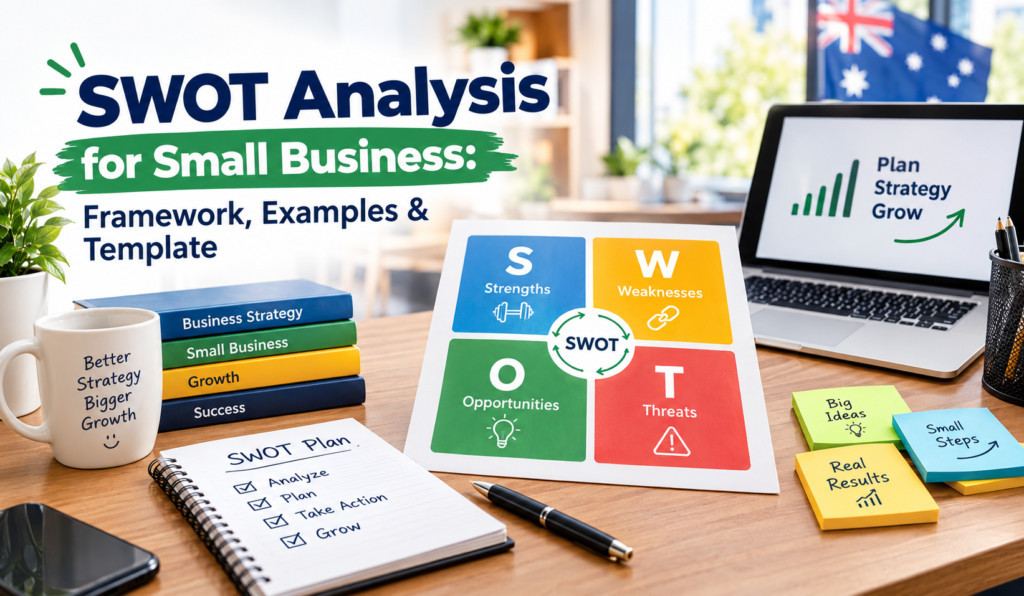
SWOT stands for Strengths, Weaknesses, Opportunities, and Threats, a straightforward framework for examining your business from four distinct angles. Strengths and weaknesses are internal factors: your team, your product, your cash flow, your location. Opportunities and threats, on the other hand, come from outside your business market trends, competitors, new regulations, or shifts in customer behaviour.
The value of a SWOT analysis lies in forcing you to look at both sides of the coin. You can't focus only on what's going well; you also have to confront what isn't working, and that honest reckoning is what makes the exercise genuinely useful. As Investopedia notes, the SWOT framework was originally built for corporate strategy, but small businesses have since adopted it widely because it's fast, low-cost, and effective.
Why Small Business Owners Should Bother With It
You might think, "I already know my business, why formalize it?" Fair question. But when you're buried in day-to-day operations, it's genuinely difficult to see the forest for the trees.
A written SWOT analysis gives you a clear record of your business's position, and that pays off in several concrete ways: it surfaces blind spots you've been overlooking, gives you a solid reference point when drafting a business plan or loan application, sharpens your decisions about where to invest time and money, and if you bring your team into the process keeps everyone aligned on the same priorities. Australia's Business.gov.au site specifically recommends including this kind of analysis in a formal business plan, particularly when applying for funding or a loan.
The Four Parts of a SWOT Analysis
Each quadrant answers a different question. Strengths are your internal advantages, what you do better than competitors, and what resources you can draw on. Weaknesses are your internal gaps where you fall short, and what customers tend to complain about. Opportunities are the external chances to grow trends that could work in your favour, or an untapped market segment. Threats are the external risks of your competitors, and anything that could realistically hurt your sales.
The key distinction to hold onto: strengths and weaknesses are about your own business, while opportunities and threats are about the world around it. Keeping that line clear will save you a lot of confusion once you start filling in your own analysis.
How to Do a SWOT Analysis for Your Small Business
You don't need a consultant to run this exercise, just follow these steps over the course of a week.
Start by gathering the right people. Don't do this alone if you can avoid it; bring in a couple of employees, a business partner, or even a trusted friend who knows your industry, since different perspectives catch things you'd otherwise miss. Next, draw a simple grid and split a page into four boxes labelled Strengths, Weaknesses, Opportunities, and Threats. A whiteboard or a plain sheet of paper works fine; there's no need for anything fancier.
Then brainstorm freely: give yourself ten minutes per box and write down everything that comes to mind without judging the ideas as they surface. Once the brainstorm is done, narrow it down, go back through your list and pick the three to five points in each category that matter most to your business right now.
Finally, turn insights into action, the step most people skip, and the most important one of all. For every strength, ask how you can lean into it further. For every weakness, ask how you can fix it or work around it. For every opportunity, ask how quickly you can act on it. For every threat, ask how you can prepare for it in advance.
A SWOT Analysis Example: A Small Café
Sometimes the clearest way to understand a concept is to see it applied. Take a small local café as an example. Its strengths might include a loyal base of local customers, a prime location near an office park, and strong online reviews. Its weaknesses could be limited seating, slow weekday mornings, and no online ordering system. On the opportunity side, there's growing demand for plant-based menu options and a nearby office building bringing in 200 new staff. And the threats facing it might include a new chain coffee shop opening two blocks away and the rising cost of coffee beans.
Laid out this way, the café owner can quickly spot a path forward: add online ordering to address the weakness, introduce a few plant-based items to capture the opportunity, and roll out loyalty discounts to defend against the new competitor. This is precisely why interpreting your SWOT results matters more than simply filling in the boxes; the real value comes from what you do with the information afterward.
Free SWOT Analysis Template
Ready to try it yourself? Copy this into a document or spreadsheet: list three to five things your business does well under Strengths; three to five areas needing improvement under Weaknesses; three to five outside trends or chances you could use under Opportunities; and three to five outside risks or challenges under Threats. Then build an action plan by asking what you'll do to build on your strengths, fix your weaknesses, seize your opportunities, and guard against your threats.
Once completed, keep the document somewhere you'll actually revisit — plenty of business owners do a SWOT analysis once and then never look at it again. Since your business and the market around it keep changing, it's worth revisiting every few months.
Common Mistakes to Avoid
Even a simple tool like this can go wrong if you're not careful. Watch out for these common slip-ups.
Being too vague. Writing "good customer service" isn't useful. Write "customers often mention our 24-hour response time in reviews" instead. Specific points lead to specific actions.
Only listing positives. Some business owners are too proud to admit weaknesses. If you skip this step, you're only getting half the picture.
Doing it once and forgetting it. Markets shift, competitors change, and your business grows. A SWOT analysis from two years ago won't reflect where you stand today.
Confusing internal and external factors. Remember, strengths and weaknesses are about you. Opportunities and threats are about the outside world. Mixing these up muddies your results.
Final Thoughts
A SWOT analysis won't solve every problem your small business faces, but it delivers something powerful: clarity. When your strengths, weaknesses, opportunities, and threats are laid out plainly in front of you, making decisions becomes a lot less stressful. Set aside an hour this week, pull in your team, and give it a try. You might be surprised by what you learn about your own business.

 English
 Arabic
 French
 Spanish
 Portuguese
 Deutsch
 Dutch
Dutch
 Italiano
 Russian
 Romaian
 Portuguese (Brazil)
 Greek
Greek