


Starting a Laundry Business? Do You Need a Commercial Dryer From Day One?
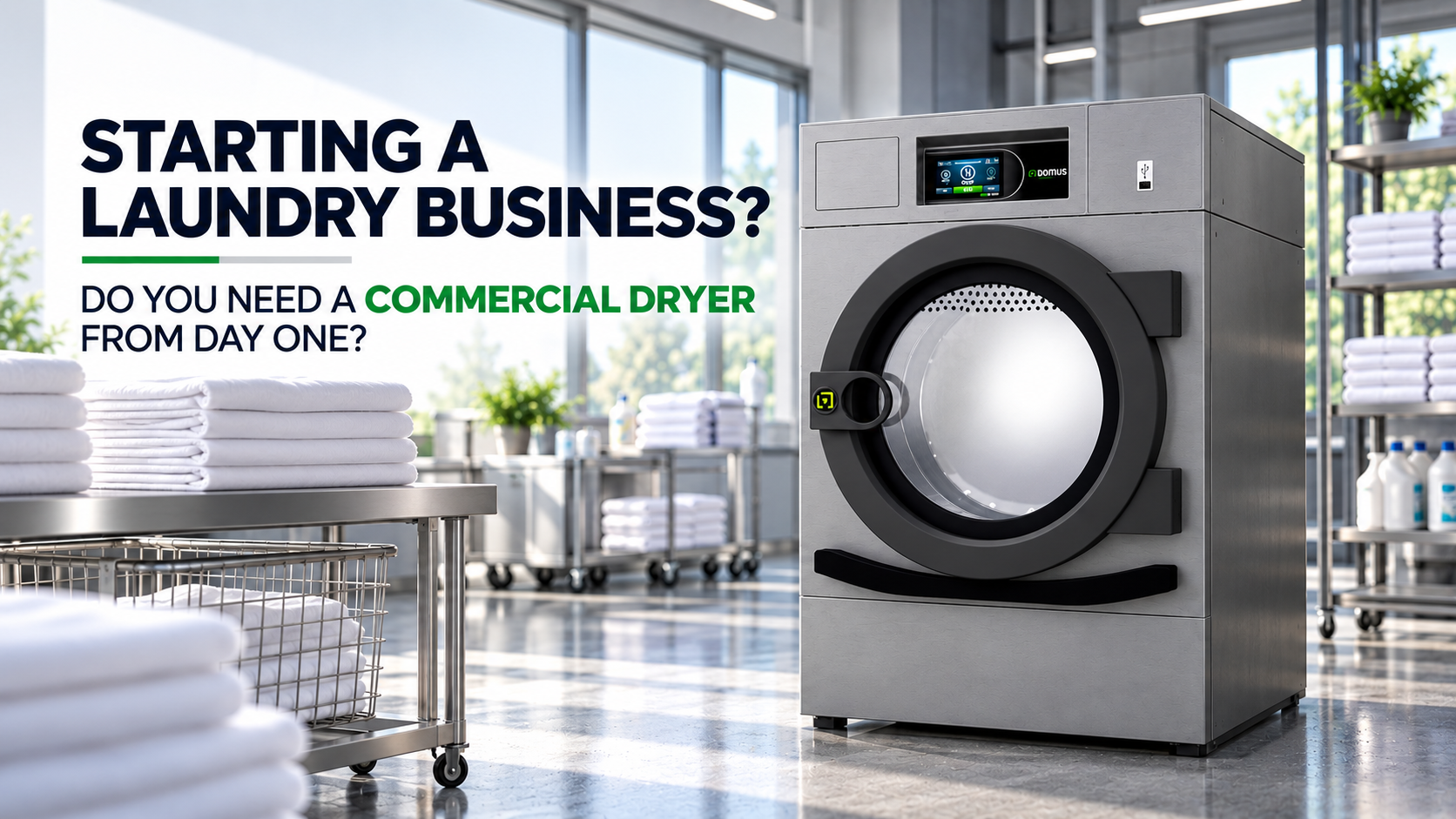
Starting a laundry business often begins with one obvious question: which washing machine should you buy? But many first-time owners overlook what happens after washing. If wet clothes, towels, or linen cannot be dried fast enough, the entire workflow can slow down even when the washing section is working properly.
That is why a commercial tumble dryer should be considered early while planning a new laundry. Whether you need one from day one depends on your services, expected load volume, turnaround time, available drying space, and the type of customers you want to serve.
Do You Need a Commercial Tumble Dryer to Start a Laundry Business?
Not every laundry starts with exactly the same equipment. Whether you need a dryer immediately depends mainly on what you promise customers.
If your business offers only washing and customers manage drying themselves, mechanical drying may not be part of your initial service. But if you plan to offer wash-and-dry, wash-and-fold, pickup and delivery, or B2B processing, drying becomes a much more important part of the setup.
Think about the difference:
Wash Only → Washing Capacity Is the Main Concern
Wash + Dry + Fold → Washing and Drying Capacity Must Work Together
A new laundry business should therefore decide its service model before purchasing equipment.
A commercial dryer can be particularly useful when you need predictable drying without relying entirely on outdoor conditions. This becomes more important when customers expect clothes back within a fixed time.
Before deciding, ask:
-
Will customers expect fully dried laundry?
-
Are you offering same-day or next-day service?
-
Do you have enough natural drying space?
-
How many loads do you expect each day?
-
What types of textiles will you process?
-
Can your drying method keep up during busy periods?
The key principle is simple:
Decide what service you are selling before deciding what equipment you need.
What Happens If You Start Without a Commercial Laundry Dryer?
Starting without a commercial laundry dryer may be possible for some business models, but you need to understand how drying will affect daily output.
Natural drying can depend on:
-
Weather
-
Humidity
-
Available space
-
Air movement
-
Textile thickness
-
Number of daily loads
-
Required turnaround
Imagine that your washer completes several loads during the day, but drying takes much longer.
The workflow becomes:
Wash Complete → Wet Laundry Waits → Drying Area Fills → Next Orders Wait → Delivery Time Increases
This is where a laundry can become slow even though the washing machine is not overloaded.
A laundry drying machine helps create controlled drying capacity where suitable. That can make workflow planning more predictable because the business is not relying only on sunlight, balconies, terraces, or large drying areas.
This becomes especially relevant in a commercial laundry setup where multiple customer orders need to move through washing, drying, finishing, packing, and dispatch.
However, simply buying a dryer is not enough. The dryer needs to match the actual wash output.
If your washing section can process more laundry than your drying section can handle, the bottleneck simply moves from washing to drying.
That is why equipment should be planned as a system:
Washing Capacity → Extraction → Drying Capacity → Finishing → Dispatch
When Does an Industrial Tumble Dryer Make Sense From Day One?
An industrial tumble dryer may make sense from the beginning if reliable drying is central to the service you want to offer.
This could include businesses planning to provide:
-
Wash-and-dry services
-
Wash-and-fold
-
Pickup and delivery
-
Fast-turnaround laundry
-
Hotel or hostel laundry processing
-
Towels and linen processing
-
B2B laundry services
-
Laundry in locations with limited outdoor drying space
The decision should not be based only on whether “other laundries have dryers.”
Instead, use this sequence:
Service Type → Expected Daily Loads → Drying Requirement → Turnaround → Space → Utilities → Dryer Requirement
For example, a small startup processing a few light loads may have very different drying needs from a business handling towels, bedsheets, or heavier textiles throughout the day.
Textile type matters because different materials may require different drying conditions and cycle times.
A tumble dryer machine should therefore be selected based on the business you are building, not just the machine’s rated capacity.
A useful planning question is:
If washing stops depending on the weather, should drying still depend on it?
For some startups, the answer may be yes. For others, particularly those promising consistent turnaround, it may be better to include drying equipment from the beginning.
How Do You Choose the Right Commercial Dryer for a New Laundry?
Choosing a commercial tumble dryer should start with actual workload, not just machine size.
Begin with:
Expected Daily KG → Practical Loads → Loads per Day → Textile Mix → Drying Cycles → Operating Hours
For example, if your laundry processes 150 KG per day, do not immediately assume you need a machine with one particular capacity. First understand how that volume will be divided across loads and textile categories.
Before choosing a laundry dryer for business, evaluate:
-
Rated capacity
-
Drum volume
-
Textile mix
-
Moisture remaining after extraction
-
Number of cycles required
-
Heating configuration
-
Electrical or other utility requirements
-
Exhaust and ventilation
-
Machine dimensions
-
Installation clearance
-
Controls and programs
-
Service and maintenance support
The moisture left in textiles after washing can also affect drying performance. Better extraction at the washing stage may reduce how much moisture the dryer needs to remove.
This is why drying equipment should not be selected independently from washing equipment.
Should You Buy a Commercial Washer and Dryer Together?
A first-time buyer may assume that a washer and dryer with the same KG rating are automatically a perfect combination.
That is not always the case.
A commercial washer and dryer setup should be balanced around actual throughput.
Consider:
-
Wash cycle time
-
Extraction performance
-
Practical load size
-
Dryer cycle time
-
Textile type
-
Peak demand
-
Available operating hours
For example:
20 KG Washer + 20 KG Dryer
may look balanced on paper.
But if the washer completes cycles much faster than the dryer, wet loads can still begin to queue.
That is why the better planning model is:
Daily Volume → Washer Capacity → Extraction → Dryer Capacity → Finishing Capacity
The washer and dryer do not necessarily need to be purchased from the same supplier, but they should be planned as part of one operating system.
A balanced setup helps prevent situations where one machine is waiting while another is overloaded.
This is especially important for first-time buyers investing in Commercial Laundry Equipment or other Professional Laundry Equipment.
What Other Laundry Equipment for Business Should You Plan?
A dryer is only one part of the operation.
Depending on the services offered, Laundry Equipment for Business may also include:
-
Commercial or industrial washing machine
-
Washer extractor
-
Drying equipment
-
Ironing and finishing equipment
-
Sorting tables
-
Trolleys and baskets
-
Storage racks
-
Packing area
-
Suitable laundry chemicals
-
Dosing system where appropriate
The complete workflow should be planned before installation:
Receive → Sort → Wash → Extract → Dry → Finish → Quality Check → Pack → Deliver
This makes it easier to understand where the real capacity requirement lies.
How OrgaEarth Can Help You Plan a Commercial Laundry Setup
OrgaEarth can help first-time laundry entrepreneurs evaluate a commercial tumble dryer according to the actual operating requirement.
Planning can begin with:
Expected Daily KG + Practical Load Size + Textile Mix + Washer Capacity + Required Turnaround + Available Space + Utilities
From there, businesses can evaluate suitable commercial drying equipment along with washer extractors, finishing equipment, laundry chemicals, and supporting solutions.
The aim is not to purchase a dryer simply because it is part of a typical laundry setup. The aim is to choose equipment that supports the service you want to deliver.
Frequently Asked Questions
Do I need a commercial tumble dryer to start a laundry business?
Not always. It depends on your service model, load volume, drying space, and customer turnaround requirements. Businesses offering wash-and-dry or fast-turnaround services may need one from the beginning.
Can I start a laundry business without a commercial dryer?
Yes, if your drying method can support the expected workload. However, you should calculate whether natural drying can consistently handle your daily loads.
What size commercial laundry dryer should I buy?
Start with expected daily KG, practical load size, textile mix, drying cycles, and working hours. Then compare suitable capacities and machine specifications.
Should washer and dryer capacity always match?
No. Matching KG ratings alone does not guarantee balanced output. Extraction performance, cycle time, textile type, and practical loads also matter.
Is an industrial tumble dryer suitable for a small laundry?
It can be suitable if the capacity, space, utilities, and operating requirements fit the business. Machine selection should follow actual workload.
What should I check before buying a tumble dryer machine?
Check capacity, drum volume, heating type, utilities, ventilation, dimensions, cycle controls, installation requirements, and after-sales support.
Conclusion
A new laundry does not automatically need every machine on day one, but drying should never be an afterthought. If your customers expect fully dried laundry, reliable turnaround, or wash-and-fold service, drying capacity should be planned from the beginning.
The right sequence is:
Choose Your Service → Estimate Loads → Understand Drying Demand → Plan Washer Output → Select Commercial Tumble Dryer → Build the Complete Workflow
Contact Us:
Orgaearth Laundry Solutions
Plot no. 774, Udyog Vihar, Phase 5, Gurugram, Haryana, India-122016
Email: marketing@orgaearth.com
Contact No.- +91 7042912777

 English
 Arabic
 French
 Spanish
 Portuguese
 Turkish
 Dutch
Dutch
 Italiano
 Russian
 Romaian
 Portuguese (Brazil)
 Greek
Greek