


Richard Mille Watch Real vs Fake Guide 2026: How to Spot an Authentic Watch
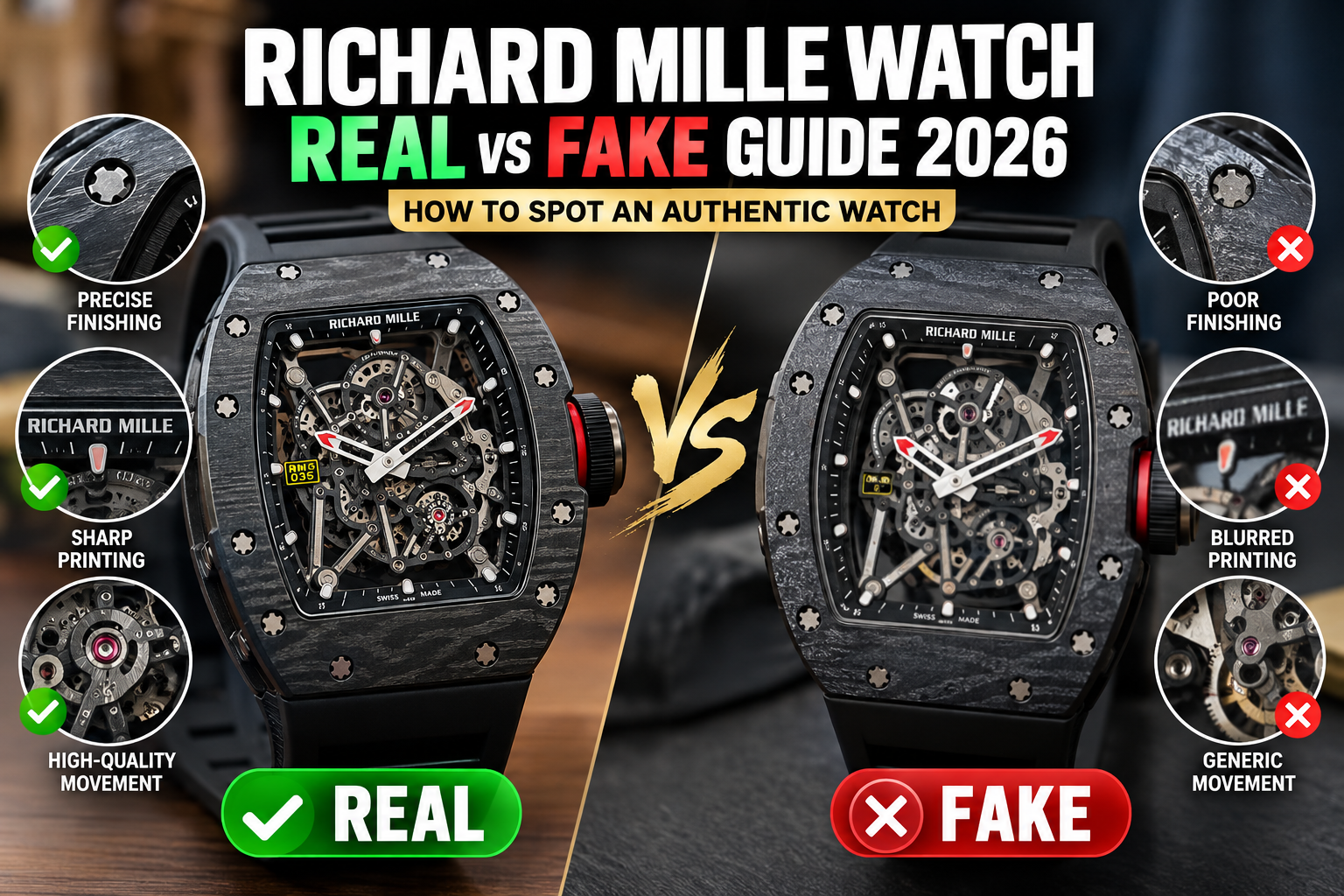
Buying a Richard Mille watch is a major investment. With prices often reaching hundreds of thousands of dollars and certain rare models selling for even more, the brand has become a major target for counterfeiters. Modern fake Richard Mille watches can look surprisingly convincing in photographs, making authentication more complicated than simply checking the logo or dial.
If you are considering buying a pre-owned Richard Mille in 2026, knowing the differences between a real and fake Richard Mille can help you identify obvious warning signs and avoid potentially expensive mistakes.
This guide explains the key things to examine, including the case, dial, movement, finishing, serial information, documentation, and seller.
Why Fake Richard Mille Watches Are Difficult to Identify
Richard Mille watches have an unusually complex appearance. Their tonneau-shaped cases, skeletonized movements, unusual materials, and technical components make them harder to authenticate using ordinary watch-checking techniques.
Counterfeit manufacturers have also improved considerably. A low-quality replica may be easy to recognize, but a sophisticated counterfeit can reproduce many external details reasonably well.
That is why authentication should involve multiple independent checks rather than relying on a single feature.
1. Start With the Reference Number
One of the first things to establish is exactly which Richard Mille model you are examining.
Examples include models from the:
-
RM 011 family
-
RM 035 family
-
RM 055 family
-
RM 07 family
-
RM 67 family
-
RM 010 family
-
RM 029 family
-
RM 030 family
-
RM 032 family
The reference should correspond with the watch's overall configuration.
Check the:
-
Case material
-
Dial configuration
-
Movement
-
Hands
-
Pushers
-
Crown
-
Strap
-
Caseback
-
Functions
A counterfeit may combine details from different Richard Mille references. For example, a watch may have a case resembling one model while using dial markings or pushers associated with another.
Important: A matching reference number does not prove authenticity. Counterfeiters can copy reference information as well.
2. Examine the Case Construction
The case is one of the most useful areas to inspect.
Richard Mille is known for technically complex cases manufactured from materials such as titanium, carbon-based composites, ceramics, gold, and other specialized materials depending on the model.
On an authentic watch, case construction should appear extremely precise.
Look closely at:
-
Case edges
-
Screws
-
Case layers
-
Surface finishing
-
Brushing
-
Polished sections
-
Gaskets
-
Pusher construction
-
Crown guards
-
Alignment between case components
A fake may have visibly uneven machining, poorly defined edges, inconsistent finishing, or hardware that doesn't match the expected construction of the reference.
Don't judge only by weight
A common misconception is that a genuine luxury watch must feel extremely heavy.
That's particularly unreliable with Richard Mille because the brand uses lightweight technical materials in many watches.
Therefore, weight alone is not an authentication test.
3. Inspect the Screws Carefully
Richard Mille's case screws are an important part of its distinctive engineering aesthetic.
On a genuine watch, the screws should generally exhibit consistent:
-
Shape
-
Finish
-
Placement
-
Alignment
-
Machining quality
Look for inconsistencies between screws that should be identical.
However, don't assume that screw-head orientation alone proves a watch is fake. Servicing, case construction, and model-specific engineering can affect how components appear.
The important question is whether the overall screw construction corresponds to the specific reference.
4. Study the Dial and Printing
Dial printing is another area where counterfeit watches can reveal themselves.
Use a loupe or high-resolution macro photographs to inspect:
-
Numerals
-
Lettering
-
Logos
-
Minute markers
-
Date displays
-
Subdial markings
-
Applied indexes
-
Hand finishing
Authentic Richard Mille components generally demonstrate exceptionally precise manufacturing.
On a questionable watch, you might see:
-
Uneven lettering
-
Incorrect typography
-
Poor spacing
-
Printing that appears too thick
-
Misaligned markers
-
Rough edges
-
Incorrect proportions
A particularly useful technique is to compare the watch with high-resolution photographs of the exact reference, rather than generic Richard Mille photographs.
5. The Movement Is One of the Most Important Checks
The movement can provide significantly more information than the exterior.
Richard Mille uses highly specialized mechanical movements, and many models have elaborate skeletonized architectures.
A genuine movement should correspond to the specific reference and its stated complications.
Depending on the model, you may encounter features such as:
-
Automatic winding systems
-
Chronograph mechanisms
-
Tourbillons
-
Variable-geometry rotors
-
Function selectors
-
Torque indicators
-
Power-reserve indicators
-
Specialized bridges
A fake movement may instead use a generic or modified movement underneath a convincing-looking exterior.
This is one reason authentication should not stop with photographs of the front of the watch.
Never open the watch yourself
If you're evaluating an expensive watch, don't remove the caseback simply to inspect the movement.
An inexperienced attempt can damage the watch, compromise water resistance, or create additional service costs.
A qualified Richard Mille service professional or experienced independent watchmaker should handle movement inspection.
6. Check the Finishing of the Movement
Movement finishing is not simply about whether the mechanism looks complicated.
Look at:
-
Bridge edges
-
Surface treatment
-
Screws
-
Jewels
-
Engravings
-
Gear finishing
-
Component geometry
-
Rotor construction
-
Bridge shapes
A counterfeit may imitate the visual layout while failing to reproduce the level of machining and finishing found on the genuine movement.
This is particularly important because some sophisticated replicas are designed primarily to look convincing through a display caseback.
The question is not simply "Does the movement look impressive?"
Instead ask:
Does this movement match the architecture and finishing expected from this exact Richard Mille reference?
7. Verify the Serial and Identification Information
Serial information can be useful, but it should never be treated as a standalone authentication method.
Depending on the watch and its documentation, examine relevant identification information and compare it against:
-
Warranty documentation
-
Purchase records
-
Service documentation
-
Case details
-
Model/reference information
A suspicious situation is one where the seller provides identification information that doesn't correspond with the watch or documentation.
Also be cautious about photographs showing serial numbers publicly. Sellers sometimes obscure portions of identification information for privacy and security reasons.
If buying a high-value watch, professional verification is considerably more meaningful than simply searching a number online.
8. Don't Ignore the Strap and Buckle
Counterfeiters frequently concentrate on the case and dial while paying less attention to smaller components.
Inspect:
-
Strap material
-
Stitching
-
Texture
-
Strap shape
-
Buckle construction
-
Engravings
-
Finishing
-
Hardware
The strap should also make sense for the specific model.
A genuine Richard Mille isn't necessarily guaranteed to have every component in its original configuration if the watch has been serviced or modified, so a replacement strap isn't automatically evidence of a counterfeit.
However, inconsistencies should be investigated.
9. Examine the Packaging and Papers
Original documentation can increase confidence, particularly when it provides a consistent ownership and service history.
Look for:
-
Warranty documentation
-
Original purchase information
-
Service receipts
-
Previous authentication records
-
Model/reference consistency
-
Dates
-
Dealer information
But remember an important rule:
Fake papers can accompany fake watches.
Counterfeiters can reproduce boxes, cards, certificates, receipts, and other accessories.
Therefore, documentation should support authentication rather than replace it.
A genuine-looking box does not make the watch inside genuine.
10. Be Careful With the Price
Price is one of the strongest practical warning signs.
If a seller offers a Richard Mille at a price dramatically below the normal market level and claims they need a quick sale, you should investigate carefully.
Potential explanations can include:
-
Damaged watch
-
Missing documentation
-
Replacement components
-
Estate sale
-
Distressed sale
-
Unusual provenance
-
Non-original parts
-
Counterfeit
A low price does not automatically mean the watch is fake.
However, an unusually low price combined with an unverified seller and weak documentation is a significant reason to slow down the transaction.
11. Examine the Seller Before Examining the Watch
Authentication isn't only about the physical watch.
Research the seller's:
-
Business history
-
Physical location
-
Reviews
-
Return policy
-
Warranty
-
Authentication process
-
Payment methods
-
Reputation among established collectors
Be especially cautious when a seller refuses independent authentication.
For an expensive watch, a seller who says "trust me, it's genuine" isn't providing meaningful evidence.
A professional transaction should give the buyer a reasonable opportunity to establish authenticity before finalizing the purchase.
Real vs Fake Richard Mille: Quick Comparison
|
Feature |
Genuine Watch |
Potential Counterfeit Warning |
|
Case |
Precise, complex construction |
Rough or inconsistent machining |
|
Screws |
Consistent and reference-specific |
Incorrect shape or poor finishing |
|
Dial |
Precise typography and alignment |
Blurry or inconsistent printing |
|
Hands |
Correct design and finishing |
Incorrect proportions |
|
Movement |
Correct architecture for reference |
Generic or incorrect movement |
|
Finishing |
High level of machining and finishing |
Rough component edges |
|
Strap |
Correct construction/material |
Poor material or stitching |
|
Buckle |
Precise finishing and engraving |
Weak or incorrect details |
|
Documentation |
Consistent provenance |
Generic or inconsistent papers |
|
Price |
Consistent with market context |
Unrealistically cheap |
|
Seller |
Transparent and verifiable |
Avoids inspection or authentication |
12. Use Multiple Authentication Methods
The safest approach is to treat authentication as a layered process.
For a high-value purchase, consider:
Step 1: Identify the exact reference
Establish the precise model and configuration.
Step 2: Compare the physical watch
Compare the case, dial, hands, pushers, crown, strap, buckle, and movement against reliable reference material.
Step 3: Review documentation
Check whether the papers and service history correspond with the watch.
Step 4: Investigate provenance
Understand where the watch came from and whether ownership history is available.
Step 5: Obtain professional authentication
For a very expensive purchase, have the watch examined by an appropriately qualified professional before completing the transaction.
Step 6: Use secure payment and return terms
Authentication is much less useful if you have no practical way to recover your money after discovering a problem.
Common Mistakes Buyers Make
One of the biggest mistakes is relying on one "secret" authentication trick.
You may see online claims such as:
-
"The screws prove it's fake."
-
"The weight proves it's real."
-
"The serial number proves authenticity."
-
"The box proves it's genuine."
-
"The movement must look exactly like this photograph."
None of these should be treated as universal rules.
Richard Mille has produced numerous references, variations, materials, and configurations. Details can differ substantially between models and production periods.
The correct authentication question is always:
Does the complete watch correspond to the specifications, construction, movement, finishing, and documented history expected for this exact reference?
What to Do If You Suspect a Fake Richard Mille
If you're already in possession of a watch that you suspect may be counterfeit, avoid selling or representing it as genuine until its status is established.
Instead:
-
Stop the transaction if you haven't purchased it yet.
-
Preserve the seller's listing and photographs.
-
Keep invoices and communications.
-
Don't modify or disassemble the watch.
-
Seek professional authentication.
-
If you purchased it and authentication indicates a counterfeit, document the findings and contact the seller and relevant payment provider.
For particularly expensive transactions, obtaining written authentication findings can be useful for establishing what was actually determined.
Final Thoughts: Richard Mille Real vs Fake in 2026
Identifying a genuine Richard Mille Richard Mille Super Clone Watches 1:1 RM 027 – 03 Full Transparent Tourbillon White Strap requires more than looking for a logo or checking a serial number. The strongest approach combines reference-specific knowledge, detailed physical inspection, movement verification, documentation, provenance, and professional authentication.
The most convincing counterfeit can sometimes look excellent in online photographs. That's why photographs should be considered an initial screening tool rather than definitive proof.
If you're considering a six-figure or similarly substantial purchase, the cost of professional authentication is small compared with the potential financial loss from buying a counterfeit.
The golden rule is simple: don't let an attractive price or convincing photographs replace proper verification.
When buying a Richard Mille in 2026, authenticate the entire watch—not just one detail.

 English
 Arabic
 French
 Spanish
 Portuguese
 Deutsch
 Turkish
 Dutch
Dutch
 Italiano
 Russian
 Portuguese (Brazil)
 Greek
Greek