


NEET 2027: Build a Weekly Study Timetable That Actually Works
Ask ten NEET toppers how they prepared, and you will hear ten different stories. Yet almost all of them share one quiet habit: they did not leave their week to chance. A clear weekly structure turns a vast syllabus into small, winnable targets, and it spares you the exhausting daily question of “what should I study now?”
If you are preparing for NEET 2027, the next several months matter more than the final few weeks. Whether you are in Class 12, repeating the attempt, or joining a classroom programme such as the Best NEET Coaching in Sikar, your own planning discipline will decide how much of your teachers’ guidance converts into marks. This article walks you through building a weekly timetable that fits your energy, your subjects, and your real life.
Why a Weekly Timetable Beats a Daily To-Do List
A daily list tells you what to finish today. A weekly timetable tells you how your effort is distributed across the full syllabus. That wider view matters because NEET is a test of breadth as much as depth.
The exam, conducted by the National Testing Agency, currently consists of 180 compulsory questions: 45 each from Physics and Chemistry, and 90 from Biology (Botany and Zoology). Each correct answer earns four marks, and each wrong one costs one, for a total of 720. Biology alone carries half the paper, so a schedule that gives it only a third of your hours is quietly working against you. Always verify the latest pattern and syllabus on the official NTA NEET website before finalising your plan, since details can change from year to year.
A weekly view also helps you:
-
Spot neglected chapters before they become emergencies
-
Protect time for revision, which most students underestimate
-
Schedule mock tests at a fixed rhythm, so exam stamina builds gradually
-
Include rest without feeling guilty about it
Step 1: Audit Your Starting Point
Before filling any slots, be honest about where you stand. Spend one weekend on this audit.
-
List every chapter from the NTA syllabus across Physics, Chemistry, Botany and Zoology.
-
Rate each chapter as strong, average or weak, using your recent test scores rather than your mood.
-
Note your available hours. A Class 12 student with school until mid-afternoon has a very different week from a dropper studying full time.
-
Identify your peak hours. Some people think sharply at 6 a.m., others only after sunset. Your hardest subject should live in your best window.
This audit becomes the raw material for everything that follows.
Step 2: Decide Your Time Split
A reasonable starting point is to allocate study hours roughly in proportion to marks, then tilt the balance toward your weak areas. For example:
-
Biology: about 40 to 45 percent of study time, because of its weightage and its heavy reliance on repeated reading of NCERT
-
Chemistry: about 28 to 30 percent, split across physical, organic and inorganic
-
Physics: about 25 to 30 percent, with a strong emphasis on numerical practice
Physics often needs more hours per mark than other subjects because problem solving cannot be absorbed passively. If Physics is your weakest area, do not be afraid to push its share higher for a few months.
Step 3: Use the Time-Block Method
Rather than writing “study Chemistry 4 to 6,” divide each day into blocks with distinct purposes. Three kinds of blocks cover nearly everything:
-
Learning blocks: new concepts, lectures, NCERT reading
-
Practice blocks: questions, previous year papers, chapter tests
-
Revision blocks: short recall sessions, flashcards, formula sheets, error-log review
A good week mixes all three every day. Studying only new topics creates a leaky bucket, because older material fades faster than most students expect.
A Sample Weekly Timetable for NEET 2027
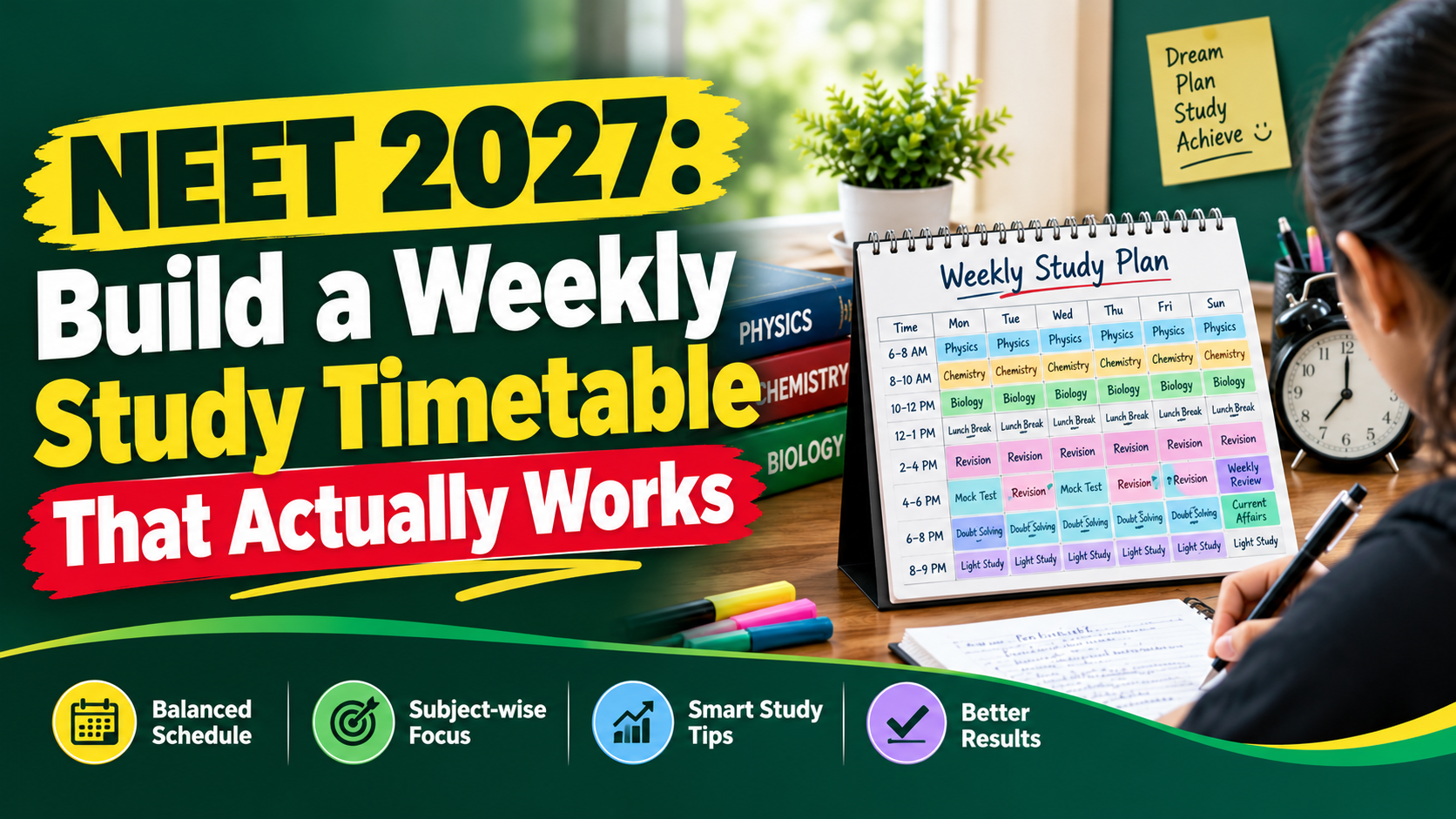
The table below suits a full-time aspirant studying around 9 to 10 effective hours. Treat it as a template. Shift the slots to match your school hours, travel time and natural energy.
|
Day |
Morning (6:00–10:00) |
Afternoon (11:00–3:00) |
Evening (4:30–8:30) |
Night (9:30–10:30) |
|
Monday |
Physics: new concept |
Biology: NCERT reading |
Chemistry: practice questions |
Quick revision of the day |
|
Tuesday |
Chemistry (Physical): new concept |
Physics: numericals |
Biology: diagram and MCQ practice |
Error-log review |
|
Wednesday |
Biology: new chapter |
Chemistry (Organic): reactions |
Physics: problem set |
Flashcards |
|
Thursday |
Physics: concept plus derivations |
Biology: revision of Mon–Wed |
Chemistry (Inorganic): NCERT lines |
Formula revision |
|
Friday |
Chemistry: mixed practice |
Biology: previous year questions |
Physics: weak-topic repair |
Short recall session |
|
Saturday |
Full-length mock test (3 hr 20 min) |
Test analysis |
Fix errors, relearn weak topics |
Light reading |
|
Sunday |
Revision of the week’s chapters |
Optional hobby, exercise or family time |
Plan the next week |
Early sleep |
Notice that Saturday is reserved for testing and analysis, and Sunday is deliberately lighter. That rhythm is intentional, and it keeps the plan sustainable.
Step 4: Make Mock Tests the Backbone of the Week
Many students treat mock tests as a final-month activity. In reality, a weekly full-length paper from early in your preparation does three useful things. It trains you to manage the 200 minutes of exam time, it exposes weak chapters with hard evidence, and it reduces exam-day anxiety through familiarity.
The test itself is only half the value. Spend at least as long reviewing it as you spent writing it. For every wrong or guessed answer, note why you missed it: a conceptual gap, a calculation slip, a misread question, or poor time management. Over several weeks, patterns will appear, and those patterns tell you exactly what to fix.
Step 5: Build a Revision Loop
Memory fades quickly without reinforcement, so revision needs its own place in the timetable instead of whatever time is left over. A simple, effective approach is spaced repetition:
-
Revise a new topic within 24 hours
-
Revise it again after about a week
-
Revise it a third time after a month
Keep a running error notebook with the questions you got wrong, the correct reasoning, and a one-line rule to avoid repeating the mistake. Reading this notebook weekly is often more productive than solving a fresh batch of questions.
Common Timetable Mistakes to Avoid
Even well-intentioned plans fail for predictable reasons.
-
Overpacking the schedule. A timetable with zero gaps collapses the first time something goes wrong. Leave a buffer of one or two hours each week for catching up.
-
Copying a topper’s routine. Someone else’s plan was built around their strengths, school, and body clock.
-
Neglecting NCERT. Biology and Chemistry questions draw heavily from NCERT, so reading it line by line, including diagrams and tables, pays off.
-
Skipping sleep. Cutting sleep to six hours or less for long stretches weakens concentration and recall. Aim for seven to eight.
-
Never reviewing the plan. Reassess every Sunday. If a block consistently fails, change it.
Protecting Your Energy and Mind
Preparation for a competitive exam is a long game, and your brain is the tool doing the work. Short breaks of five to ten minutes between blocks help sustain focus. Light exercise, a walk or stretching, improves alertness. Keep the phone away during study blocks, and use a simple checklist to record what you actually completed.
If anxiety or exhaustion builds up, talk to a teacher, parent or counsellor early. Asking for support is a sign of maturity and not of weakness.
Adjusting the Plan as NEET 2027 Approaches
Your timetable should evolve across three broad phases:
-
Foundation phase: finish the syllabus, build concepts, read NCERT thoroughly
-
Consolidation phase: shift toward practice, previous year papers and topic-wise tests
-
Final phase: emphasise full-length mocks, quick revision, and exam temperament
As the phases change, the proportion of learning blocks should shrink while practice and revision blocks grow.
Final Thoughts
An effective NEET 2027 timetable is not about the most hours or the prettiest colour-coded chart. It is about a realistic structure that you can repeat week after week, with space for learning, practice, revision, testing and rest. Start with an honest audit, split your time sensibly, protect your mock-test routine, and adjust without drama when something is not working. Consistency over several months will do far more for your score than any single heroic study day.
FAQs
1. How many hours should I study daily for NEET 2027?
Most serious aspirants study 8 to 10 focused hours daily. Quality matters more than quantity, so include breaks, revision, and enough sleep rather than chasing very long, unproductive sessions.
2. Which subject should get the most time in my weekly timetable?
Biology deserves the largest share because it carries 90 of 180 questions. However, give extra hours to whichever subject is your weakest, especially Physics if numericals feel difficult.
3. How often should I take mock tests?
Take one full-length mock test every week from early in your preparation, then increase the frequency to two per week in the final two to three months.
4. Can I follow a topper’s timetable directly?
It is better to adapt rather than copy. Your school hours, peak concentration time, and weak topics differ, so customise any borrowed routine to fit your own situation.
5. How do I stay consistent with my weekly timetable?
Keep the plan realistic, include a weekly buffer, track completed tasks daily, and review the schedule every Sunday. Small, repeatable habits beat ambitious plans you abandon quickly.

 English
 Arabic
 French
 Portuguese
 Deutsch
 Turkish
 Dutch
Dutch
 Italiano
 Russian
 Romaian
 Portuguese (Brazil)
 Greek
Greek