


Improving Tooth Accuracy in Linear Drive Systems
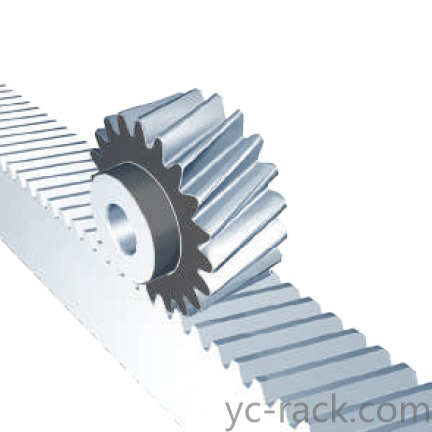
In industrial motion systems, tooth geometry and manufacturing accuracy directly influence force transfer, positioning consistency, operating noise, and long-term wear, making a well-engineered Helical Rack an important component for applications that require smooth linear movement. Zhejiang Yuchen Transmission Technology Co., Ltd. approaches rack production through coordinated material selection, tooth-profile engineering, machining, heat treatment, surface finishing, and quality inspection to support dependable integration into industrial equipment.
Material selection establishes the foundation for the component's mechanical characteristics. Carbon steel and alloy steel may be considered according to the required strength, toughness, machinability, and resistance to repeated tooth contact. Different material compositions respond differently to cutting and thermal processing, so the manufacturing route must be compatible with the selected grade. Zhejiang Yuchen Transmission Technology Co., Ltd. considers these relationships when developing transmission components intended for different mechanical environments.
Tooth geometry is another important factor in transmission design. An angled tooth arrangement creates progressive engagement between the rack and its mating pinion, allowing contact to develop gradually as the components move. This arrangement can help distribute force across the engagement area and reduce abrupt changes in contact. Its effectiveness, however, depends on accurate tooth formation, appropriate alignment, consistent spacing, and a suitable mating gear design.
The manufacturing process begins with preparing the rack blank to the required dimensions. A stable blank provides a reliable foundation for tooth generation and subsequent finishing. Depending on the design and production requirements, machining methods such as milling, shaping, and other precision cutting processes may be used. Tool condition, machine rigidity, workpiece positioning, and process stability all affect the accuracy of the finished component.
Heat treatment can improve the material's resistance to repeated mechanical contact. Processes such as carburizing, quenching, and tempering may be selected according to the material and intended working conditions. The goal is to establish an appropriate balance between surface hardness and internal toughness. Because thermal processing can introduce distortion, dimensional inspection and corrective finishing may be required to maintain the intended geometry.
Surface finishing helps refine the functional tooth surfaces. Grinding can improve profile consistency and reduce certain irregularities left by earlier manufacturing stages. A controlled surface condition supports more predictable interaction between the rack and pinion and can contribute to consistent lubrication behavior. Zhejiang Yuchen Transmission Technology Co., Ltd. considers finishing requirements alongside material characteristics and heat-treatment results to maintain consistency throughout the production sequence.
Quality inspection is essential at several stages. Tooth spacing, profile accuracy, straightness, mounting dimensions, and surface condition can influence how the rack performs after installation. Suitable measurement equipment helps verify that manufactured components meet their engineering requirements. Digital inspection systems can also record dimensional results, making it easier to identify production trends and address recurring deviations before they affect additional components.
Digital engineering connects design intent with manufacturing execution. Three-dimensional modeling allows engineers to examine tooth geometry, mounting relationships, and potential interference before production begins. Computer-aided manufacturing tools can then translate design information into production instructions. Inspection data can provide feedback for refining machining and finishing processes. This connection between design, production, and verification helps Zhejiang Yuchen Transmission Technology Co., Ltd. maintain a more integrated approach to transmission engineering.
The operating environment also influences component selection. CNC machinery, automated positioning systems, robotic equipment, packaging lines, and material-handling mechanisms may require different combinations of motion accuracy, duty cycle, and load behavior. Installation rigidity, lubrication, operating speed, environmental exposure, and pinion characteristics should all be considered when evaluating the transmission assembly. Selecting a component without considering these conditions may limit the effectiveness of otherwise precise manufacturing.
Noise and vibration deserve attention in equipment that performs frequent or high-precision movements. Irregular tooth contact, incorrect alignment, or inconsistent mounting can produce unwanted mechanical disturbances. Accurate tooth generation and suitable surface finishing help establish more consistent contact, while correct installation maintains the intended relationship between the rack and pinion. The final operating result depends on the combined accuracy of the components and the structure supporting them.
Maintenance requirements should also be incorporated into system planning. Lubrication intervals, inspection access, contamination control, and alignment checks influence how a transmission system performs over time. Even a carefully manufactured component can experience premature wear if it operates under unsuitable lubrication or mounting conditions. Coordinating manufacturing quality with practical maintenance requirements supports more predictable service behavior.
For equipment manufacturers, reliable linear motion depends on the combined effects of material properties, tooth geometry, machining accuracy, heat treatment, finishing, and installation. Zhejiang Yuchen Transmission Technology Co., Ltd. applies this integrated engineering perspective to transmission components for industrial machinery and automated systems. When these factors are properly coordinated, a Helical Rack can support smooth engagement and repeatable linear movement. Further product information is available at https://www.yc-rack.com/product/spur-gear-rack/.

 Arabic
 French
 Spanish
 Portuguese
 Deutsch
 Turkish
 Dutch
Dutch
 Italiano
 Russian
 Romaian
 Portuguese (Brazil)
 Greek
Greek