


ISI Mark Certification: Complete Guide for Indian Manufacturers
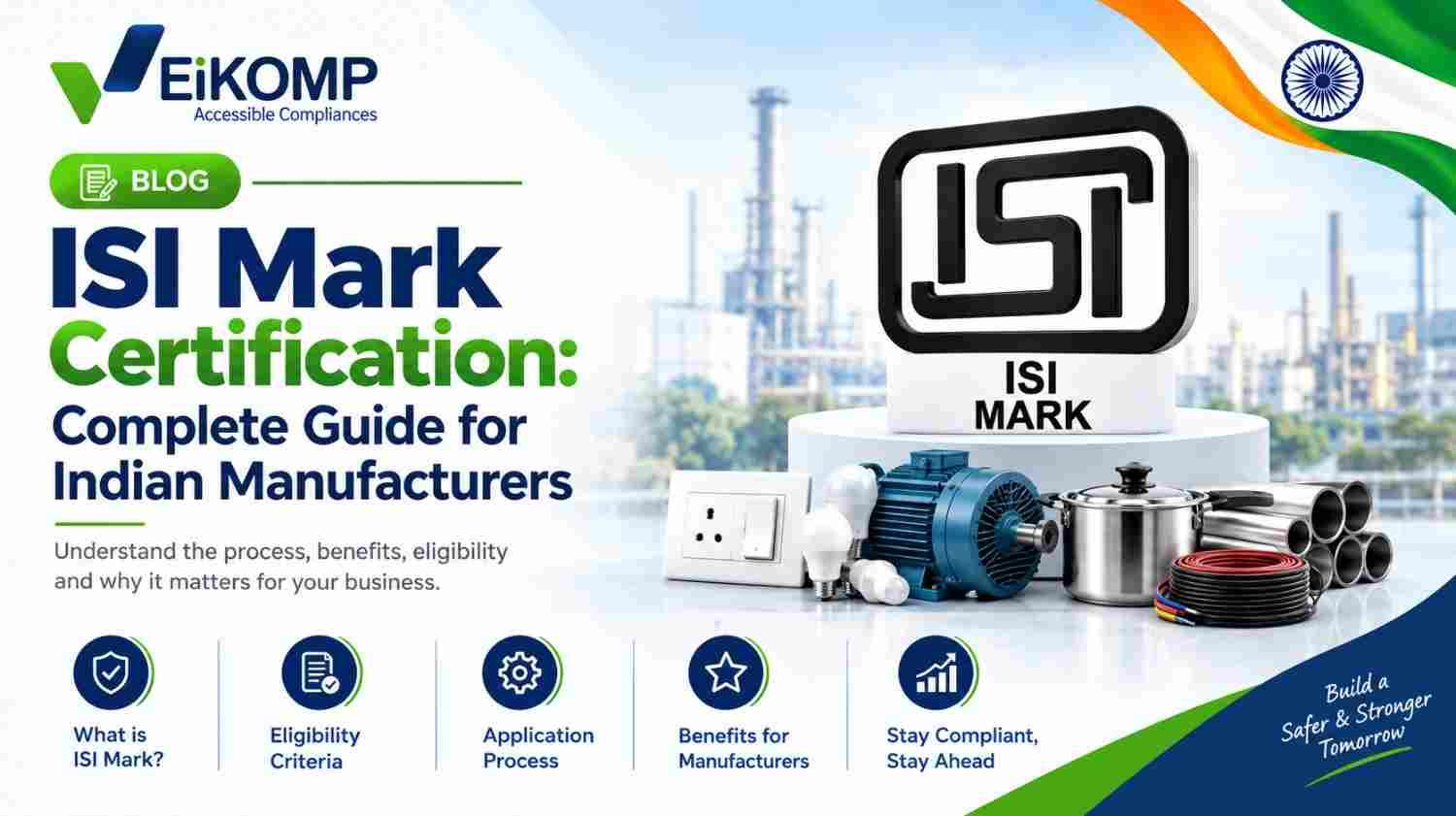
Product quality, safety, and compliance are essential for manufacturers looking to build trust in the Indian market. The Bureau of Indian Standards (BIS) is India's national standards body, responsible for developing standards and operating product certification schemes. For products covered under the applicable certification requirements, obtaining the ISI mark helps manufacturers demonstrate conformity with the relevant Indian Standard.
The ISI Mark is widely recognised by consumers as an indication that a product has been certified against a specified Indian Standard under the applicable BIS scheme. It is particularly important for products such as cement, electrical appliances, steel products, and other notified categories. However, not every product requires this certification, so manufacturers must first check the applicable standard and current regulatory requirements.
Understanding the ISI Mark Certification process enables businesses to plan product testing, documentation, factory inspections, and licensing more effectively. For manufacturers aiming to enter or expand in India, proper compliance can help reduce regulatory risks and strengthen market credibility.
What Is an ISI Mark?
The ISI mark is a product certification mark associated with the BIS Standard Mark. It indicates that a product covered by a valid licence conforms to the relevant Indian Standard, subject to the applicable certification scheme and licence conditions.
The certification process generally involves evaluating product samples, assessing manufacturing facilities, and verifying the manufacturer's quality control arrangements. BIS grants a licence only when the applicable requirements are fulfilled.
Manufacturers should understand that the ISI mark is not simply a quality logo that can be printed on packaging at their discretion. Its use is governed by BIS licensing conditions. Using the mark without valid authorisation can lead to legal and regulatory consequences.
For businesses, obtaining the appropriate certification is therefore both a compliance responsibility and a way to demonstrate that their products meet established technical requirements.
Why Is ISI Mark Certification Important?
-
Improved customer confidence: The certification provides assurance that the product has been assessed against the relevant Indian Standard.
-
Regulatory compliance: For products covered by mandatory Quality Control Orders (QCOs), the required BIS licence must be obtained before the applicable restrictions take effect.
-
Better market acceptance: Certified products may be preferred by institutional buyers, distributors, and customers who prioritise compliance.
-
Quality control: The certification process encourages manufacturers to maintain consistent production practices and suitable testing facilities.
-
Business growth: Demonstrating compliance can help manufacturers strengthen their reputation and build long-term business relationships.
BIS certification is generally voluntary unless made compulsory by the government for a particular product category. Manufacturers should verify the latest applicable requirements before selling their products.
BIS ISI Mark Certification for Indian Manufacturer
BIS ISI Mark Certification for Indian Manufacturer is the process through which an Indian manufacturing unit obtains a BIS licence to use the Standard Mark on products that comply with the relevant Indian Standard.
The licence is granted after BIS evaluates the manufacturer's production capabilities, quality control procedures, testing arrangements, and product conformity. The exact requirements depend on the product category and the applicable certification scheme.
Indian manufacturers should first identify the correct Indian Standard (IS) for their products. They must also confirm whether certification is mandatory under a relevant QCO or whether they can apply voluntarily.
The manufacturer should have suitable production machinery, trained personnel, quality control arrangements, and the testing facilities required under the applicable product guidelines. A licence is linked to the approved product scope and manufacturing premises, so separate applications may be required for different products, standards, or factory locations.
Documents Required for ISI Mark Certification
The documents required can vary depending on the product and the applicable BIS guidelines. Commonly required documents include:
-
Business registration documents and manufacturing unit details
-
Identity and address proof of the authorised signatory
-
Factory layout and manufacturing process details
-
List of machinery and testing equipment
-
Quality control and testing personnel details
-
Product specifications and technical information
-
Test reports, where applicable
-
Details of raw materials and suppliers, where required
-
Documents related to the applicable Indian Standard
Applicants should check the product-specific guidelines and current application requirements before submitting their documents. Incomplete information or inadequate testing arrangements may delay the assessment.
Step-by-Step ISI Mark Certification Process
The ISI Mark Certification process generally involves the following stages:
Step 1: Identify the applicable Indian Standard. Determine the relevant IS number and confirm the product's certification requirements.
Step 2: Prepare the manufacturing facility. Ensure that production equipment, quality control procedures, and testing capabilities meet the applicable requirements.
Step 3: Submit the online application. Apply through the official BIS portal, Manakonline, and provide the required documents and fees.
Step 4: Factory assessment. BIS evaluates the manufacturing unit, production process, and quality control arrangements as required by the applicable procedure.
Step 5: Product testing. Samples are tested through the prescribed testing arrangements to establish conformity with the relevant Indian Standard.
Step 6: Licence grant. BIS reviews the assessment and test results before deciding whether to grant the licence.
Step 7: Maintain compliance. After approval, the manufacturer must follow licence conditions, marking requirements, and applicable surveillance procedures.
The applicable route and processing time may differ according to the product, testing requirements, and completeness of the application.
Role of a BIS ISI Mark Consultant
A BIS ISI Mark Consultant helps manufacturers understand the certification requirements and manage the application process. Professional assistance can be useful for businesses that are unfamiliar with Indian Standards, product testing procedures, factory inspections, or online application requirements.
A consultant may assist with identifying the relevant standard, preparing documentation, reviewing factory readiness, coordinating testing, responding to technical queries, and tracking application progress.
However, manufacturers should select a consultant based on relevant experience, technical knowledge, and transparency. A consultant cannot guarantee certification or replace the official assessment conducted by BIS. The final decision to grant a licence rests with BIS.
Working with an experienced consultant can help manufacturers identify documentation gaps early and organise the process more efficiently.
Conclusion
The ISI mark plays an important role in demonstrating product conformity and supporting regulatory compliance in India. Manufacturers should identify the correct Indian Standard, assess their factory's readiness, prepare the necessary documentation, and complete the prescribed testing and assessment procedures.
Whether certification is mandatory or voluntary depends on the product and applicable regulations. By understanding the requirements and maintaining consistent quality controls, businesses can approach certification with greater confidence and build trust in their products.
For the latest product-specific requirements, manufacturers should consult the official BIS Product Certification Process and Products Under Compulsory Certification pages.

 English
 French
 Spanish
 Portuguese
 Deutsch
 Turkish
 Dutch
Dutch
 Italiano
 Russian
 Romaian
 Portuguese (Brazil)
 Greek
Greek