


BIS Certification for Power Inverters: Complete Guide for Manufacturers
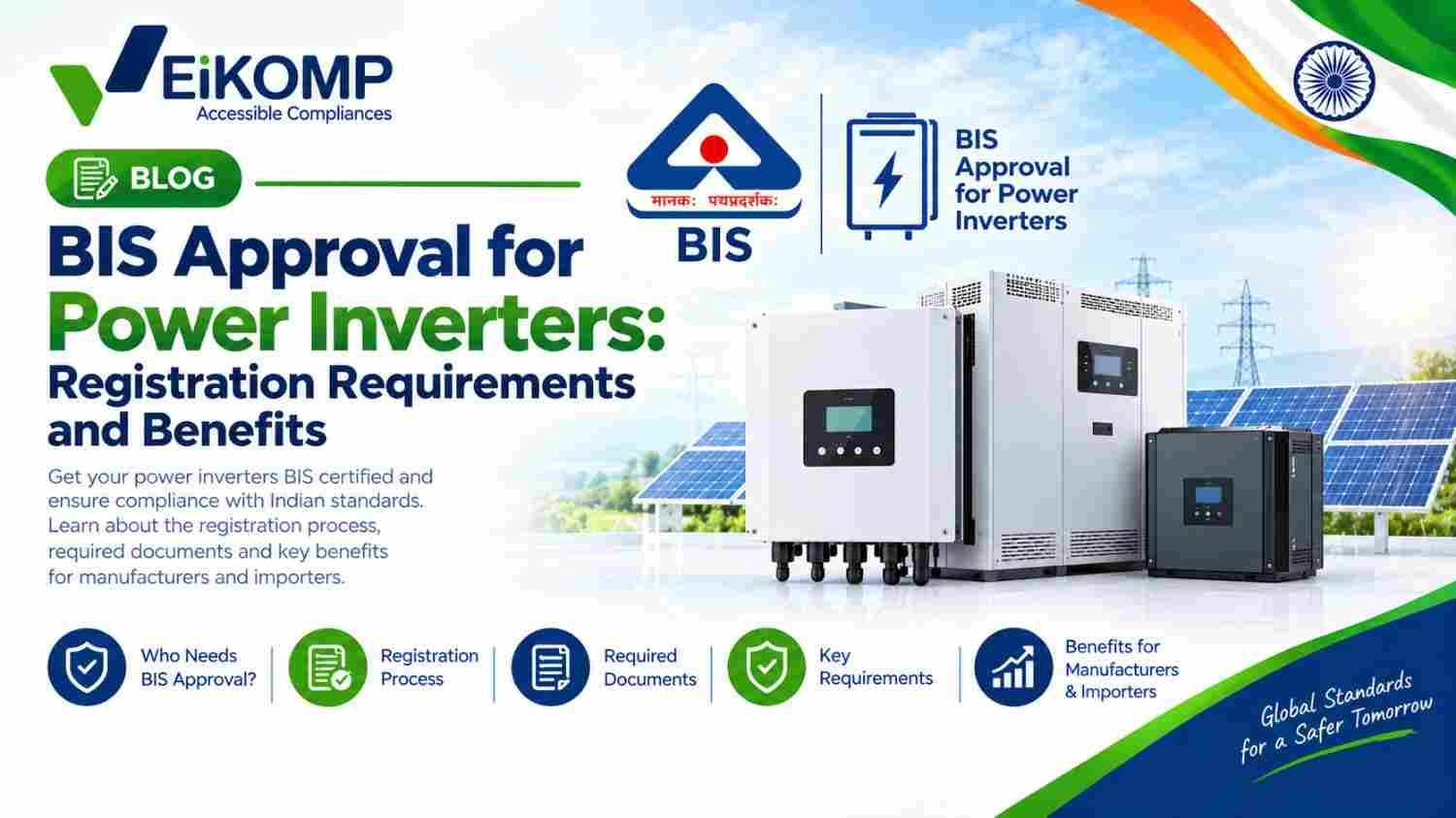
Power inverters are widely used in residential, commercial, industrial, and renewable energy applications. They convert direct current (DC) into alternating current (AC), making them essential for solar power systems, backup power solutions, and various electronic applications. To ensure product safety and compliance with Indian regulations, manufacturers and importers must determine whether their products fall under applicable Bureau of Indian Standards (BIS) requirements.
BIS Certification for Power Inverters helps businesses understand the applicable Indian Standard, product testing requirements, and certification procedure. However, the exact approval route depends on the inverter's intended use, technical specifications, and the applicable Quality Control Order (QCO) or compulsory registration requirements.
This guide explains the certification process, documentation, testing, and the role of professional consultants.
What Is BIS Certification for Power Inverters?
The Bureau of Indian Standards (BIS) is India's national standards body, responsible for developing standards and administering product certification schemes. BIS certification demonstrates that a product complies with the relevant Indian Standard when certification is applicable and granted by the authority.
For power inverters, it is important to identify the correct product category before applying. Solar inverters, UPS systems, standalone power converters, and other inverter-based equipment may fall under different standards or regulatory frameworks. Not every product described commercially as a power inverter is automatically covered by the same certification scheme.
Manufacturers and importers should verify the latest BIS notifications, applicable Indian Standards, and product-specific requirements before manufacturing for sale or importing into India.
BIS CRS Registration for Power Inverters
BIS CRS Registration for Power Inverters is a commonly searched term for compliance with the Compulsory Registration Scheme (CRS). Under this scheme, notified electronic and IT products must meet the applicable Indian Standard and obtain registration before being placed on the Indian market, subject to the relevant rules and exemptions.
However, businesses should not assume that every power inverter requires CRS registration. The product's classification and the currently notified product list must be checked to establish whether CRS applies or whether another BIS certification scheme or regulatory requirement is relevant.
The registration process generally involves the following steps:
-
Product identification: Determine the product type, intended application, model variants, and relevant technical specifications.
-
Applicable standard verification: Identify the Indian Standard and regulatory notification applicable to the specific inverter.
-
Laboratory testing: Arrange testing through a BIS-recognised or otherwise appropriately authorised laboratory, as required under the applicable scheme.
-
Document preparation: Compile the prescribed application documents, product details, test reports, and manufacturing information.
-
Application submission: Submit the application through the relevant BIS procedure and pay the applicable fees.
-
BIS review: Respond to any queries or requests for clarification from the authority.
-
Approval and compliance: After approval, comply with the applicable marking, registration, validity, and ongoing regulatory requirements.
Following the correct procedure helps businesses avoid unnecessary applications, testing delays, and compliance issues.
Applicable Indian Standards for Power Inverters
Selecting the correct Indian Standard is an important part of BIS Certification for Power Inverters. The applicable standard depends on the product category and the relevant regulatory order.
Some important standards and categories include:
-
IS 16221 (Part 2):2015: Safety requirements for inverters used in photovoltaic power systems.
-
IS 16169: Requirements relating to islanding prevention measures for utility-interconnected photovoltaic inverters, subject to the applicable edition and regulatory requirements.
-
IS 16242 (Part 1): Safety requirements for UPS systems and certain inverter products covered under the relevant CRS category, subject to the applicable edition and product scope.
The applicable standards and editions should be verified against the latest BIS and Ministry of New and Renewable Energy (MNRE) notifications. The revised Solar Systems, Devices and Components Goods Order, 2025, also introduced updated requirements for specified solar PV products, including inverters.
Documents Required for BIS Registration
Before starting BIS CRS Registration for Power Inverters, manufacturers should prepare the documents required under the applicable certification scheme. Requirements may vary depending on the product category and whether the applicant is an Indian or foreign manufacturer.
Commonly required documents and information include:
-
Manufacturer's name, address, and factory details.
-
Business registration documents, as applicable.
-
Product specifications and technical datasheets.
-
Circuit diagrams, block diagrams, and product photographs.
-
User manuals and product labels.
-
Brand name and model or model-family details.
-
Test reports from the prescribed laboratory.
-
Authorisation documents, where applicable.
-
Required declarations and application forms.
-
Details of the authorised Indian representative, where applicable to a foreign manufacturer.
Applicants should confirm the current checklist before submitting their application. Incomplete documentation, inconsistencies in model details, or incorrect product classification can delay the process.
Why Hire a BIS CRS Consultant for Power Inverters?
Working with a BIS CRS Consultant for Power Inverters can help manufacturers and importers understand the regulatory requirements before investing in testing and application preparation. Professional guidance is particularly useful for businesses handling multiple models, imported products, or solar power equipment.
A consultant may assist with:
-
Identifying the relevant certification scheme and Indian Standard.
-
Reviewing product specifications and regulatory applicability.
-
Coordinating laboratory testing and documentation.
-
Preparing application information and supporting records.
-
Checking model details, labels, and technical documents.
-
Responding to procedural queries and tracking application progress.
A consultant can help reduce avoidable errors, but cannot guarantee approval or replace the authority's assessment. Final registration or certification is granted by BIS when the applicable requirements are satisfied.
Role of a BIS Consultant for Power Inverters
A BIS Consultant for Power Inverters can support businesses throughout the compliance process, from the initial applicability assessment to post-approval obligations.
The first step is to establish whether the product falls under CRS, another BIS certification scheme, or a separate regulatory order. This distinction is important because the application route, testing requirements, and approval conditions may differ.
After determining the applicable route, the consultant can help organise technical documents, coordinate required testing, prepare the application, and address queries raised during review. For foreign manufacturers, additional assistance may be required to coordinate communication between the overseas factory and the relevant Indian representative.
Businesses should choose a consultant with relevant product-compliance experience and verify the latest requirements directly through official BIS resources. The official BIS product certification portal provides information on products covered by compulsory certification and the applicable schemes.
Benefits of BIS Compliance for Power Inverters
Obtaining the required approval offers several practical benefits for businesses:
-
Regulatory compliance: Helps meet applicable mandatory certification or registration requirements.
-
Product safety: Supports conformity with relevant safety standards.
-
Market access: Helps businesses meet regulatory conditions for selling covered products in India.
-
Customer confidence: Demonstrates that applicable conformity requirements have been addressed.
-
Better documentation: Establishes a clearer compliance record for manufacturing, importing, and distribution activities.
Businesses should also monitor changes to applicable standards, QCOs, marking requirements, and registration conditions to maintain ongoing compliance.
Conclusion
BIS Certification for Power Inverters is an important compliance consideration for manufacturers, importers, and solar energy businesses operating in India. The correct procedure depends on the inverter's application, capacity, technical specifications, and applicable regulatory requirements.
Before applying for BIS CRS for Power Inverters, businesses should verify the relevant Indian Standard, testing requirements, and current regulatory classification. Working with an experienced BIS CRS Consultant for Power Inverters or BIS Consultant for Power Inverters can simplify documentation, testing coordination, and application management.
The most effective approach is to confirm applicability through official BIS and MNRE notifications before beginning the certification process.

 English
 French
 Spanish
 Portuguese
 Deutsch
 Turkish
 Dutch
Dutch
 Italiano
 Russian
 Romaian
 Portuguese (Brazil)
 Greek
Greek