


FMI Study Finds Packaged Bread Market on Track for USD 4.7 Billion Valuation by 2036
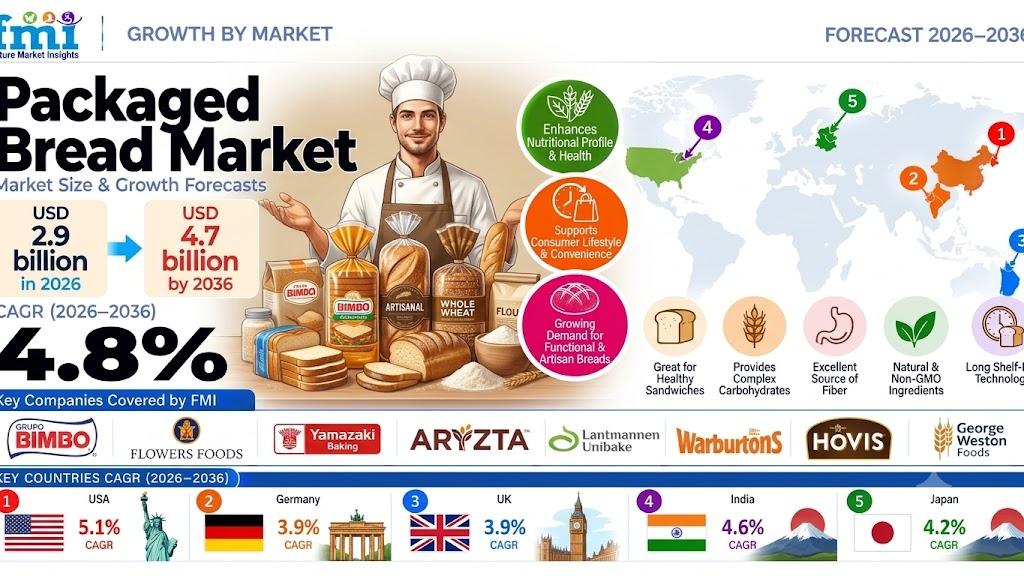
NEWARK, Del., October 21, 2026 — The global Packaged Bread Market is gaining momentum as consumers increasingly prioritize convenient bakery products, longer-lasting packaged formats, and versatile bread options for everyday meals. According to the latest market intelligence report published by Future Market Insights (FMI), the market is valued at USD 2.9 billion in 2026 and is projected to reach USD 4.7 billion by 2036. The industry is anticipated to expand at a compound annual growth rate (CAGR) of 4.8% over the forecast period. Growth is supported by changing consumption patterns, expanding organized retail distribution, increasing demand for specialty bread varieties, and the growing popularity of whole-grain, organic, and clean-label bakery products.
Packaged Bread Market Key Market Takeaways
- Market Valuation: USD 2.9 billion in 2026, rising to USD 4.7 billion by 2036.
- Growth Rate: Expanding at a 4.8% CAGR from 2026 to 2036.
- Leading Product Segment: Sandwich bread is projected to account for 38.0% of the product segment in 2026.
- Leading Nature Segment: Conventional packaged bread is projected to account for 86.0% of the nature segment in 2026.
- Leading Distribution Channel: Supermarkets and hypermarkets are expected to account for 49.0% of distribution in 2026.
- Leading Application: Bakery products are projected to account for 51.0% of the application segment in 2026.
- Fastest-Growing Country: South Korea is projected to record the highest growth among the profiled country markets, at a 5.2% CAGR.
- Other High-Growth Markets: The United States is forecast to expand at a 5.0% CAGR, followed by the European Union at 4.9%, the United Kingdom at 4.6%, and Japan at 4.4%.
- Core Growth Driver: Increasing demand for convenient everyday bakery products, premium bread varieties, organized retail distribution, and specialty packaged bread formats.
👉 Get Detailed Market Forecasts, Competitive Benchmarking & Industry Insights: Request a Sample Report: https://www.futuremarketinsights.com/reports/sample/rep-gb-14408
Industry Shifts & Market Dynamics
The packaged bread market is evolving as consumers increasingly seek bakery products that combine convenience, consistent quality, and versatility. Packaged bread serves a wide range of consumption occasions, including breakfast, sandwiches, snacks, and meal accompaniments. Its availability through supermarkets, convenience stores, specialty retailers, and online channels supports regular purchasing by households and foodservice operators.
Convenience remains a fundamental demand driver. Pre-sliced bread, packaged rolls, buns, tortillas, pitas, wraps, and frozen bread products provide consumers with practical options for preparing meals without requiring daily purchases from traditional bakeries. Standardized portions and protective packaging also support distribution through modern retail networks.
Product differentiation is becoming increasingly important as manufacturers seek to balance affordability with premiumization. Sandwich bread is projected to account for 38.0% of the product segment in 2026, reflecting its established role in household consumption, school lunches, and commercial sandwich preparation. White bread, whole-wheat bread, multigrain varieties, and specialty seed-topped products allow manufacturers to serve consumers with different taste preferences and nutritional priorities.
Tortillas, pitas, and wraps are creating additional opportunities as consumers explore convenient meal formats and international cuisines. Their versatility across home cooking, foodservice menus, and ready-to-eat meals supports demand beyond conventional sliced bread. Manufacturers are also exploring specialty formulations and packaging formats to improve convenience and product differentiation.
The conventional segment is projected to account for 86.0% of the nature segment in 2026. Conventional packaged bread continues to benefit from established purchasing habits, broad availability, and price accessibility. At the same time, organic and clean-label products provide opportunities for manufacturers targeting consumers willing to pay more for specific ingredient, sourcing, and production attributes.
Distribution efficiency remains a critical factor in market development. Supermarkets and hypermarkets are expected to account for 49.0% of distribution in 2026, reflecting their importance in routine grocery shopping. Their established supply networks and retail shelf space provide manufacturers with opportunities to expand brand visibility and introduce new product varieties.
Packaging also influences purchasing decisions and product performance. Plastic packaging is widely used because it can help protect bread against moisture loss and contamination while maintaining product visibility. However, growing attention to packaging waste and sustainability is encouraging manufacturers and retailers to evaluate recyclable materials and alternative packaging formats where product protection and shelf-life requirements can be maintained.
Competition across the market depends on manufacturing scale, distribution reach, product freshness, brand recognition, and the ability to meet changing consumer preferences. Manufacturers that combine efficient production with differentiated product portfolios and dependable retail relationships are positioned to strengthen their market presence.
Key Players Influencing the Packaged Bread Market
Grupo Bimbo S.A.B. de C.V., Flowers Foods, Inc., Aryzta AG, Mondelez International, Inc., and Campbell Soup Company through its Pepperidge Farm business are among the major companies identified in the packaged bread market landscape.
Other companies and brands participating in the broader market include The Rustik Oven, Mestemacher, Brace's Bakery, Silver Hills Bakery, and Simple Mills.
These companies compete through different strategies, including large-scale manufacturing, established retail distribution, branded product portfolios, specialty bread offerings, and foodservice supply.
Grupo Bimbo benefits from its broad international manufacturing and distribution network, with products spanning packaged bread, rolls, tortillas, and other baked goods. Flowers Foods competes through established U.S. brands serving conventional and premium bread categories. Aryzta AG participates in retail and foodservice bakery markets, including packaged and frozen bakery products.
Competitive differentiation depends on product quality, freshness management, production efficiency, pricing, packaging performance, and the ability to maintain reliable supply across distribution networks.
Retail-focused manufacturers must address shelf-life requirements, consumer preferences, promotional pricing, and product availability. Suppliers serving foodservice customers must also maintain consistent specifications and dependable delivery schedules.
As the industry develops, manufacturers that balance production scale with clean-label formulations, premium product development, and multichannel distribution are positioned to capture opportunities across the global packaged bread market.
Recent Developments in the Packaged Bread Market
- Premium Bread Innovation: Manufacturers are expanding whole-grain, seeded, multigrain, and specialty bread offerings to address demand for differentiated bakery products.
- Expansion of Convenience Formats: Packaged rolls, buns, tortillas, pitas, and wraps are creating opportunities for manufacturers to serve quick meals, on-the-go consumption, and foodservice applications.
- Retail Distribution Development: Supermarkets, hypermarkets, and convenience stores continue to provide important routes to market for packaged bread brands.
- Packaging and Sustainability Initiatives: Greater attention to packaging waste and material efficiency is encouraging manufacturers to evaluate recyclable and alternative packaging solutions.
- Product Quality Improvements: Improvements in production controls, packaging performance, and freshness management are helping manufacturers address retail and foodservice requirements.
- Premium and Better-for-You Offerings: Organic, whole-grain, and clean-label bread varieties are creating opportunities for companies targeting consumers seeking specific ingredient and nutritional attributes.
FMI's competitive analysis also identifies recent company activity, including ARYZTA's bakery expansion in Perth in August 2026, its acquisition of a French distribution business in June 2026, and Flowers Foods' product initiatives in May 2026. These developments illustrate the importance of regional production capacity, distribution access, and product innovation in the packaged bread industry. Company-specific details should be verified against original announcements before publication.
For detailed Packaged Bread Market analysis covering market size, forecasts, product categories, nature, applications, distribution channels, packaging, regional opportunities, and competitive developments, visit the FMI Official Report: https://www.futuremarketinsights.com/reports/packaged-bread-market
Regional Market Summary
According to Future Market Insights, South Korea is projected to record the fastest growth among the profiled country markets, with a CAGR of 5.2% from 2026 to 2036. Expanding convenience-store distribution, bakery café culture, and demand for convenient bakery products are creating opportunities for packaged bread manufacturers.
The United States is expected to expand at a CAGR of 5.0%, supported by established sandwich bread consumption, premiumization of specialty bakery products, and increasing demand for tortillas and wraps. The European Union is projected to register a CAGR of 4.9%, supported by established bread consumption patterns and opportunities in organic, artisanal-style, and premium packaged products.
The United Kingdom is forecast to grow at a CAGR of 4.6%, while Japan is expected to expand at 4.4%. Across these markets, established bread consumption habits provide a stable demand base, while product innovation and distribution development create opportunities for additional growth.
Regional market performance will depend on consumer purchasing patterns, retail infrastructure, product pricing, packaging requirements, and the ability of manufacturers to adapt product portfolios to local preferences.
- South Korea: The packaged bread market is projected to grow at a CAGR of 5.2% from 2026 to 2036, supported by convenience-store distribution, bakery café culture, and growing demand for convenient packaged bakery products.
- United States: The market is expected to expand at a CAGR of 5.0%, driven by established sandwich bread consumption, specialty bread premiumization, and growth in tortillas and wraps.
- European Union: The market is projected to register a CAGR of 4.9%, supported by established bread consumption, premium bakery products, and interest in organic and specialty packaged bread.
- United Kingdom: The market is forecast to grow at a CAGR of 4.6%, supported by established retail bakery distribution and continued demand for convenient packaged bread products.
- Japan: The market is expected to expand at a CAGR of 4.4%, supported by routine bread consumption, convenience-focused purchasing, and demand for differentiated bakery formats.
Analyst Insights
The packaged bread market is increasingly shaped by demand for convenient food products, established household consumption habits, and product innovation across conventional and premium bakery categories.
Sandwich bread remains the leading product segment because of its versatility across breakfast, lunch, school meals, and foodservice applications. Manufacturers can serve a broad customer base through white bread, whole-wheat bread, multigrain products, and specialty formulations.
Tortillas, pitas, and wraps offer additional growth opportunities as consumers seek flexible meal formats. These products can serve as alternatives to traditional sliced bread in sandwiches, wraps, quick meals, and foodservice menus.
Distribution remains a central competitive advantage. Supermarkets and hypermarkets provide broad consumer access, while convenience stores can support frequent purchases and demand for smaller packaged formats. Manufacturers with established retail relationships and effective inventory management can improve product availability and distribution efficiency.
Premiumization is also influencing market development. Whole-grain, seeded, organic, and clean-label products allow manufacturers to differentiate their offerings beyond price. However, companies must balance ingredient costs and production requirements against consumers' willingness to pay for premium attributes.
Packaging and freshness management remain important operational priorities. Manufacturers must protect bread quality throughout storage, transportation, and retail display while addressing changing expectations concerning packaging materials and sustainability.
Companies can strengthen their market positions by investing in manufacturing efficiency, product innovation, packaging improvements, and distribution capabilities. Expanding specialty portfolios while maintaining affordable core products may help manufacturers serve both value-conscious and premium consumer segments.
As the industry develops, suppliers that combine operational scale, product quality, competitive pricing, and effective distribution are positioned to capture emerging opportunities in the global packaged bread market.
Frequently Asked Questions
Q: What is the projected size of the packaged bread market by 2036?
A: The global packaged bread market is valued at USD 2.9 billion in 2026 and is projected to reach USD 4.7 billion by 2036, growing at a CAGR of 4.8%.
Q: Which product segment leads the packaged bread market?
A: Sandwich bread is projected to account for 38.0% of the product segment in 2026, supported by its widespread use in household meals, sandwiches, school lunches, and foodservice applications.
Q: Which nature segment holds the leading market share?
A: Conventional packaged bread is projected to account for 86.0% of the nature segment in 2026, reflecting the importance of affordability and established purchasing habits in the bread category.
Q: Which distribution channel leads the packaged bread market?
A: Supermarkets and hypermarkets are expected to account for 49.0% of distribution in 2026, supported by routine grocery shopping and established retail distribution networks.
Q: Which application leads the packaged bread market?
A: Bakery products are projected to account for 51.0% of the application segment in 2026, reflecting the use of packaged bread in sandwiches, toast, and everyday meal accompaniments.
Q: Which country exhibits the highest growth rate?
A: South Korea is projected to record the highest growth among the profiled country markets, with a CAGR of 5.2% from 2026 to 2036. The United States follows at 5.0%, while the European Union is forecast to grow at 4.9%.
Q: What factors are driving the packaged bread market?
A: Market growth is supported by demand for convenient bakery products, established bread consumption habits, expanding retail distribution, premium bread varieties, and the growing popularity of tortillas, pitas, and wraps.
Q: Who are the key players in the packaged bread market?
A: Major companies include Grupo Bimbo S.A.B. de C.V., Flowers Foods, Inc., Aryzta AG, Mondelez International, Inc., and Campbell Soup Company through Pepperidge Farm. Other market participants include Mestemacher, Silver Hills Bakery, and Simple Mills.
Q: What challenges affect the packaged bread market?
A: Key challenges include raw material price fluctuations, competitive retail pricing, production costs, freshness management, packaging requirements, and the need to maintain product quality throughout distribution.
Q: How is packaged bread used across different food applications?
A: Packaged bread is used for sandwiches, toast, breakfast meals, burgers, wraps, snacks, and foodservice preparations. Product selection depends on texture, shelf life, portion requirements, intended use, and consumer preferences.
Q: How are premiumization trends influencing the market?
A: Demand for whole-grain, multigrain, seeded, organic, and clean-label bread varieties is creating opportunities for manufacturers to differentiate products and target consumers willing to pay more for specific ingredients and product attributes.
Q: What role do supermarkets and hypermarkets play in market development?
A: Supermarkets and hypermarkets provide broad product availability, established distribution networks, and convenient access to packaged bread. They also provide manufacturers with opportunities to expand brand visibility and introduce new products.
Q: How is packaging innovation influencing the packaged bread market?
A: Packaging helps protect bread quality, maintain product freshness, and improve retail presentation. Sustainability considerations are encouraging manufacturers to evaluate recyclable materials and alternative formats while maintaining appropriate product protection and shelf life.
Related Food & Beverage Industry Reports
Refrigerated and Frozen Soup Market https://www.futuremarketinsights.com/reports/refrigerated-and-frozen-soup-market
Rice Bran Wax Market https://www.futuremarketinsights.com/reports/rice-bran-wax-market
Tempeh Market https://www.futuremarketinsights.com/reports/tempeh-market
Low pH Stable Probiotic Protection Agents for RTD Drinks Market https://www.futuremarketinsights.com/reports/low-ph-stable-probiotic-protection-agents-for-rtd-drinks-market
Salt Perception Enhancing Flavor Modulators Market https://www.futuremarketinsights.com/reports/salt-perception-enhancing-flavor-modulators-market
About Future Market Insights
Future Market Insights (FMI) is an ESOMAR-certified market research and consulting firm providing syndicated, customized, investment, and social media research across industries, including food and beverage, healthcare, chemicals, technology, and consumer products. FMI delivers market intelligence, competitive analysis, and strategic insights to help organizations evaluate emerging opportunities and make informed business decisions. The company has offices in the United States, the United Kingdom, the UAE, and India.
Media Contact
For Press & Corporate Inquiries
Rahul Singh
AVP – Marketing and Growth Strategy
Future Market Insights, Inc.
Phone: +91 8600020075
For Sales: sales@futuremarketinsights.com
For Media: Rahul.singh@futuremarketinsights.com
Website: https://www.futuremarketinsights.com/

 English
 Arabic
 Spanish
 Portuguese
 Deutsch
 Turkish
 Dutch
 Italiano
 Russian
 Romaian
 Portuguese (Brazil)
 Greek