


Forex Broker Software Development: Features, Architecture and Cost in the UAE
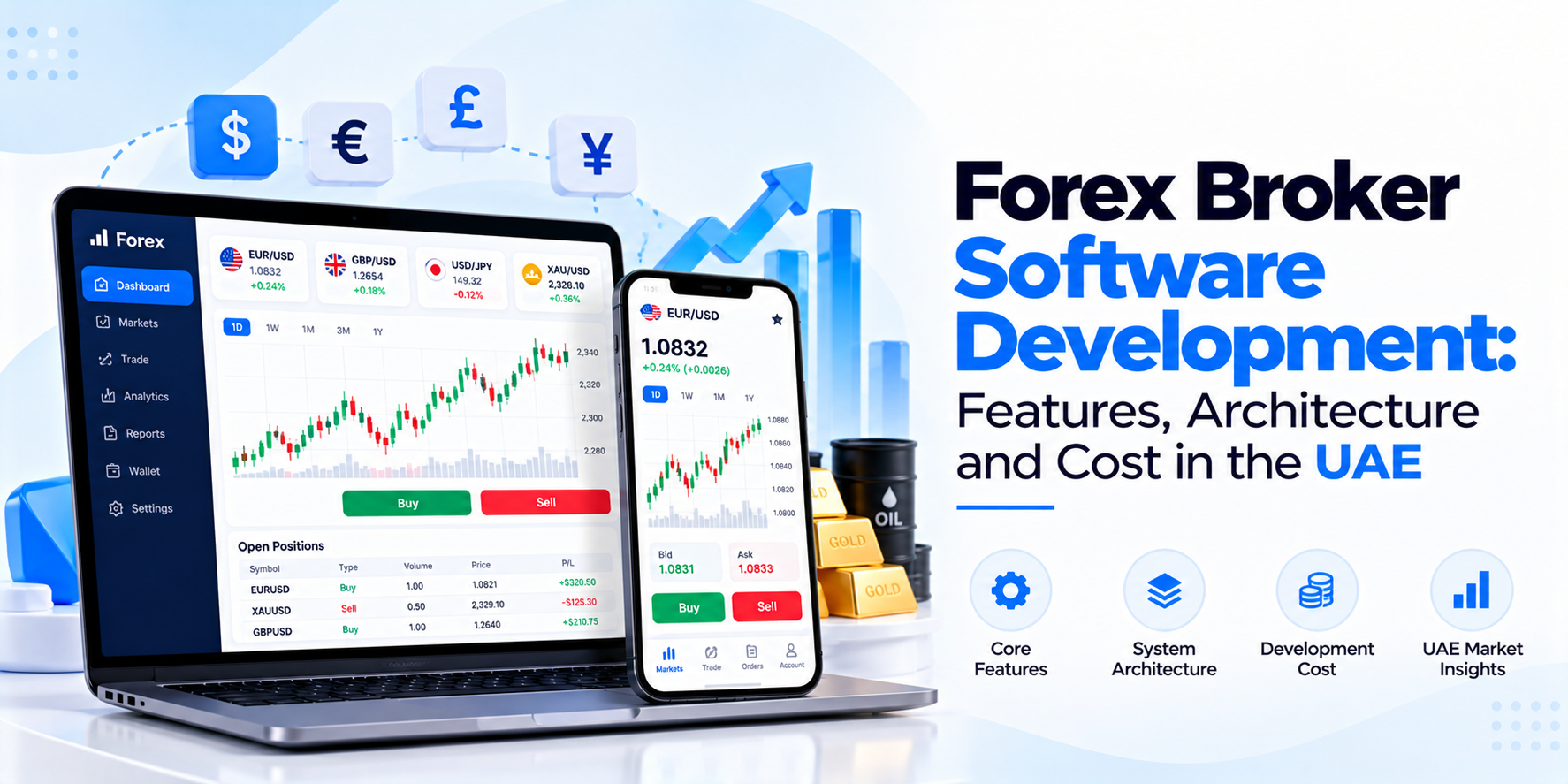
A forex brokerage runs on software. Clients need to open accounts, deposit funds, trade and withdraw, while the business needs to manage risk, monitor exposure and report to regulators. This guide explains what a forex broker platform includes, how it is structured, and what it can cost.
Figures are indicative estimates for software development only and are not quotes.
What a Forex Broker Platform Includes
A complete setup usually combines several systems:
-
Trading platform: the interface clients use to view prices and place orders. Many brokers license MetaTrader, while others build a proprietary platform.
-
Client portal: registration, KYC, deposits, withdrawals, account management and documents.
-
Back office: tools for staff to manage accounts, funding, commissions and reports.
-
CRM: lead and client management, support and marketing workflows.
-
Liquidity and bridge connections: links to liquidity providers for pricing and order execution.
-
Risk management: exposure monitoring, margin controls, limits and alerts.
-
Payment integrations: cards, bank transfers and other methods where permitted.
-
Reporting and compliance tools: audit trails, transaction records and regulatory reports.
Key Features to Plan For
Client side
-
Account registration and identity verification.
-
Multiple account types and base currencies.
-
Deposit and withdrawal workflows.
-
Trading history, statements and notifications.
-
Web and mobile access.
Broker side
-
Client and account management.
-
Configurable spreads, commissions and leverage rules where permitted.
-
Risk dashboards and exposure monitoring.
-
Role-based access and audit logs.
-
Reports for finance, risk and compliance teams.
Technical
-
Secure authentication and data encryption.
-
Reliable price feeds and order handling.
-
Monitoring, backups and disaster recovery.
Architecture Overview
A common structure includes:
-
Front end: client web portal and mobile apps.
-
Application services: accounts, payments, KYC and notifications.
-
Trading layer: the trading platform and server, or a custom matching and order system.
-
Bridge and liquidity layer: connects the trading server to liquidity providers.
-
Data layer: databases for accounts, transactions and audit records.
-
Risk and reporting layer: real-time exposure calculations and reports.
-
Infrastructure: cloud or dedicated hosting with monitoring and redundancy.
Each part adds integration work, and failures between them (such as duplicated or missing transactions) need careful handling and reconciliation.
Cost Estimates
|
Broker solution |
Estimated cost (AED) |
Typical scope |
|
Basic broker interface |
350,000–600,000 |
Client portal, account views, basic integrations |
|
Mid-level brokerage platform |
600,000–1,000,000 |
Trading workflows, reporting, multiple integrations |
|
Advanced broker infrastructure |
1,000,000–1,500,000+ |
Complex execution, risk controls, monitoring |
What Is Usually Not Included
The software estimate does not cover the full cost of launching a brokerage. Budget separately for:
-
Regulatory licensing and legal advice.
-
Capital requirements.
-
Platform licences, such as trading platform fees.
-
Liquidity provider arrangements.
-
Market data subscriptions.
-
Payment provider fees.
-
Compliance, risk and support staff.
-
Ongoing hosting and maintenance, often planned at 15% to 20% of build cost per year.
Build or License?
|
Approach |
Pros |
Cons |
|
License an existing platform and integrate |
Faster launch, proven technology |
Licence fees, less control |
|
Build a proprietary platform |
Full control and differentiation |
Higher cost and longer timeline |
|
Hybrid (license platform, custom portal and CRM) |
Balanced cost and branding |
Integration effort |
Many new brokers choose the hybrid route: a licensed trading platform with a custom client portal and back-office tools.
Timeline
A basic client portal with integrations may take around 4 to 6 months. Advanced platforms with custom execution, risk engines and multiple integrations can take 9 months or longer. Delays often come from third-party onboarding, so start vendor conversations early.
Regulation in the UAE
Forex and other financial services are regulated activities in the UAE, and the relevant regulator depends on the activity and location. Depending on the business model, this can involve authorities such as the Securities and Commodities Authority (SCA), the Dubai Financial Services Authority (DFSA) in DIFC, or the Financial Services Regulatory Authority (FSRA) in ADGM. Requirements on licensing, client money, reporting and marketing vary, so confirm them with qualified legal and compliance advisers before you build. Software development and licensing are separate workstreams.
Questions to Ask a Development Partner
-
Have you built broker back-office, CRM or portal systems before?
-
How do you handle order, balance and transaction reconciliation?
-
Which trading platforms and liquidity providers have you integrated?
-
How will risk and exposure be monitored in real time?
-
What is included in the quote, and what third-party costs are excluded?
-
Who owns the source code and documentation?
Next Steps
Before requesting quotes, define your business model, target clients, platforms, payment methods and jurisdiction. A clear scope produces comparable proposals. For a broader view of budget ranges across platform types, see this guide to trading software development cost in Dubai.
Final Thoughts
A forex broker platform is a set of connected systems, not a single app. Plan the architecture, separate software costs from licensing and operating costs, and choose a partner with real financial-market experience. A phased build keeps early spending under control.

 English
 Arabic
 French
 Spanish
 Portuguese
 Deutsch
 Turkish
 Dutch
 Italiano
 Russian
 Romaian
 Greek