


Superfood Powders Market Accelerates: USD 15.8 Billion Valuation Expected by 2036
Superfood Powders Market FMI Market Intelligence Report
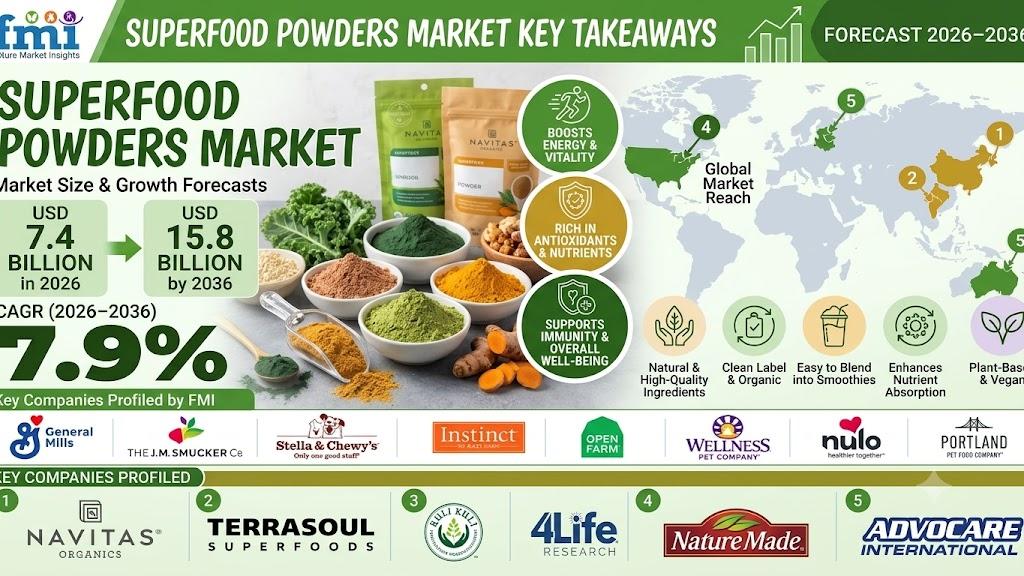
NEWARK, Del., October 22, 2026 — The global Superfood Powders Market is gaining momentum as food manufacturers, beverage companies, supplement producers, and health-focused brands increasingly incorporate concentrated plant-based ingredients into their product portfolios. According to the latest market intelligence report published by Future Market Insights (FMI), the market is valued at USD 7.4 billion in 2026 and is projected to reach USD 15.8 billion by 2036. The industry is anticipated to expand at a compound annual growth rate (CAGR) of 7.9% over the forecast period. Growth is supported by rising demand for convenient nutrition formats, increasing use of botanical ingredients in food and beverages, expanding organic product offerings, and the adoption of superfood powders in smoothies, functional drinks, and dietary supplements.
Superfood Powders Market Key Market Takeaways
- Market Valuation: USD 7.4 billion in 2026, rising to USD 15.8 billion by 2036.
- Growth Rate: Expanding at a 7.9% CAGR from 2026 to 2036.
- Leading Nature Segment: Organic products are projected to account for approximately 90.0% of the nature segment in 2026.
- Leading Product Type: Matcha and green tea powders are projected to account for approximately 30.0% of the product type segment in 2026.
- Leading Application: Drink applications are expected to represent approximately 44.0% of the application segment in 2026.
- Fastest-Growing Country: The United Kingdom is projected to record the highest growth among the profiled country markets, at a 10.0% CAGR.
- Other High-Growth Markets: Japan is forecast to expand at a 9.0% CAGR, followed by South Korea at 7.0%, Germany at 6.1%, and the United States at 6.0%.
- Core Growth Driver: Increasing demand for convenient plant-based nutrition, functional beverages, organic ingredients, and concentrated botanical powders.
👉 Get Detailed Market Forecasts, Competitive Benchmarking & Industry Insights: Request a Sample Report: https://www.futuremarketinsights.com/reports/sample/rep-gb-12334
Industry Shifts & Market Dynamics
The superfood powders market is evolving as food and beverage manufacturers increasingly seek convenient ways to incorporate plant-derived ingredients into established formulations. Superfood powders include concentrated ingredients derived from fruits, vegetables, leaves, algae, tea, mushrooms, and other botanical sources. These ingredients are used in applications ranging from smoothies and nutritional beverages to snack products, functional foods, and dietary supplements.
Powder formats offer practical advantages for manufacturers because they can be incorporated into dry-blending operations, packaged in measured portions, and distributed without the liquid-handling requirements associated with many ready-to-drink products. Their versatility supports product development across conventional food categories and specialized nutrition applications.
Organic products are projected to account for approximately 90.0% of the nature segment in 2026. Demand for organic powders is supported by consumer interest in certified ingredients and manufacturers' efforts to communicate sourcing and production attributes. Certification, ingredient traceability, and consistent documentation remain important considerations for suppliers serving food manufacturers and supplement brands.
Product-type differentiation also influences market development. Matcha and green tea powders are projected to represent approximately 30.0% of the product type segment in 2026. Their established use in beverages, bakery products, desserts, and other food applications provides manufacturers with multiple opportunities to develop new products. Ingredient grade, color, flavor, origin, and dispersibility can influence purchasing decisions and formulation suitability.
Drink applications are expected to account for approximately 44.0% of the application segment in 2026. Superfood powders can be incorporated into smoothies, powdered beverage mixes, nutritional drinks, and other drink formats. Manufacturers are evaluating these ingredients for product differentiation, convenience, and their compatibility with existing beverage-processing and packaging systems.
Other product categories, including berries, spirulina, chlorella, moringa, ashwagandha, wheatgrass, maca, and mushroom-based powders, contribute to the diversity of the market. These ingredients serve different formulation requirements and can be marketed as individual powders or incorporated into multi-ingredient blends.
Despite these opportunities, the industry faces challenges related to raw material variability, ingredient sourcing, quality assurance, contamination controls, certification requirements, and product formulation. Differences in flavor, color, moisture content, and processing characteristics can affect finished-product consistency. Suppliers must also maintain reliable documentation when ingredient sources or processing locations change.
Companies that invest in dependable sourcing, standardized processing, quality testing, and product development are positioned to strengthen their market presence. As manufacturers expand their functional food and beverage portfolios, consistent ingredient performance and supply reliability are likely to remain important competitive factors.
Key Players Influencing the Superfood Powders Market
Navitas Organics, Terrasoul Superfoods, Kuli Kuli Foods, 4Life Research, Nature Made (Pharmavite), and AdvoCare International are among the companies identified in the superfood powders market landscape.
These companies participate in different parts of the broader superfood and nutritional supplement ecosystem. Their offerings span botanical powders, greens blends, drink mixes, and other powdered nutrition products.
Competitive differentiation depends on ingredient quality, product variety, sourcing transparency, processing capabilities, distribution reach, and the ability to meet the requirements of retail and commercial customers. Suppliers serving manufacturers and supplement brands must address formulation consistency, ingredient specifications, and dependable replenishment.
Product developers and ingredient suppliers also need to respond to differences in consumer preferences, application requirements, and regional regulations. Organic certification, traceability, ingredient identity, and appropriate product labeling can influence supplier qualification and purchasing decisions.
As the industry develops, companies that combine reliable sourcing with consistent quality, differentiated formulations, and efficient distribution may be better positioned to address opportunities across food, beverage, and supplement applications.
Recent Developments in the Superfood Powders Market
- Product Portfolio Expansion: Manufacturers are introducing additional powdered greens, botanical blends, and functional drink mixes to serve changing nutrition preferences.
- Organic Ingredient Demand: Continued interest in organic products is increasing the importance of certification, traceability, and transparent sourcing practices.
- Beverage Application Growth: Superfood powders are being incorporated into smoothies, powdered drinks, and other beverage formulations that support convenient preparation.
- Retail Distribution Expansion: Brands are pursuing broader retail and e-commerce availability to reach consumers seeking plant-based nutrition products.
- Processing and Quality Improvements: Improvements in ingredient handling, drying, milling, packaging, and quality-control procedures can support more consistent powder performance.
- Botanical Product Innovation: Interest in matcha, green tea, berries, moringa, algae, and other plant-derived ingredients is creating opportunities for differentiated formulations.
These developments reflect broader trends in functional nutrition, botanical ingredients, product innovation, and the expansion of powdered food and beverage formats. Specific commercial announcements should be evaluated against the relevant company's official communications.
For detailed Superfood Powders Market analysis covering market size, forecasts, nature, product types, applications, regional opportunities, and competitive developments, visit the FMI report: https://www.futuremarketinsights.com/reports/superfood-powders-market
Regional Market Summary
According to Future Market Insights, the United Kingdom is projected to record the fastest growth among the profiled country markets, with a CAGR of 10.0% from 2026 to 2036. Demand is supported by opportunities in organic food retail, functional nutrition, and the use of botanical ingredients in food, beverage, and supplement formulations.
Japan is projected to expand at a CAGR of 9.0%, supported by established demand for powdered tea, particularly matcha, and its applications in beverages and foods. South Korea is expected to register a CAGR of 7.0%, reflecting opportunities in functional nutrition and health-oriented product development.
Germany is forecast to grow at a CAGR of 6.1%, while the United States is expected to expand at 6.0%. In these markets, demand is influenced by product innovation, organic ingredient availability, established supplement distribution, and the use of powdered botanicals in food and beverage formulations.
Across international markets, adoption will depend on ingredient availability, sourcing costs, regulatory requirements, product quality, consumer preferences, and the ability of manufacturers to develop commercially viable formulations.
- United Kingdom: The superfood powders market is projected to grow at a CAGR of 10.0% from 2026 to 2036, supported by organic retail demand and opportunities for botanical ingredients in food and nutrition products.
- Japan: The market is expected to expand at a CAGR of 9.0%, driven by established matcha consumption, powdered tea applications, and interest in premium botanical ingredients.
- South Korea: The market is projected to register a CAGR of 7.0%, supported by functional nutrition, product innovation, and demand for convenient powdered formulations.
- Germany: The market is forecast to grow at a CAGR of 6.1%, supported by organic ingredient demand and opportunities across food, beverage, and supplement applications.
- United States: The market is expected to expand at a CAGR of 6.0%, supported by established supplement distribution, functional beverage development, and demand for plant-derived ingredients.
- China: The market presents opportunities associated with expanding food and beverage applications, botanical ingredient use, and interest in convenient nutrition formats.
- India: The market offers opportunities linked to botanical ingredient availability, growing food-processing capabilities, and the development of functional beverage and nutrition products.
- Other European Markets: Opportunities are associated with organic product development, botanical sourcing, and the integration of superfood powders into food, beverage, and supplement portfolios.
Analyst Insights
The superfood powders market is increasingly shaped by demand for convenient nutrition, botanical ingredients, and versatile formats that can be incorporated into established food and beverage production systems. Powdered ingredients provide manufacturers with opportunities to develop new product variations while maintaining familiar blending, portioning, and packaging processes.
Organic products remain an important segment because certification and sourcing documentation can help buyers assess ingredient claims. At the same time, matcha and green tea powders are expected to retain a significant position within the product-type category, supported by their established use in beverages and foods.
Drink applications are expected to remain a major source of demand as manufacturers develop powdered beverage mixes, smoothies, and other functional drink products. However, commercial success depends on factors such as flavor, solubility, ingredient consistency, raw material costs, and compliance with applicable product requirements.
Regional investment and demand patterns also indicate opportunities for suppliers. The United Kingdom and Japan are projected to record comparatively strong growth among the profiled markets, while the United States and Germany offer opportunities across established food, beverage, and supplement distribution channels.
Manufacturers and ingredient suppliers can strengthen their market positions by improving sourcing reliability, maintaining appropriate quality documentation, developing differentiated ingredient blends, and supporting consistent product performance. Partnerships with food processors, beverage manufacturers, and supplement brands may also help suppliers expand their commercial reach.
As the industry develops, companies that balance ingredient quality, product innovation, regulatory compliance, and supply reliability are positioned to capture emerging opportunities in the global superfood powders market.
Frequently Asked Questions
Q: What is the projected size of the superfood powders market by 2036?
A: The global superfood powders market is projected to reach USD 15.8 billion by 2036, increasing from USD 7.4 billion in 2026 and expanding at a CAGR of 7.9% over the forecast period.
Q: Which nature segment leads the superfood powders market?
A: Organic products are projected to account for approximately 90.0% of the nature segment in 2026, supported by demand for certified ingredients and traceable sourcing.
Q: Which product type holds the leading market share?
A: Matcha and green tea powders are projected to represent approximately 30.0% of the product type segment in 2026, supported by their established applications in beverages and foods.
Q: Which application leads the superfood powders market?
A: Drink applications are expected to account for approximately 44.0% of the application segment in 2026, reflecting the use of superfood powders in smoothies, powdered beverages, and other drink formulations.
Q: Which country exhibits the highest growth rate?
A: The United Kingdom is projected to record the highest growth among the profiled country markets, with a CAGR of 10.0% from 2026 to 2036.
Q: What factors are driving the superfood powders market?
A: Market growth is supported by demand for convenient nutrition formats, increased use of botanical ingredients, organic product development, functional beverage innovation, and the integration of superfood powders into food and supplement formulations.
Q: Who are the key players in the superfood powders market?
A: Notable companies identified in the market landscape include Navitas Organics, Terrasoul Superfoods, Kuli Kuli Foods, 4Life Research, Nature Made (Pharmavite), and AdvoCare International.
Q: What challenges affect the superfood powders market?
A: Key challenges include raw material variability, sourcing costs, quality assurance, contamination controls, certification requirements, product formulation, and the need for consistent flavor, color, and ingredient performance.
Q: How are superfood powders used in food and beverage production?
A: Superfood powders are incorporated into smoothies, powdered drinks, nutritional beverages, bakery products, functional foods, and other formulations. They can be used individually or combined with other ingredients to develop differentiated products.
Q: How does organic certification influence the superfood powders market?
A: Organic certification helps buyers evaluate sourcing and production claims. Consistent certification records and ingredient traceability can support supplier qualification and help manufacturers maintain documentation when sourcing or processing arrangements change.
Q: What role does matcha play in market development?
A: Matcha and green tea powders serve established beverage and food applications, including tea drinks, smoothies, bakery products, and desserts. Their flavor, color, origin, and grade influence their suitability for different formulations.
Q: What role do drink applications play in market growth?
A: Drink applications provide an important route for superfood powders through smoothies, powdered beverage mixes, and functional drinks. Manufacturers can incorporate these ingredients into convenient products, subject to formulation, quality, and labeling requirements.
Related Food & Beverage Industry Reports
Probiotic Ingredients Market https://www.futuremarketinsights.com/reports/probiotic-ingredients-market
Food Flavors Market https://www.futuremarketinsights.com/reports/food-flavors-market
Collagen Hydrolysates Market https://www.futuremarketinsights.com/reports/collagen-hydrolysates-market
Food Stabilizers Market https://www.futuremarketinsights.com/reports/food-stabilizers-market
Food Starch Market https://www.futuremarketinsights.com/reports/food-starch-market
About Future Market Insights
Future Market Insights (FMI) is an ESOMAR-certified market research and consulting firm providing syndicated, customized, investment, and social media research across industries, including food and beverage, healthcare, chemicals, technology, and consumer products. FMI delivers market intelligence, competitive analysis, and strategic insights to help organizations evaluate emerging opportunities and make informed business decisions. The company has offices in the United States, the United Kingdom, the UAE, and India.
Media Contact
For Press & Corporate Inquiries
Rahul Singh
AVP – Marketing and Growth Strategy
Future Market Insights, Inc.
Phone: +91 8600020075
For Sales: sales@futuremarketinsights.com
For Media: Rahul.singh@futuremarketinsights.com
Website: https://www.futuremarketinsights.com/

 English
 Arabic
 Spanish
 Portuguese
 Deutsch
 Turkish
 Dutch
 Italiano
 Russian
 Romaian
 Portuguese (Brazil)
 Greek