


Prosthetics and Orthotics Market Outlook Focuses on Digital Manufacturing and Patient-Specific Designs
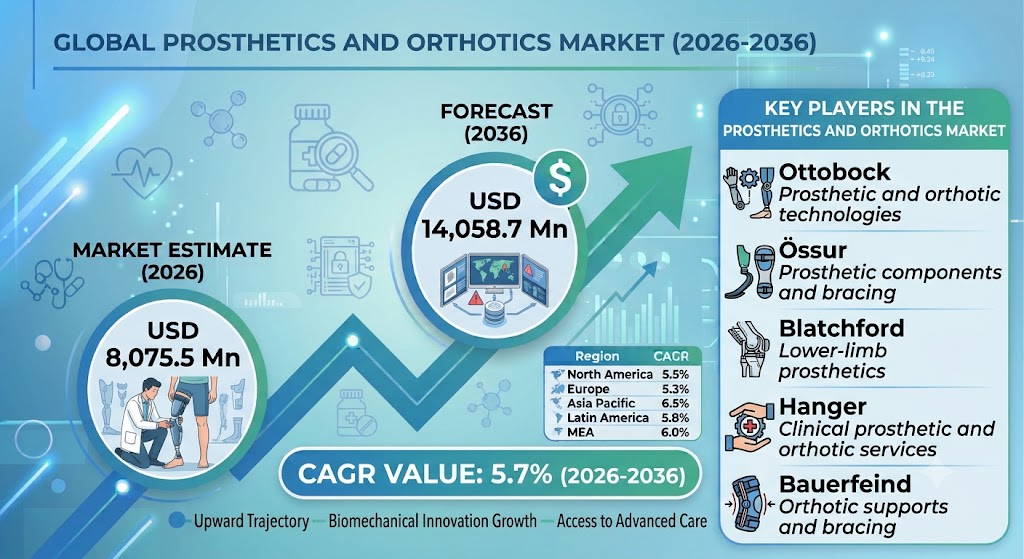
According to the latest market intelligence report published by Future Market Insights (FMI), the global prosthetics and orthotics market is projected to grow from USD 7.64 billion in 2025 to USD 13.30 billion by 2035, registering a compound annual growth rate (CAGR) of 5.7% between 2025 and 2035. Rising demand for mobility-restoration devices, increasing prevalence of diabetes-related complications, musculoskeletal disorders, and advances in customized rehabilitation technologies are supporting market expansion.
Prosthetics and orthotics play an important role in restoring mobility, supporting physical function, and improving independence for people living with limb loss, injuries, and musculoskeletal conditions. Technological developments in powered prosthetic limbs, digital scanning, 3D printing, and customized orthotic devices are expanding treatment options for patients and rehabilitation professionals.
👉 Get Detailed Market Forecasts, Competitive Benchmarking, and Pricing Trends:
https://www.futuremarketinsights.com/reports/sample/rep-gb-16484
FMI identifies orthotics as the leading type segment, accounting for 58.9% of market revenue in 2025. Electric-powered solutions account for 40.8% of the technology segment, while prosthetic clinics represent 42.3% of end-user revenue.
Market Size and Growth Forecasts
· 2025 Baseline Market Value: USD 7,640.0 million
· 2035 Projected Market Value: USD 13,300.5 million
· Forecast CAGR: 5.7% (2025–2035)
· Incremental Growth Opportunity: USD 5,660.5 million
· Leading Type Segment: Orthotics, with a 58.9% share in 2025
· Leading Technology Segment: Electric-powered solutions, with a 40.8% share
· Leading End-User Segment: Prosthetic clinics, with a 42.3% share
The market's expansion reflects increasing demand for devices that combine functional performance with patient comfort, individualized fitting, and long-term rehabilitation support. Healthcare providers and manufacturers are also evaluating digital technologies that can streamline device design, improve fitting processes, and support adjustments as patients' needs change.
Key Market Segments
By Type: Prosthetics and Orthotics
Orthotics accounted for 58.9% of the market in 2025. These devices support or correct the function of the musculoskeletal system and are used in managing gait abnormalities, joint instability, diabetic foot complications, and other mobility-related conditions. Advances in lightweight materials and digital customization are helping improve fit, comfort, and usability.
Prosthetics replace missing limbs or body parts and help users regain functional mobility following amputation or congenital limb differences. Demand is supported by the need for rehabilitation following trauma, vascular disease, and diabetes-related complications. Developments in socket design, powered components, and adaptive control systems are expanding the range of available solutions.
By Technology
Electric-powered solutions represent 40.8% of the technology segment. Powered prosthetic devices can support more controlled movement, while sensor integration and advanced signal processing are improving functionality in selected applications.
Conventional mechanical systems remain important because of their established performance, practical maintenance requirements, and suitability for particular users. The appropriate technology depends on individual clinical needs, functional goals, affordability, and access to training and rehabilitation services.
By End User
Prosthetic clinics account for 42.3% of market revenue. These specialist facilities provide assessment, device selection, fitting, alignment, training, and follow-up support.
Hospitals, rehabilitation centers, and other clinical providers also contribute to demand. Collaboration among prosthetists, orthotists, physiotherapists, occupational therapists, and physicians is important for ensuring that devices meet individual requirements and support effective rehabilitation.
Country and Regional Growth Outlook
FMI projects the following country-level growth rates through 2035:
· United States: 5.9% CAGR, supported by reimbursement arrangements, advanced clinical services, and adoption of technologically sophisticated mobility devices.
· Japan: 5.8% CAGR, reflecting aging-related mobility needs and increasing interest in advanced rehabilitation technologies.
· South Korea: 5.6% CAGR, supported by healthcare investment and demand for personalized mobility solutions.
· United Kingdom: 5.5% CAGR, driven by rehabilitation requirements, customized orthotic devices, and advances in prosthetic materials.
· European Union: 5.7% CAGR, reflecting demand for assistive devices, rehabilitation services, and technological innovation.
The report covers North America, Latin America, Western Europe, Eastern Europe, East Asia, South Asia and Pacific, and the Middle East and Africa.
Major Market Trends and Growth Drivers
1. Increasing demand for personalized devices: Digital scanning, computer-aided design, and 3D printing are helping manufacturers and clinics develop devices tailored to individual anatomy and functional requirements.
2. Growth in powered prosthetics: Electric-powered systems and sensor-assisted technologies are expanding functional options for selected users, although clinical suitability, training, maintenance, and affordability remain important.
3. Rising chronic disease burden: Diabetes, vascular disease, osteoarthritis, and other conditions can increase the need for limb replacement, joint support, and mobility assistance.
4. Greater focus on rehabilitation outcomes: Integrated care pathways emphasize appropriate fitting, patient training, continued adjustments, and follow-up to help users achieve their mobility goals.
5. Expanding digital clinical workflows: Gait analysis, remote consultations, and digital fabrication tools are creating opportunities to improve fitting efficiency and coordination between manufacturers and rehabilitation providers.
Access Full Report: https://www.futuremarketinsights.com/reports/prosthetics-and-orthotics-market
Competitive Landscape
The market includes manufacturers of prosthetic limbs, orthotic supports, powered mobility components, and rehabilitation-related products. Companies compete through product engineering, material innovation, digital fitting capabilities, specialist-clinic partnerships, and technical support.
Key companies profiled by FMI include:
· B. Braun Melsungen AG
· Bauerfeind AG
· Blatchford Group
· Fillauer LLC
· Hanger, Inc.
· Ortho Europe
· Össur
· Ottobock SE & Co. KGaA
· Smith & Nephew plc
· Steeper Inc.
· WillowWood South Asia LLC
· Zimmer Biomet Holdings Inc.
· Tynor Orthotics Pvt. Ltd.
Manufacturers that combine suitable product design with clinician training, fitting support, and reliable after-sales service may be better positioned to meet the needs of patients and rehabilitation providers.
Analyst Perspective
“The prosthetics and orthotics market is likely to shift toward personalized mobility solutions where digital scanning, powered assistance and specialist fitting support decide clinical value. Manufacturers with stronger clinic integration are expected to gain advantage as rehabilitation moves toward outcome-based care.”
— Anurag Sharma, Principal Consultant for Healthcare at Future Market Insights
Related Reports:
· Non-Wearable Sleep Tracker Market - https://www.futuremarketinsights.com/reports/non-wearable-sleep-tracker-market
· Immunoadsorption Columns Market - https://www.futuremarketinsights.com/reports/immunoadsorption-columns-market
· Craniomaxillofacial Devices Market - https://www.futuremarketinsights.com/reports/craniomaxillofacial-devices-market
About Future Market Insights (FMI)
Future Market Insights (FMI) is a global market intelligence and consulting firm providing comprehensive market research, competitive intelligence, and strategic business insights across industries. The firm delivers detailed forecasts, technology analysis, and data-driven recommendations that support informed decision-making for manufacturers, investors, distributors, and policymakers worldwide.
For Press & Corporate Inquiries
Rahul Singh
AVP – Marketing and Growth Strategy
Future Market Insights, Inc.
+91 8600020075
For Sales – sales@futuremarketinsights.com
For Media – Rahul.singh@futuremarketinsights.com
For Web – https://www.futuremarketinsights.com

 English
 Arabic
 French
 Spanish
 Portuguese
 Deutsch
 Turkish
 Dutch
 Italiano
 Russian
 Portuguese (Brazil)
 Greek