


How Microprocessor Controlled Prosthetic Knees Improve Stability and Mobility
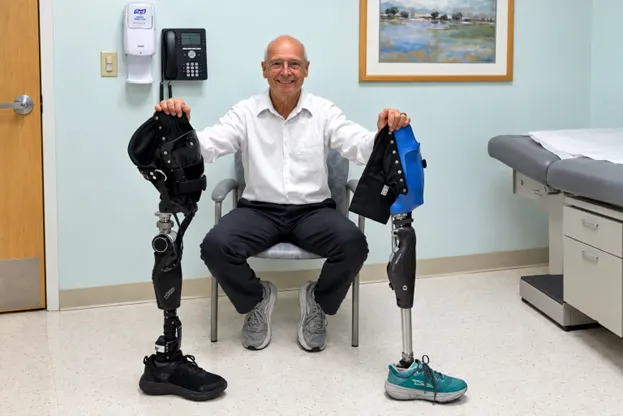
A microprocessor controlled prosthetic knee uses onboard sensors and computer processing to adjust resistance in real time as a person walks, providing more consistent stability during standing and more natural, controlled movement during each step than a traditional mechanical knee can offer. Rather than relying on fixed mechanical settings that stay the same regardless of terrain or walking speed, this technology continuously reads the wearer’s movement and adjusts accordingly, which is why it has become one of the more significant advances in above knee prosthetic care over the past two decades.
For above knee amputees in particular, knee stability is one of the biggest factors separating confident, independent walking from a constant, tiring effort to avoid falls. A microprocessor controlled prosthetic knee addresses this directly by preventing the knee from buckling unexpectedly during standing or weight bearing, while still allowing enough controlled flexion to swing the leg forward and clear the ground safely during the swing phase of a step. This combination, stability when it’s needed and flexibility when it’s needed, is difficult to replicate with a purely mechanical system.
How the Technology Actually Works
At its core, a microprocessor controlled knee relies on sensors that continuously monitor factors like joint angle, walking speed, and the forces moving through the leg during each step. That data feeds into a small onboard computer that adjusts hydraulic or pneumatic resistance within the knee in real time, effectively deciding, many times per second, how much resistance to apply based on what the wearer is actually doing. Walking on flat ground, going down a ramp, and standing still all place different demands on the knee, and a microprocessor controlled system can respond to each of these situations differently rather than applying one fixed setting to every scenario.
This is a meaningful shift from older mechanical knee designs, which typically rely on fixed springs or friction settings that stay constant no matter what the wearer is doing. A mechanical knee set for comfortable flat ground walking might feel unstable on a ramp or stairs, forcing the wearer to compensate with extra caution or upper body effort. Microprocessor technology reduces the need for that kind of constant manual compensation.
Learning to Walk With a Powered Knee
Transitioning to a microprocessor controlled knee is not simply a matter of putting on a new device and walking normally right away. The knee itself is only half of the equation, the wearer also has to learn a gait pattern that works with the technology rather than against it. This often involves practicing a specific walking rhythm that the knee is designed to recognize, sometimes reinforced with feedback cues, such as an audible signal, that let the wearer know the knee has registered the correct movement and is ready to flex.
This learning process takes time and repetition, and it’s a normal part of adapting to the technology rather than a sign that something is wrong. Patients who are further along in this process often describe the walking pattern becoming more automatic over time, requiring less conscious thought with each training session. Because this adjustment period varies significantly from person to person, ongoing support from a prosthetist familiar with the specific device matters just as much as the technology itself.
Who Tends to Benefit Most From This Technology
Microprocessor controlled knees are often considered for above knee amputees whose daily life involves a mix of walking environments, including uneven terrain, ramps, or stairs, where a fixed mechanical knee setting would require more frequent manual adjustment or added physical effort to stay safe. Patients managing other health factors that affect energy levels or cardiovascular strain can also benefit, since a knee that actively assists stability can reduce the overall physical effort required to walk compared to constantly compensating for an unresponsive joint.
That said, this technology isn’t automatically the right fit for every above knee amputee. Individual health, activity level, lifestyle, and personal goals all play a role in determining whether a microprocessor controlled knee makes sense compared to other prosthetic knee options. This is part of why a thorough, individualized evaluation matters more than defaulting to the most advanced technology available simply because it exists.
What to Expect During the Fitting and Adjustment Process
Fitting a microprocessor controlled knee typically starts with a detailed evaluation of the patient’s current mobility, health history, and specific goals, since the knee’s settings are programmed around the individual rather than applied generically. Initial programming gives the wearer a starting point, but real world walking often reveals adjustments that need to be made as the patient gains experience with the device. Follow up appointments allow a prosthetist to fine tune these settings based on how the patient is actually moving, rather than relying solely on the initial clinical assessment.
Because this technology represents a meaningful shift from how a patient may have walked before, whether coming from an earlier mechanical knee or adapting after a more recent amputation, patience throughout this adjustment period is a normal and expected part of the process, not an indication that the device isn’t working as intended.
Frequently Asked Questions
Is a microprocessor controlled knee heavier than a traditional mechanical knee?
Microprocessor controlled knees do typically weigh more than basic mechanical knees due to the added sensors, processor, and battery, though designs have become progressively lighter as the technology has advanced. The added weight is often offset by the reduced physical effort required during walking.
How long does the battery last on a microprocessor controlled knee?
Battery life varies by specific device and model, but most microprocessor controlled knees are designed to last through a full day of typical use on a single charge, with charging done overnight similar to other rechargeable devices.
Does insurance typically cover microprocessor controlled prosthetic knees?
Coverage varies significantly depending on the specific insurance plan and the documented medical necessity for the patient. This is generally evaluated on a case by case basis rather than through a universal coverage standard.
Can someone switch from a mechanical knee to a microprocessor controlled knee later on?
Yes, many patients transition to microprocessor controlled knees after starting with a mechanical option, though this does require a new learning period to adapt to how the powered knee responds differently during walking.

 English
 Arabic
 French
 Spanish
 Portuguese
 Deutsch
 Turkish
 Dutch
 Italiano
 Russian
 Romaian
 Greek