A business logo represents a company's identity and appears on uniforms, promotional apparel, corporate gifts, caps, jackets, and many other branded products. For embroidered logos to look professional, the embroidery file must be created with accuracy and attention to detail. Choosing professional online embroidery digitizing helps businesses convert their artwork into machine-ready files that produce clean, consistent, and high-quality embroidery.
Unlike automatic software conversion, professional digitizers manually adjust every stitch according to the design, fabric, and embroidery machine. This process improves stitch quality, reduces production problems, and helps businesses maintain a consistent brand image across every embroidered product.
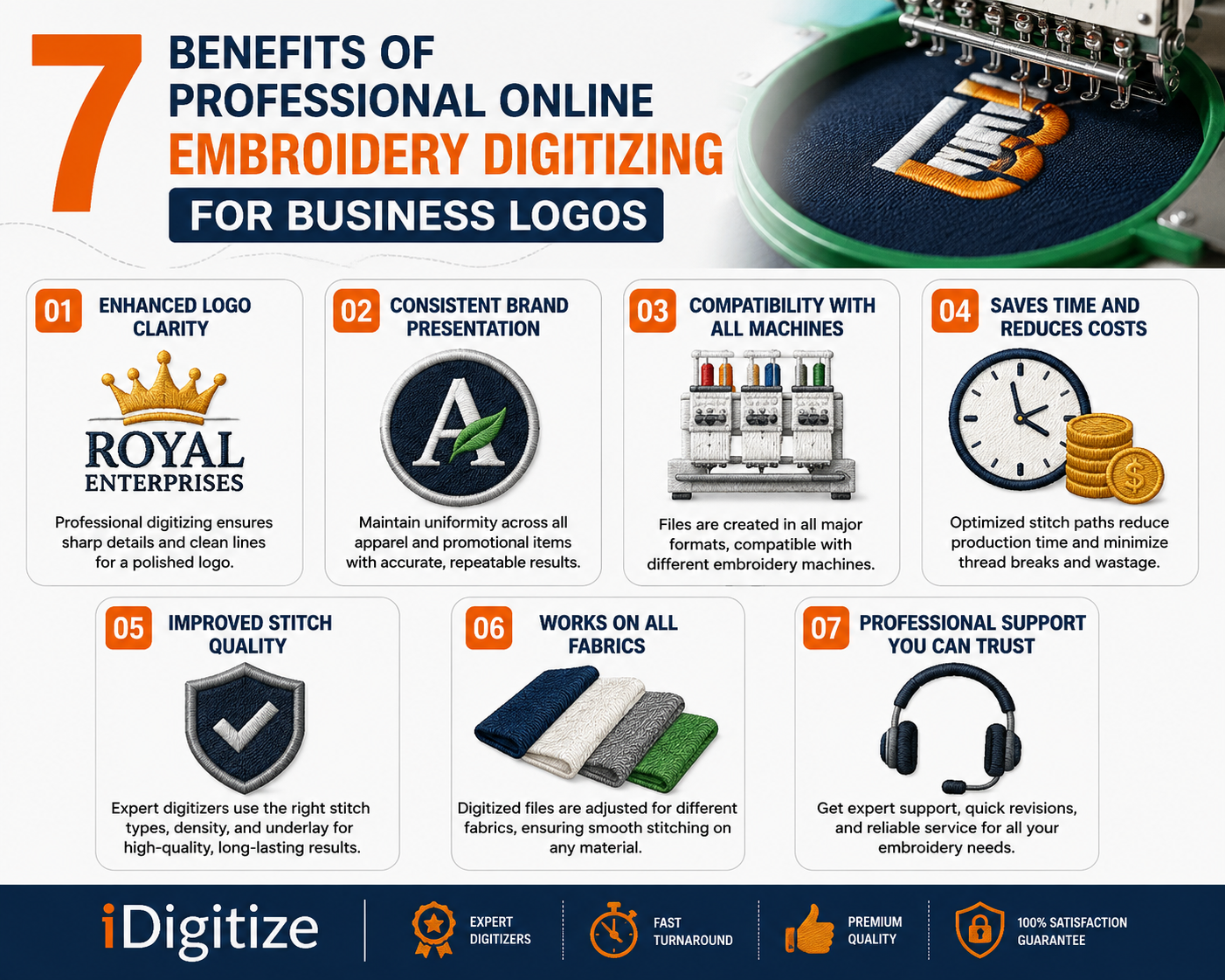
Below are seven important benefits of choosing professional online embroidery digitizing for business logos.
1. Better Stitch Quality
The primary advantage of professional digitizing is cleaner embroidery.
Experienced digitizers carefully select stitch types, stitch direction, density, and underlay to create embroidery files that reproduce logos accurately. Sharp outlines, smooth fills, and clear lettering help business logos maintain a professional appearance.
Well-planned stitch paths also reduce unnecessary machine movement, producing more consistent embroidery.
2. Consistent Brand Identity
Every business wants its logo to appear the same across all products.
Professional digitizing helps maintain consistent proportions, spacing, lettering, and design details whether the logo is embroidered on shirts, jackets, caps, bags, or uniforms.
Consistent embroidery strengthens brand recognition and creates a more professional image for customers and employees.
3. Reduced Production Errors
Poorly digitized files often cause thread breaks, fabric puckering, misaligned outlines, and repeated machine stoppages.
Professional digitizers minimize these problems by adjusting stitch density, underlay, pull compensation, and stitch sequencing before production begins.
Fewer production interruptions improve efficiency and reduce material waste.
4. Better Fabric Compatibility
Business logos are embroidered on many different materials.
Cotton shirts, polyester uniforms, fleece jackets, denim workwear, caps, canvas bags, towels, and performance apparel all require different digitizing adjustments.
Professional digitizers modify stitch settings according to the fabric, helping maintain consistent embroidery quality across different products.
5. Improved Small Lettering
Many business logos include company names, taglines, or small design details.
Small lettering requires careful stitch planning to remain readable after embroidery.
Professional digitizers adjust satin stitch widths, spacing, density, and underlay to improve clarity while reducing excessive stitch buildup.
This creates cleaner and more professional-looking embroidered logos.
6. Faster Production Efficiency
Professionally digitized embroidery files allow embroidery machines to operate more efficiently.
Optimized stitch paths reduce unnecessary trims, jump stitches, and machine stops. This allows production teams to complete logo embroidery more quickly while maintaining consistent quality.
Improved efficiency is especially valuable for businesses handling bulk uniform or promotional apparel orders.
7. Long-Term Cost Savings
Although professional digitizing may require a higher initial investment, it often reduces long-term production costs.
High-quality embroidery files help reduce:
- Thread waste
- Needle breakage
- Fabric damage
- Machine downtime
- Product rejection
- Operator adjustments
These savings become significant for businesses producing embroidered logos regularly.
Why Manual Digitizing Is Better Than Automatic Conversion
Automatic digitizing software creates basic embroidery files using preset algorithms.
Professional digitizers manually evaluate every design and adjust stitch settings according to artwork complexity, fabric type, and embroidery size.
Manual digitizing produces cleaner embroidery, improved registration, better stitch flow, and fewer production problems compared to automatic conversion.
How to Choose a Professional Online Embroidery Digitizing Service
Before selecting a provider, evaluate several important factors.
Look for a company that offers:
- Manual embroidery digitizing
- Experienced digitizers
- Multiple embroidery file formats
- Stitched sample portfolio
- Fast turnaround
- Quality control procedures
- Responsive customer support
- Fair revision policy
Choosing an experienced provider helps ensure consistent embroidery quality for every business logo.
Common Mistakes to Avoid
Many businesses reduce embroidery quality by making avoidable mistakes.
Avoid selecting services based only on price, uploading low-resolution artwork, failing to specify the embroidery size, or assuming one embroidery file will work for every garment. Providing complete project information allows the digitizer to create a file that matches your production requirements.
Conclusion
Professional embroidery digitizing plays an essential role in producing high-quality business logos. Accurate stitch planning, proper density, suitable underlay, and fabric-specific adjustments help create embroidery that looks clean, consistent, and professional across different products. Investing in professional online embroidery digitizing also improves production efficiency, reduces waste, and supports long-term brand consistency. Whether your business produces uniforms, promotional products, workwear, or corporate apparel, professionally digitized logo files provide reliable results for every order. iDigitize offers professional online embroidery digitizing services designed to create accurate, production-ready embroidery files that deliver excellent stitch quality and dependable performance.
Frequently Asked Questions
Q1. Why is professional online embroidery digitizing important for business logos?
Professional digitizing creates accurate embroidery files that improve stitch quality, maintain logo consistency, and reduce production problems.
Q2. Can professional digitizing improve small lettering?
Yes. Experienced digitizers adjust stitch settings to produce clearer and more readable small text in embroidered logos.
Q3. Does professional digitizing reduce embroidery machine problems?
Yes. Proper stitch planning helps reduce thread breaks, needle damage, machine stoppages, and fabric puckering.
Q4. Can one embroidery logo file be used on every garment?
Not always. Different garment sizes and fabric types often require separate digitized files for the best embroidery quality.
Q5. What should businesses look for in an online embroidery digitizing service?
Look for manual digitizing, experienced professionals, stitched sample portfolios, multiple file formats, quality control, responsive communication, and a reliable revision policy.




 English
 Arabic
 French
 Spanish
 Portuguese
 Deutsch
 Turkish
 Italiano
 Russian
 Romaian
 Portuguese (Brazil)
 Greek
Greek