


Why the Brain Sees Patterns in Random Results
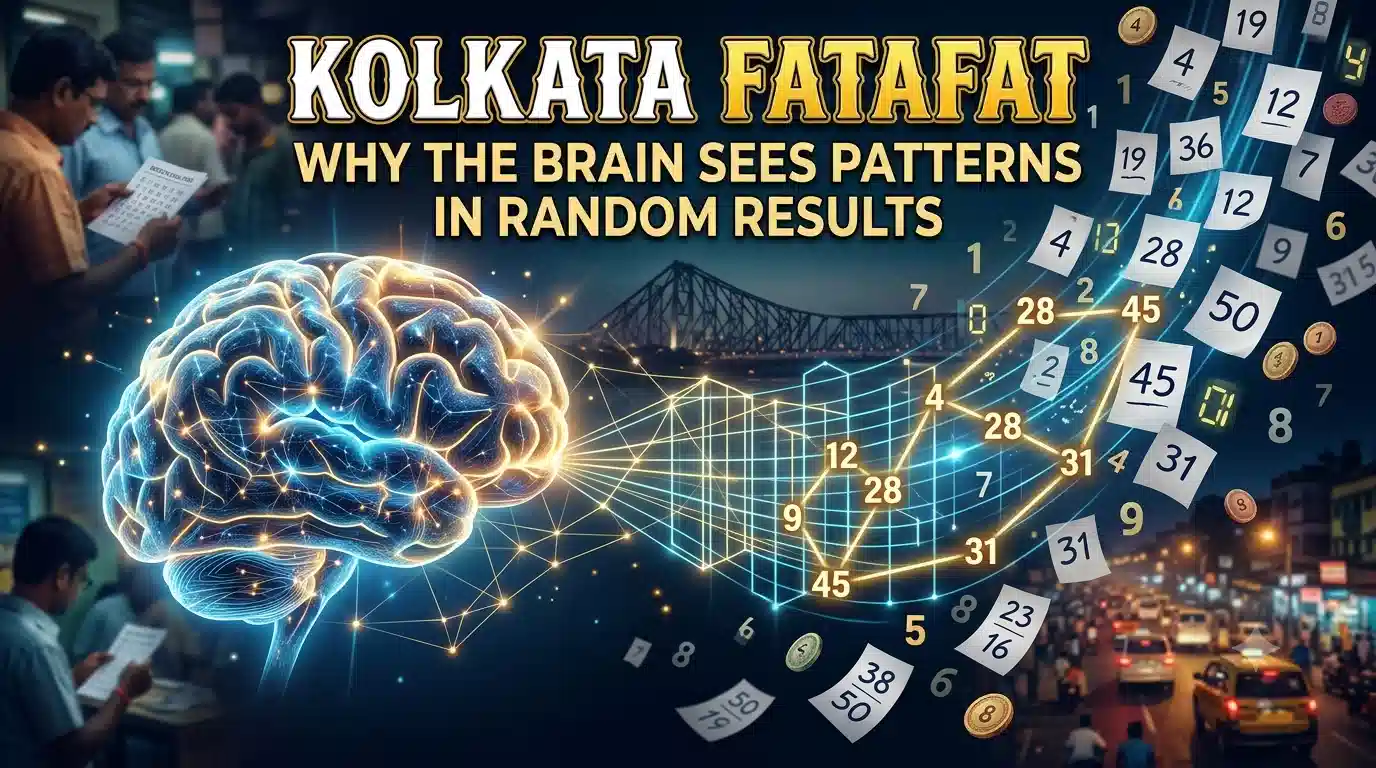
Are you one of those people that browse through the result chart of Kolkata FF on kolkataff.net and believe that "the number 6 was three times this week, it is time for a break" or "1 did not come in five Bajis, it is coming soon"? Congratulations, you became a victim of one of the oldest brain traps that are known to psychologists. Humans find meaning patterns in completely random information; such tendency has its scientific name and is a basic feature of our mind. Understanding why the brain sees patterns in random sequences can be considered the first step to becoming a good Kolkata FF player.
The Scientific Term
The phenomenon is called "apophenia" or "clustering illusion". The idea is that our brain recognizes the patterns in random noise and interprets them as some kind of a system. This helped our ancestors to spot dangerous animals in the bushes, and was extremely useful. The same feature gets activated when we are browsing through a table with results of Baji draws, which is completely useless. Random sequences create clusters, streaks, and repeating digits, but our brain refuses to accept this and tries to build some kind of a "system".
Today's Result Kolkata Fatafat
Relative of the Gambler's Fallacy
One of the most famous examples of this psychological trap is called "gambler's fallacy". It means that the player assumes that a number that did not appear for a while is "due". This assumption is completely wrong, yet pretty obvious. Every Baji is an independent event, and the digit-sum draw never remembers anything that happened before. The result of 3 has the same chances to be drawn today as any other day – no matter how long it did not show up. But to make your brain understand that is like trying to teach a dog to stay away from squirrels.
Why the Result Charts Are So Seductive?
- The data is organized into rows and columns – an ideal field for finding patterns.
- The digit-sum system creates a limited range of outputs (0-9), therefore it creates plenty of natural repeats.
- Human eyes are naturally prone to finding symmetries, sequences and mirrors in data, even if they are not there.
- Once you find "a pattern", your brain ignores all data that contradicts it – this is a confirmation bias.
- The longer you look at the chart, the more "patterns" your brain creates for you.
The True Nature of Randomness
There is a common misunderstanding related to the nature of a random sequence. In fact, the truly random sequence is quite different from what most people imagine. First of all, a random sequence contains long streaks of the same numbers, weird clusters and gaps that are seemingly impossible. For example, if a coin toss gave you 6 heads in a row – it is not weird at all, this is the way the random distribution acts. The same principle works for Kolkata FF. Drawing 4 in 3 out of 5 Bajis is not a sign of a system – it is a natural process of the random distribution. In the long run everything averages out, but the short-term sample is always random.
How to Analyze a Chart Properly?
- Look at the chart as a historic record, not as a predictive tool.
- Once you find a pattern, write it down and verify it during 30 Bajis.
- Never think that any number is "due" – every draw is an independent event.
- Be very skeptical of people that claim to have decoded the system – the math forbids that.
- Use kolkataff.net only as a result verification tool, not as a signal generator.
Conclusion
The fact that our brain sees patterns in random results is natural and cannot be controlled with sheer willpower. Yet, you can always learn to detect when your brain does it and to be skeptical about "patterns" it finds.

 English
 Arabic
 French
 Spanish
 Portuguese
 Deutsch
 Turkish
 Dutch
Dutch
 Italiano
 Romaian
 Portuguese (Brazil)
 Greek
Greek