


Why Framing Crews Keep Running Out of Lumber Mid-Project (And How to Actually Fix It)
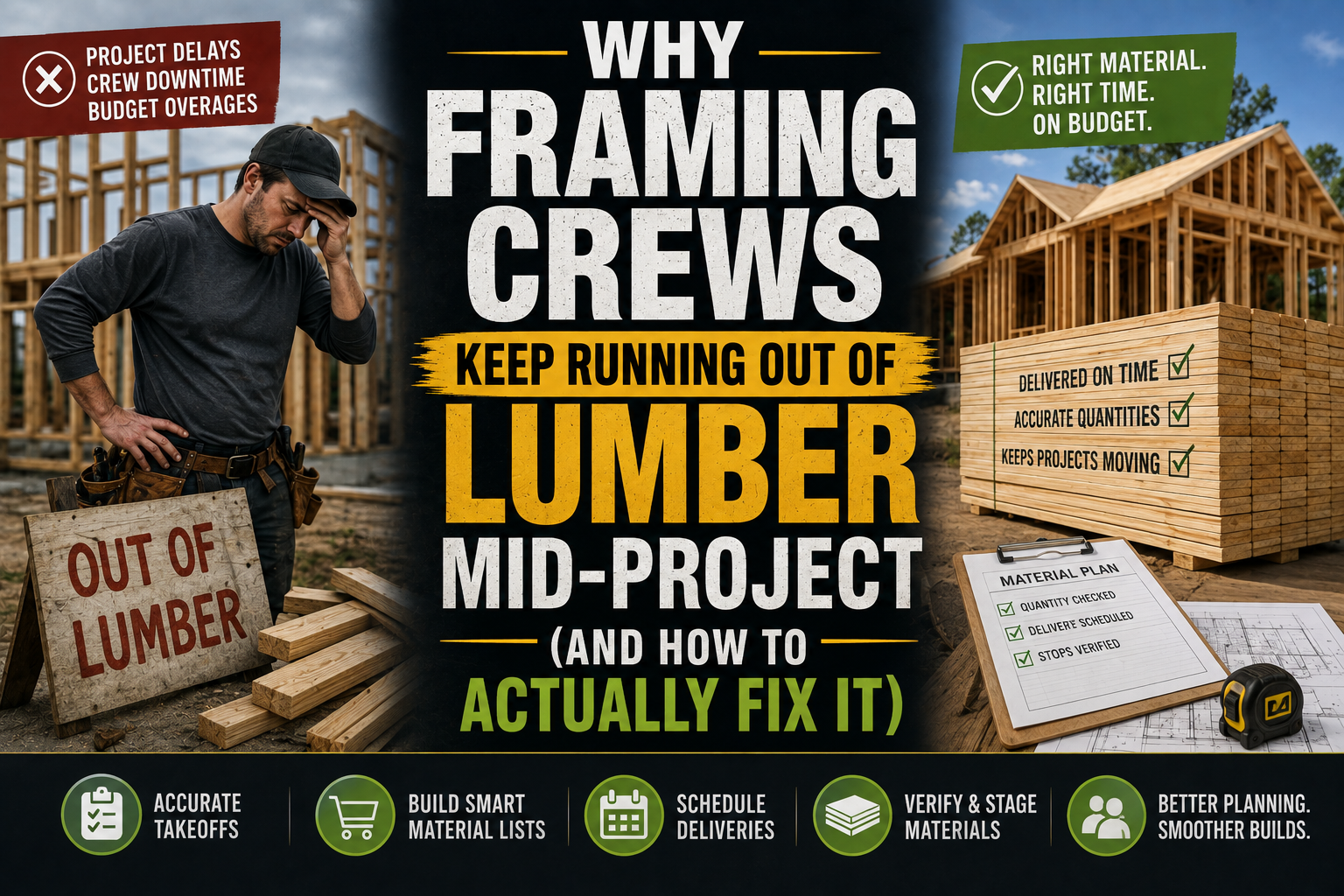
Ask any framing contractor about their biggest recurring headache, and lumber shortages will come up more often than you'd expect. Not because lumber is hard to buy — it's because most framing packages are estimated using rough guesses instead of an actual count of what the job needs. The crew shows up, starts framing, and halfway through the second floor someone realizes there aren't enough studs to finish the wall run. Now there's a scramble: a rush order, a delivery delay, a crew standing around waiting on material that should have been on-site from day one.
That scenario plays out on job sites constantly, and it's almost always traceable back to the same root cause — a takeoff that wasn't detailed enough to begin with.
The "Rule of Thumb" Trap
A lot of framing estimates still get built using shortcuts: a rough board-foot-per-square-foot ratio, a percentage-based waste factor pulled from memory, or a number that "worked on the last job." The problem is that no two framing packages are identical. Wall height, stud spacing, header sizes, truss configurations, and floor system design all shift the actual lumber count — sometimes by a significant margin.
A rule-of-thumb estimate might get close on a simple single-story rectangle. It falls apart fast on anything with vaulted ceilings, complex rooflines, engineered floor systems, or non-standard framing details. And once it's wrong, it's wrong for every stud, plate, header, and sheet of sheathing tied to that miscalculation.
Where Lumber Estimates Actually Go Wrong
Waste factors that don't match the framing method. Stick framing, engineered lumber, and prefabricated wall panels all generate different amounts of waste. Applying a blanket 10% waste allowance across every material type ignores that offcuts, defects, and layout inefficiencies vary a lot depending on what's actually being framed.
Engineered lumber treated like dimensional lumber. TJI joists, LVL beams, and PSL posts are priced and ordered differently than standard dimensional lumber, and they're often the most expensive line items in a framing package. Underestimating engineered lumber quantities — or the sizing needed to meet span requirements — creates cost surprises that are hard to absorb once the order is placed.
Connector hardware getting left out entirely. Joist hangers, hurricane ties, structural screws, and other connector hardware rarely make it into a rough lumber estimate, even though code requirements increasingly demand them. Leaving hardware out of the takeoff means the "lumber budget" was never actually complete.
No accounting for delivery staging. Even a perfectly accurate quantity takeoff can cause problems if material isn't sequenced to match the framing schedule. Ordering everything in one drop without staging it by phase leads to site congestion, material damage, or crews working around stacks of lumber that should have arrived in a second delivery.
Why This Keeps Happening on Bid Deadlines
None of this is really about a lack of skill — it's about time. Framing contractors bidding multiple jobs at once often don't have the hours to manually count every stud, header, and truss configuration off a full set of drawings. So the estimate gets built fast, using shortcuts that are "close enough" to submit a competitive number, and the gap only becomes visible once material starts hitting the site.
This is exactly the kind of gap that dedicated lumber takeoff services are built to close — pulling actual quantities from the drawings component by component (studs, plates, headers, joists, trusses, sheathing) rather than relying on a blended average. When someone's full-time job is quantifying wood framing packages accurately, the takeoff reflects what the drawings actually call for, not a shortcut built under bid-deadline pressure.
What a Reliable Lumber Takeoff Should Include
A framing estimate that actually holds up on-site typically breaks down:
-
Quantities by component — studs, plates, headers, joists, rafters, and trusses counted separately, not lumped together
-
Engineered lumber sized to span requirements, priced and ordered on its own line
-
Waste factors matched to framing method, not a flat percentage applied everywhere
-
Connector hardware and fasteners, included as part of the material list, not an afterthought
-
A cut list or material breakdown organized in a way that supports staged deliveries
The Real Cost of Getting This Wrong
A lumber shortfall doesn't just mean a rush delivery fee. It means a crew standing idle, a schedule slipping, and — depending on the contract — a hard conversation with a client about why the framing phase is taking longer than promised. On a tight-margin job, that kind of delay can erase whatever profit the bid was supposed to protect.
Framing is one of the few trades where the material list is almost entirely knowable in advance — there's a drawing, there's a spec, and there's a correct answer. The contractors who treat their lumber takeoff as a precise exercise instead of a rough guess are the ones who don't find themselves short a bundle of studs on a Friday afternoon.

 Arabic
 French
 Spanish
 Portuguese
 Deutsch
 Turkish
 Dutch
Dutch
 Italiano
 Russian
 Romaian
 Portuguese (Brazil)
 Greek
Greek