


RWA Tokenization Platform Development: How Wallets, Tokens, and Smart Contracts Work Together
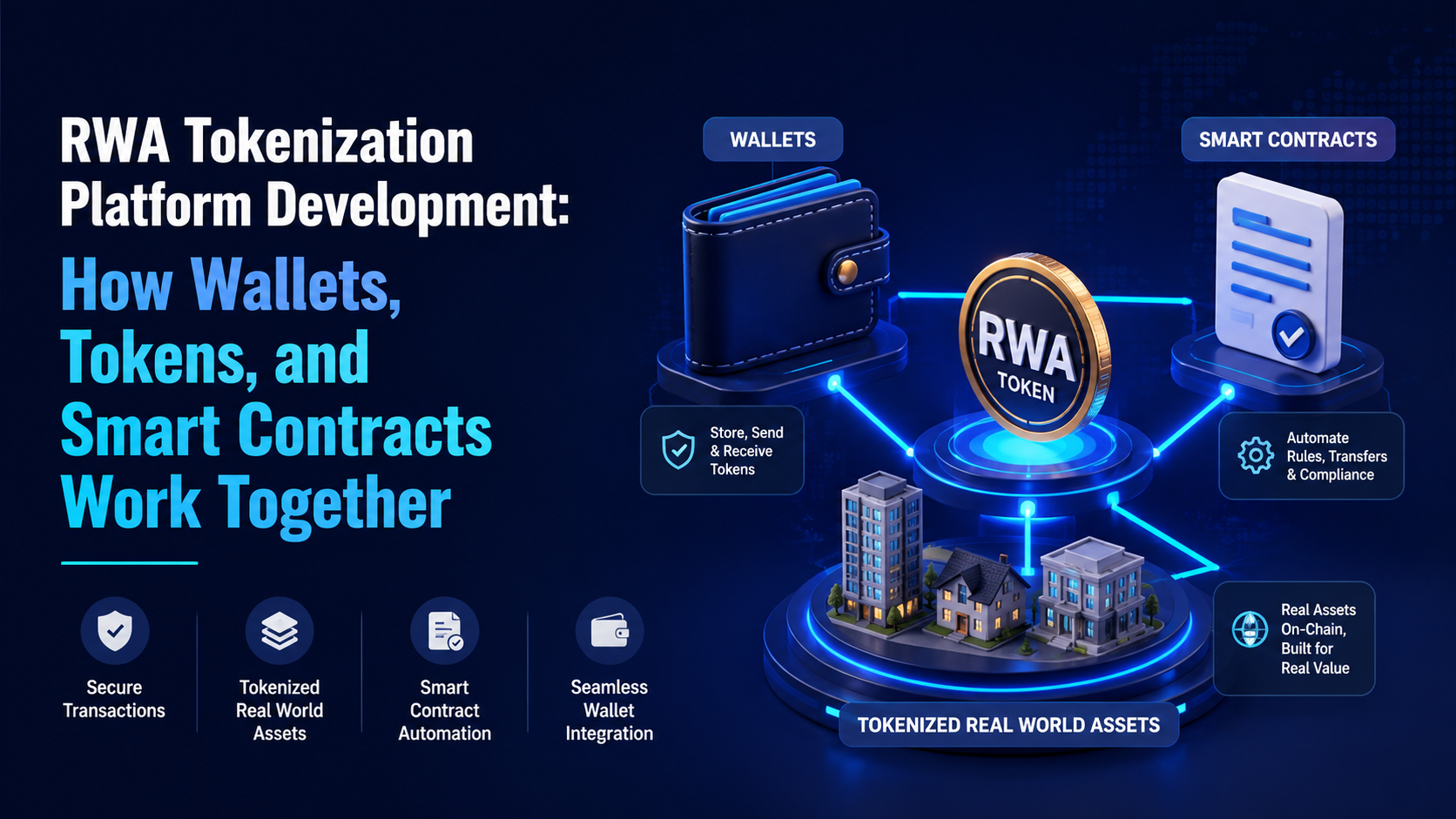
RWA tokenization brings physical and financial assets into blockchain-based environments. Real estate, private credit, commodities, artwork, bonds, and other assets can be represented through digital tokens that record ownership or economic rights. Behind this process, three components play an important role: wallets, tokens, and smart contracts. Each has a different function, but they work together as part of a single platform.
In an RWA tokenization platform, wallets give users access to their digital assets, tokens represent the rights connected with an asset, and smart contracts manage rules related to issuance, transfers, ownership, and compliance. The relationship between these components determines how users purchase, hold, transfer, and redeem tokenized assets.
For businesses planning RWA Tokenization, understanding this interaction is important because the platform is not simply a marketplace for digital tokens. It requires a system that connects asset information, blockchain records, user accounts, compliance checks, wallet activity, and smart contract logic. This article explains how these components work together and what businesses should consider during RWA tokenization platform development.
What Is RWA Tokenization Platform Development?
RWA tokenization platform development refers to creating a blockchain-based system where real-world assets can be represented digitally and managed through blockchain infrastructure. The platform can support activities such as asset onboarding, token issuance, investor verification, wallet management, trading, ownership tracking, and asset redemption.
Real World Asset Tokenization usually starts with identifying an asset and determining what rights the digital token will represent. For example, a commercial property could be divided into digital units representing fractional ownership. A debt instrument could issue tokens representing claims on repayments. The token does not necessarily represent the physical object itself. Instead, its legal and economic meaning depends on the structure of the offering.
An RWA tokenization platform connects these asset structures with blockchain records. Users interact with wallets, while smart contracts handle predefined blockchain operations. The platform's backend manages information that may not be stored directly on-chain, such as user profiles, documents, compliance records, asset details, and transaction information.
How Wallets Work in an RWA Tokenization Platform
A wallet provides the user's access point to blockchain assets. It stores or manages private keys that allow users to interact with blockchain networks and hold tokenized assets. Depending on the platform model, wallets may be self-custodial, custodial, or connected through third-party wallet infrastructure.
For investors, the wallet is where token balances can be viewed and transactions can be initiated. When an investor purchases an RWA token, the token balance is associated with the wallet address. When the investor transfers or sells tokens, the wallet signs the relevant blockchain transaction.
Wallet integration also affects the user experience. A platform may support external wallets, embedded wallets, institutional custody solutions, or a combination of these options. Businesses should decide which wallet model fits their users, asset classes, regulatory requirements, and operational structure.
In many platforms, wallet activity is also connected to identity and compliance checks. A user may need to complete KYC and other verification procedures before receiving permission to hold or transfer certain tokens. The wallet address can then be associated with an approved user record within the platform.
How Tokens Represent Real-World Assets
Tokens provide the blockchain representation of an asset or a specific right connected with that asset. During RWA Token development, developers need to decide what the token represents and how ownership or economic rights will be recorded.
For example, one token could represent a fractional interest in a property-holding entity. Another token could represent a claim associated with a private credit agreement. Token structures vary depending on the asset, jurisdiction, ownership arrangement, investor rights, and regulatory framework.
Tokens can also contain restrictions. Some RWA assets cannot be transferred freely between every wallet. A smart contract may check whether the receiving wallet has completed verification before allowing a transfer. This is particularly relevant for regulated assets where investor eligibility and jurisdictional restrictions may apply.
The token therefore works as a digital record within the wider platform. Its usefulness comes from the relationship between the blockchain token, the legal documentation, the underlying asset, and the platform's compliance system.
The Role of Smart Contracts
Smart contracts contain blockchain-based rules that execute when specified conditions are met. In an RWA platform, they can manage token issuance, transfers, ownership records, investor restrictions, payments, and other activities.
Suppose a platform issues 100,000 tokens linked to an investment asset. The smart contract can define the total supply and establish rules for transferring those tokens. When an approved investor purchases 1,000 tokens, the relevant transaction updates the blockchain records.
Smart contracts can also include permission rules. If a token is restricted to verified investors, the contract can check whether a wallet has the required status before accepting a transfer. This creates a direct connection between compliance logic and blockchain activity.
However, smart contracts cannot independently verify every real-world event. Information such as property valuation, rental income, debt repayment, or commodity ownership may come from external systems or authorized data providers. This is where oracles, backend services, custodians, and asset administrators can become part of the platform architecture.
How Wallets, Tokens, and Smart Contracts Work Together
The three components can be viewed as different layers of the same transaction process.
A user first interacts with the platform through an account and wallet. The wallet provides the blockchain address and transaction-signing capability. The token represents the user's digital asset position. The smart contract applies the rules governing how that token can be issued, transferred, or redeemed.
Consider a property token purchase. An investor completes verification and connects an approved wallet. The platform confirms the investor's eligibility and purchase amount. The investor sends the required payment. The smart contract then processes the transaction and assigns the appropriate number of property-linked tokens to the investor's wallet.
Later, if the investor sells the tokens, the wallet signs the transaction. The smart contract checks the applicable transfer conditions and records the movement of tokens from one wallet to another. The platform can update its database and display the new ownership information to the users.
This interaction reduces the need for separate manual records for every blockchain transaction. The blockchain provides a shared transaction history, while the platform's backend handles information and processes that require off-chain storage or services.
Token Issuance Process in RWA Platforms
Token issuance normally begins with asset verification and legal structuring. The platform operator needs to establish what asset is being tokenized, who owns it, what rights investors receive, and how those rights are represented.
After the asset structure is established, token parameters can be configured. These may include token name, supply, decimals, transfer restrictions, investor requirements, and distribution rules. The smart contract is then deployed to the selected blockchain network.
The platform can connect the issued tokens to verified investor wallets. Depending on the model, token distribution may happen through a direct sale, private offering, marketplace transaction, or another distribution process.
A well-planned issuance process also includes testing and contract review before tokens are released to users. Errors in token logic can create serious operational and financial problems, so contract testing and security review should be treated as important development activities.
Wallet and Compliance Integration
Compliance plays an important role when tokenized assets represent regulated financial or ownership interests. Wallet addresses alone do not provide enough information about the identity or eligibility of a user.
An RWA platform can connect wallet addresses with KYC, AML, accreditation, jurisdiction, and investor-status information. The compliance system can operate off-chain while smart contracts receive the information required to apply transfer restrictions.
For instance, a token may only be transferable between wallets belonging to verified investors in approved jurisdictions. When a transaction is initiated, the platform can check the relevant conditions before allowing the smart contract transaction to proceed.
This approach allows blockchain-based ownership records to work alongside conventional compliance processes rather than treating blockchain activity as a replacement for legal and regulatory procedures.
Role of the Backend in RWA Tokenization
Although wallets, tokens, and smart contracts receive much attention, the backend remains an important part of the platform. It connects blockchain activity with user accounts, asset records, payment systems, compliance services, analytics, and administrative tools.
The backend can monitor blockchain events and update platform records when tokens are transferred or issued. It can also manage asset documentation, investor profiles, transaction history, notifications, and reporting.
For example, when a smart contract records a token transfer, the backend can detect the blockchain event and update the investor dashboard. Users can then see their revised token balance without manually checking the blockchain.
This combination of on-chain and off-chain infrastructure is common in Real World Asset Tokenization Services because not every piece of platform information needs to be stored directly on a blockchain.
Choosing Blockchain Infrastructure
The blockchain selected for an RWA platform affects transaction costs, transaction speed, wallet support, smart contract compatibility, ecosystem availability, and operational requirements.
Businesses can consider networks that support smart contracts and token standards appropriate for their asset model. The selection should also consider whether the platform needs public blockchain access, permissioned infrastructure, or a hybrid architecture.
For regulated assets, businesses may require additional controls around wallet permissions and transaction visibility. The blockchain decision should therefore be made after considering the asset class, users, transaction volume, jurisdiction, compliance model, and long-term operating requirements.
Security Considerations
Security should be considered throughout RWA tokenization development. Wallets, smart contracts, APIs, databases, authentication systems, and administrative interfaces can each introduce different security risks.
Smart contracts should undergo testing and independent security reviews before deployment. Wallet systems need suitable key management practices. Administrative functions should use role-based access controls and strong authentication.
The platform should also monitor blockchain transactions and unusual account activity. Backup procedures, incident response processes, audit logs, and contract upgrade policies can help operators manage operational risks.
Security is especially important because tokenized assets can represent significant financial interests. A technical weakness can affect both the digital token and the platform's reputation.
Choosing an RWA Tokenization Development Company
Businesses looking for an RWA tokenization development company should assess more than coding capabilities. The development team should understand blockchain architecture, token standards, wallet integration, smart contracts, compliance workflows, backend systems, and asset-specific requirements.
An experienced RWA Tokenization Company can help determine the platform architecture according to the intended asset class and business model. It can also assist with token design, smart contract development, wallet integration, marketplace functions, investor dashboards, and administrative systems.
RWA tokenization development services may cover the complete development cycle or selected components. Some businesses may require a complete platform, while others may already have infrastructure and only need smart contract or wallet integration.
What Businesses Should Include in RWA Tokenization Services
A complete RWA Tokenization Services package can include asset onboarding, token creation, smart contract development, wallet integration, KYC and AML integration, investor management, payment processing, trading functions, dashboards, reporting, and administrative controls.
Real World Asset Tokenization Services can also include platform maintenance, smart contract updates, blockchain monitoring, security testing, and technical support. The exact service scope depends on the asset type and platform model.
Businesses should define the required functions before development begins. A real estate tokenization platform, for example, may need property documentation, rental income tracking, investor distributions, and ownership records that differ from those required for tokenized bonds or commodities.
Future of Wallet and Token Integration in RWA Platforms
The relationship between wallets, tokens, and smart contracts is likely to become more sophisticated as tokenized asset markets develop. Wallets may become more closely connected with identity and compliance systems, while smart contracts may support more detailed transfer and distribution rules.
Platforms may also support multiple asset classes through a single user interface. Investors could manage property tokens, credit-related tokens, and other RWA products from the same account, subject to the applicable rules for each asset.
For businesses, the focus will remain on creating a reliable connection between legal asset structures and blockchain records. Technology can provide the transaction infrastructure, but the platform still needs appropriate legal, compliance, operational, and financial processes around it.
Conclusion
RWA Tokenization depends on several technologies working together rather than a single blockchain component. Wallets provide users with access to their digital asset holdings, tokens represent ownership or economic rights, and smart contracts apply the rules governing transactions. The backend connects these blockchain functions with user accounts, compliance systems, asset information, payments, and administrative operations. When these parts are designed as one platform, businesses can create practical systems for issuing and managing tokenized assets across different markets. The right architecture also depends on the asset type, regulatory requirements, investor model, blockchain network, and operating process. Businesses planning an RWA platform can work with an experienced RWA tokenization development company to select suitable technologies and development methods. Blockchain App Factory provides RWA tokenization development services covering platform architecture, token development, smart contracts, wallet integration, and related blockchain requirements.
FAQs
1. What is an RWA tokenization platform?
An RWA tokenization platform is a blockchain-based system used to represent real-world assets or related rights through digital tokens. It can support asset onboarding, token issuance, investor verification, wallet management, transactions, and ownership tracking.
2. Why are wallets important in RWA tokenization?
Wallets provide users with blockchain addresses through which they can hold and transact with RWA tokens. They also interact with smart contracts when users initiate token-related transactions.
3. What do smart contracts do in RWA platforms?
Smart contracts contain rules for activities such as token issuance, transfers, supply management, investor restrictions, and other blockchain transactions.
4. Can one wallet hold multiple RWA tokens?
Yes. A wallet can generally hold different token types when the blockchain and wallet infrastructure support them. The specific rights and transfer conditions depend on each token and its smart contract.
5. What does RWA token development include?
RWA token development can include token architecture, token standards, supply configuration, smart contract programming, transfer rules, testing, deployment, and integration with the wider platform.
6. How does compliance work with tokenized assets?
Compliance can be handled through KYC, AML, investor verification, jurisdiction checks, and wallet permissions. Smart contracts can apply certain transfer restrictions based on approved wallet status.
7. What are RWA tokenization development services?
RWA tokenization development services can cover platform development, token creation, smart contracts, wallet integration, investor dashboards, compliance integration, marketplace functions, testing, deployment, and maintenance.
8. How long does RWA platform development take?
The development period depends on the asset type, platform functions, blockchain network, compliance requirements, integrations, and testing requirements. A basic platform generally requires less development time than a multi-asset platform with extensive trading and compliance functions.

 English
 Arabic
 Spanish
 Portuguese
 Deutsch
 Turkish
 Dutch
Dutch
 Italiano
 Russian
 Romaian
 Portuguese (Brazil)
 Greek
Greek