


How Real Estate Sales Training Improves Conversion Rates
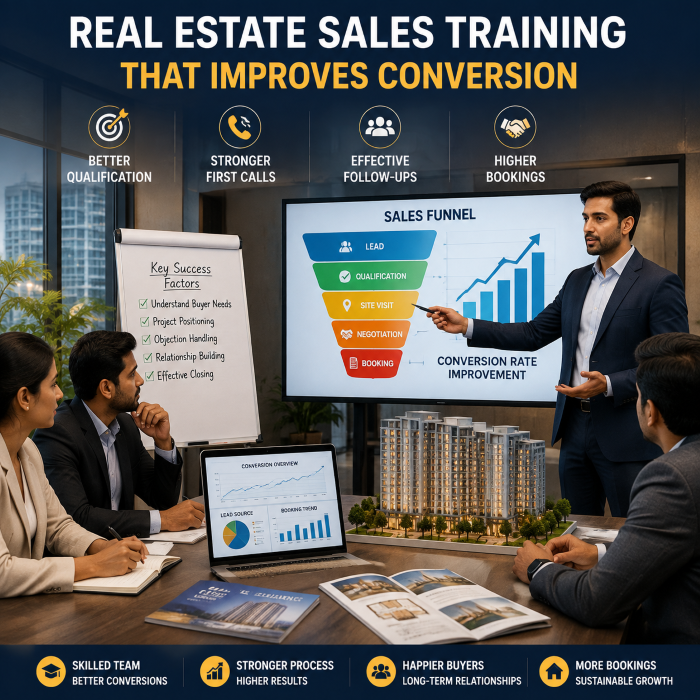
Most real estate developers don't have a lead problem. They have a conversion problem.
A project can generate thousands of enquiries in a quarter, yet only a small fraction turn into site visits, and an even smaller fraction turn into bookings. When this happens, the instinct is often to spend more on marketing and generate more leads. But if the sales process itself is leaking buyers at every stage poor qualification, generic first calls, inconsistent follow-up, weak site visit experiences, or clumsy objection handling more leads simply means more leakage at scale.
This is where real estate sales training becomes relevant, not as a motivational exercise, but as a structured way to fix specific, identifiable gaps in how a sales team talks to buyers. Done well, it connects directly to measurable stages of the buyer journey: Lead → Qualification → First Call → Follow-Up → Site Visit → Objection Handling → Negotiation → Booking.
This article explains, stage by stage, how training influences conversion and where its limits are.
What Is Real Estate Sales Training?
Real estate sales training is a structured program that helps salespeople handle property-specific buyer conversations from the first enquiry to booking. It differs from generic sales training because it addresses real estate's unique buying behavior: long decision cycles, high ticket sizes, family involvement, financing dependencies, and the emotional weight of a home or investment decision.
A generic sales training program might teach persuasion techniques or objection-handling scripts that work for a software product. It won't necessarily teach a salesperson how to qualify whether a buyer is an end-user or investor, how to run a site visit that builds emotional relevance, or how to respond when a buyer says they need to "discuss it with family."
Real estate-specific training typically covers:
- Lead qualification frameworks
- Project and location positioning
- Buyer psychology across segments
- Structured first-call and discovery frameworks
- Site visit planning and delivery
- Follow-up cadence and channel strategy
- Objection handling specific to price, timing, and family decision-making
- Negotiation and closing conversations.
What Does Conversion Rate Mean in Real Estate Sales?
In real estate, "conversion" is not a single number — it happens across a funnel, and each stage has its own conversion rate:
Lead —> Qualified Lead —>Connected Lead (first meaningful conversation)—>Site Visit —> Negotiation —>Booking
A developer who just monitors lead-to-booking conversions overlooks where the actual leakage occurs. A project may convert leads to site visits pretty successfully yet lose most of those buyers during the negotiation stage, indicating an entirely different training requirement than, say, poor first-call handling. Tracking conversions at each stage allows us to diagnose the problem before recommending training as a solution.
Why Real Estate Leads Fail to Convert
Lead leakage usually isn't caused by one single failure — it accumulates across the funnel. Common causes include:
- Poor lead qualification — treating every enquiry as equally serious, regardless of budget, intent, or timeline
- Slow response times — a lead enquires and doesn't hear back for hours or days
- Generic first calls — reciting project details instead of understanding what the buyer actually needs
- Feature dumping — listing amenities and specifications without connecting them to buyer motivation
- Weak project positioning — failing to differentiate the project from competing options
- Inconsistent follow-up — sporadic, low-value check-ins like "any update?"
- Not understanding buyer psychology — using the same pitch for a first-time buyer and a seasoned investor
- A flat site visit experience — a walkthrough that doesn't create emotional relevance
- Poor objection handling — reacting to price objections with an immediate discount instead of understanding the real concern
- Inconsistent sales process — every salesperson following a different approach, with no shared playbook.
A typical real-world scenario: a customer inquires online and receives a same-day call, but the salesman begins with "Let me tell you about our project" rather than asking what the buyer is looking for. The buyer respectfully disengages, and the lead goes cold – not because they were uninterested, but because the conversation never addressed their specific need.
How Real Estate Sales Training Improves Conversion Rates
Direct answer: Real estate sales training boosts conversion rates by strengthening specific behaviors at each funnel stage — qualification, discovery, positioning, follow-up, site visits, objection handling, and negotiation — so that fewer genuinely interested buyers drop out due to a bad sales experience rather than a lack of enthusiasm.
The following describes how training affects each level independently.
1. Better Lead Qualification
Training enables salespeople to ask the relevant questions early on – budget range, location preference, property type, schedule, decision-makers engaged, and finance preparedness. This is important because unqualified leads take up time that should be spent on buyers who are truly ready to move forward. A competent salesperson can rapidly identify between a serious buyer and an early-stage browser, and vary the conversation and follow-up pace accordingly, rather than putting the same effort to each inquiry.
2. Stronger First Sales Conversations
Untrained conversations frequently begin with, "Here are our project details." Trained talks begin with the phrase "Let me understand what you're looking for." The transition from pitching to discovery is key to consultative selling. Training educates salespeople to ask open-ended questions, listen for buying signals, and personalize the conversation based on what the buyer says, rather than following a predetermined script regardless of the client's specific situation.
3. Better Project Positioning
Listing amenities and positioning a project are not the same thing. Untrained pitches frequently sound like a checklist: clubhouse, carpet space, location, pricing. Trained salesmen match characteristics to customer demands.
Instead of mentioning "the project has a large clubhouse," a professional salesperson can say "for a family that wants weekend recreation without traveling far, the clubhouse adds everyday convenience." This is demonstrative; the actual framing should match the buyer's stated goals rather than a memorized sentence.
4. Improved Buyer Psychology Understanding
Buyers do not form a single audience. First-time buyers, investors, upgrading families, luxury purchasers, and budget-conscious buyers all prioritize different variables, such as emotional security, rental yield, school location, status, and affordability. Training enables sales teams to understand which persona they're interacting with early in the encounter, ensuring that the pitch, tone, and information supplied are relevant rather than generic. A salesperson who fails to determine if a buyer is an investor or an end user, for example, risks promoting resale value to someone who is more concerned with school proximity.
5. Better Follow-Up
A considerable portion of the leakage occurs after the initial call. Training enables teams to follow up consistently, use the appropriate channel (phone, WhatsApp, email) for the buyer's preference, and add value at each touchpoint rather than repeating "any update?". It also covers re-engaging inactive leads and tailoring follow-up cadence to the buyer's stated timescale, rather than adhering to a rigid, one-size-fits-all schedule.
6. Higher Site Visit Conversion
A confirmed site visit is not the end goal — it's a stage that still needs to convert. Training can improve pre-visit expectation-setting, on-site storytelling, and the ability to read buying signals during the walkthrough. It also covers post-visit follow-up, since a visit without a structured next step often goes cold. A site visit where the salesperson fails to create emotional relevance — walking a buyer through rooms without connecting the space to how they'll actually use it — is a common, avoidable point of leakage.
7. Stronger Objection Handling
Real estate concerns frequently repeat: "The price is too high," "I need to think about it," "I need to discuss it with my family," "another project is cheaper," "the location is far," "I need to arrange the loan." Training allows salespeople to understand why an objection is being raised rather to respond defensively or give a discount right away. A pricing issue, for example, is not always about price; it may reflect confusion about value, financing worries, or a contrast that the salesperson has not addressed. Discounting instantly without comprehending the underlying issue can harm both margin and buyer confidence.
8. Better Negotiation and Closing
Structured training enables salespeople to spot genuine buying signals and steer the conversation toward a decision without resorting to pressure methods. The emphasis should be on addressing any residual issues, reinforcing value established earlier in the conversation, confirming requirements, knowing how the buyer makes decisions (alone or with family), and deciding on a specific next step. Aggressive or manipulative closing approaches undermine trust and are not part of an effective training strategy.
9. Consistent Sales Conversations Across Teams
When each salesman takes a different technique, developers lose the capacity to determine what works. Training includes shared frameworks such as call structures, objection guides, approved messages, and project FAQs, allowing performance to be compared fairly across the team and effective ways to be copied rather than remaining with a single individual.
10. Continuous Coaching and Performance Improvement
A single workshop rarely changes long-term behavior. Skills fade without reinforcement. Sustainable improvement typically requires:
Training + Practice + Call Reviews + Audits + Coaching + Measurement
This is why one-time training sessions often show a short-term spike in enthusiasm but little lasting change in conversion metrics — the skills were introduced but never reinforced through real conversations.
Which Real Estate Sales Metrics Should Training Improve?
Training should be evaluated against specific funnel metrics, not vague notions of "better sales."
| Metric | What It Measures | How Training Can Influence It |
|---|---|---|
| Lead-to-contact rate | How quickly and consistently leads are reached | Response discipline, call cadence training |
| Qualified lead rate | Share of leads that meet defined buying criteria | Qualification frameworks and discovery questions |
| Contact-to-site-visit rate | How many conversations convert to a scheduled visit | First-call quality, positioning, rapport-building |
| Site visit show-up rate | How many scheduled visits actually happen | Pre-visit communication and expectation-setting |
| Site visit-to-booking rate | How many visits progress toward a decision | On-site storytelling, buying-signal recognition |
| Lead-to-booking rate | Overall funnel efficiency | Combined effect of qualification, follow-up, and closing |
| Follow-up response rate | How often follow-ups get a buyer response | Follow-up cadence, channel choice, message value |
| Conversion by salesperson | Individual performance variance | Coaching, call reviews, skill gaps |
| Conversion by lead source | Which channels produce buyer-ready leads | Helps separate a training issue from a lead-quality issue |
Training does not immediately move every metric. If lead quality is poor to begin with, or if pricing is out of sync with the market, training can enhance how conversations are handled without significantly affecting the booking volume. Metrics such as conversion by lead source can assist distinguish between a marketing/lead-quality issue and a sales-skill issue.
Real Estate Sales Training vs Generic Sales Training
| Area | Generic Sales Training | Real Estate Sales Training |
|---|---|---|
| Industry knowledge | Not industry-specific | Built around property buying cycles |
| Buyer psychology | General persuasion principles | End-users vs investors, family decision dynamics |
| Project positioning | Not covered | Connecting features to buyer motivation |
| Site visits | Not applicable | Core skill: walkthrough storytelling, engagement |
| Property-specific objections | Generic objection handling | Price, family consultation, loan-related objections |
| Real estate negotiation | General negotiation tactics | High-ticket, long-cycle, emotionally weighted decisions |
| Follow-up | General follow-up cadence | Multi-week/month cycles, channel-specific (calls, WhatsApp) |
| CRM discipline | Rarely covered | Central to lead tracking and funnel measurement |
| Sales funnel | Generic pipeline concepts | Real estate-specific funnel: lead to qualified to site visit to booking |
Real estate sales cycles are lengthier, more emotionally charged, and frequently necessitate family consensus factors that conventional sales training rarely tackles in depth. This is why many developers believe that real estate-specific training develops more relevant, immediately useable abilities than general sales courses.
What Should a Real Estate Sales Training Program Include?
A practical program typically covers:
- ✓ Buyer psychology across segments
- ✓ Lead qualification frameworks
- ✓ First-call structure and discovery
- ✓ Project and location positioning
- ✓ Sales storytelling
- ✓ Pre-sales process alignment
- ✓ Site visit conversion techniques
- ✓ Follow-up discipline and cadence
- ✓ WhatsApp and digital communication etiquette
- ✓ Objection handling
- ✓ Negotiation
- ✓ Closing conversations
- ✓ CRM discipline
- ✓ Performance measurement
- ✓ Ongoing coaching
- ✓ Sales conversation audits
Programs that skip the last three — measurement, coaching, and audits — tend to see skills fade within a few months.
How Developers Can Measure Whether Training Is Working
Direct answer: Training efficacy should be determined by measuring stage-by-stage conversion metrics before and after training, inspecting actual sales calls, and coaching against specific gaps, not by counting the number of people who attended a session.
A practical procedure looks like this:
- Establish baseline metrics by capturing current conversion rates at each funnel level.
- Identify sales gaps—use call reviews and CRM data to discover where the leakage occurs.
- Train against specific gaps—rather than a generic curriculum.
- Practice and role-play—so skills are rehearsed, not just talked.
- Audit sales conversations—listen to genuine calls and site visit debriefs.
- Coach the team, individually, depending on audit findings.
- Compare performance against the baseline, stage by stage.
- Repeat and improve – regard training as an ongoing cycle rather than a one-time event.
"Number of people trained" is a typical yet ineffective performance statistic, as it indicates nothing about whether behavior changed in real buyer conversations.
Common Mistakes Developers Make With Sales Training
- Training without first determining where the funnel is leaking.
- Using one-size-fits-all material, regardless of team experience level.
- Keeping sales managers out of the training and reinforcement process
- Skipping follow-up coaching after the first session
- Not tracking conversion numbers before and after training.
- Focusing solely on scripts, without addressing the underlying buyer understanding
- Ignoring buyer psychology in favor of generic persuasion strategies
- Site visits are treated as a formality rather than a conversion stage.
- Overlooking CRM discipline has an impact on follow-up consistency.
- Treating training as a singular event rather than a continual process.
Training alone cannot solve every conversion problem. Poor lead quality, inappropriate price, insufficient product-market fit, unsuitable location or inventory, low-quality marketing, or inconsistent sales management can all hinder the effectiveness of training. Training is most effective when used in conjunction with coaching, measurement, and process discipline, rather than as a stand-alone solution.
Frequently Asked Questions
Q: How does real estate sales training improve conversion rates?
Answer: It improves certain behaviors like as qualification, first-call quality, follow-up, site visit delivery, objection handling, and negotiation, resulting in fewer prospective buyers lost due to a poor sales experience rather than real disinterest.
Q: What is the most important skill in real estate sales?
Answer: There is no single talent; qualification, discovery, and follow-up discipline are frequently the most leveraged areas, as flaws in these areas cause leakage before a buyer even enters the negotiation process.
Q: Can sales training improve site visit conversions?
Answer: Yes, when it covers pre-visit expectations, on-site storytelling, and post-visit follow-up. Training that focuses solely on the walkthrough and ignores the surrounding process has low impact.
Q: How often should real estate sales teams receive training?
Answer: Most teams benefit from occasional refreshers – quarterly or in conjunction with new project launches — combined with continuous mentoring, rather than a single annual session.
Q: What should a real estate sales training program include?
Answer: Minimum requirements include lead qualification, discovery and first-call frameworks, project positioning, site visit conversion, follow-up discipline, objection handling, negotiation, CRM use, and performance monitoring.
Q: How do you measure sales training effectiveness?
Answer: By comparing stage-by-stage conversion numbers before and after training, reviewing actual sales calls, and evaluating individual coaching success, rather just recording attendance.

 English
 Arabic
 French
 Spanish
 Portuguese
 Deutsch
 Turkish
 Dutch
Dutch
 Italiano
 Romaian
 Portuguese (Brazil)
 Greek
Greek