


What Developers Discuss on Real Estate Podcasts
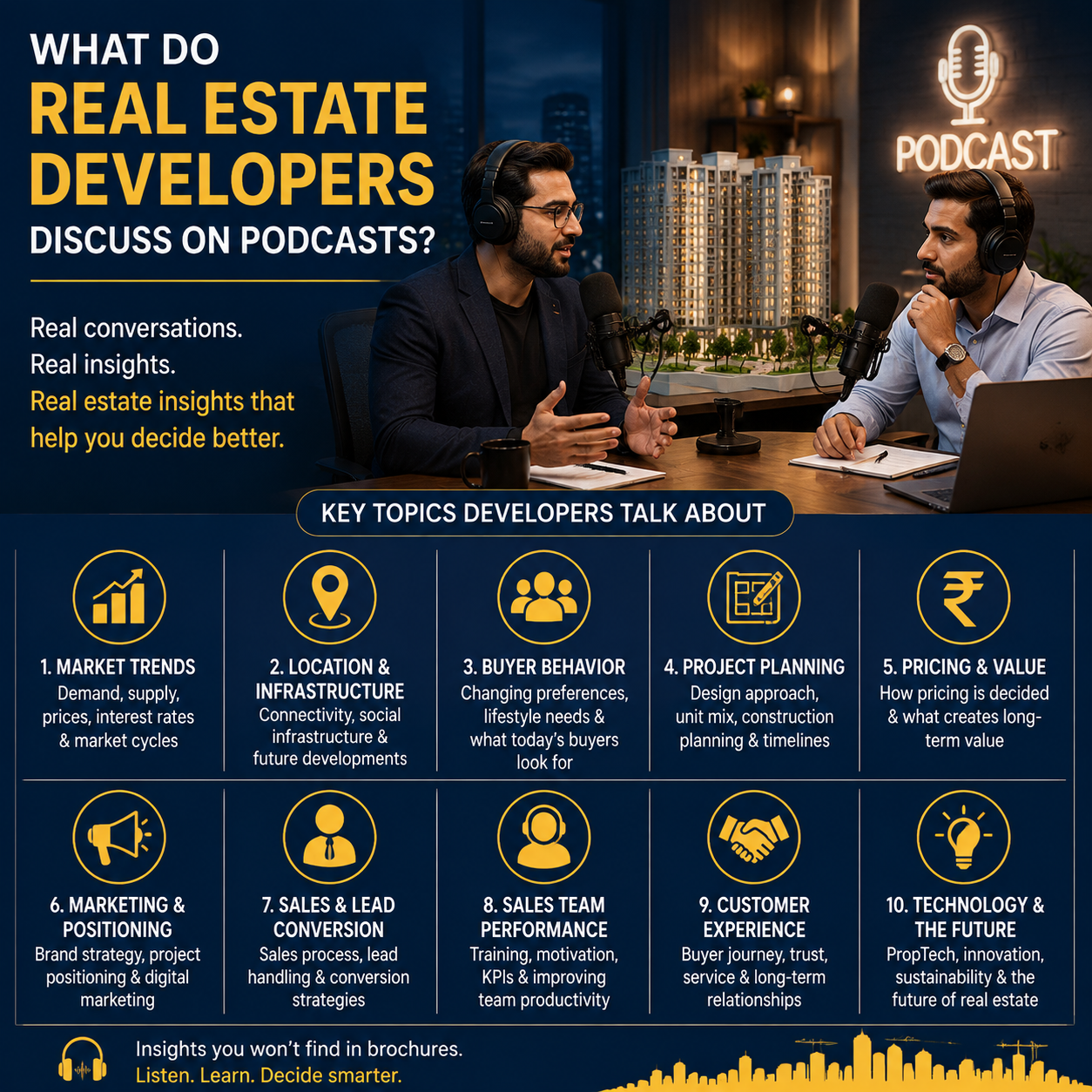
Real estate podcasts have opened up a kind of conversation that used to happen mostly behind closed doors — in boardrooms, site visits, and industry conferences. When a developer sits down for a podcast interview, the discussion rarely stays limited to a single project launch. It tends to move across market conditions, buyer behavior, planning decisions, infrastructure, pricing, sales, marketing, technology, and the broader challenges facing the industry.
What do real estate developers discuss on podcasts? Developers typically discuss market trends and demand patterns, location and infrastructure decisions, buyer behavior and changing expectations, project planning and positioning, pricing logic, marketing and sales strategy, customer experience, redevelopment, sustainability, technology adoption, and the operational challenges of running a development business. These conversations offer listeners a working view of how development decisions actually get made.
This article breaks down the categories of topics developers commonly discuss, explains why each matters to different stakeholders, and — importantly — how to listen to these conversations critically rather than treating every statement as fact.
What Do Developers Discuss on Real Estate Podcasts?
Developers on real estate podcasts typically talk about market trends, location and infrastructure, buyer behavior, project planning, pricing strategy, marketing and positioning, sales and lead conversion, sales team performance, customer experience, redevelopment, sustainability, and technology. Conversations frequently combine factual industrial information with personal opinions, commercial perspectives, and forward-looking predictions.
These themes typically fall into a bigger arc that represents how a real estate organization actually operates.
Developer Perspective → Market → Buyer → Project → Marketing → Sales → Customer Experience → Technology → Future
The sections below walk through each of these areas.
1. Real Estate Market Trends
Developers commonly discuss demand and supply patterns, price fluctuations, buyer mood, the impact of interest rates on affordability, and market cycle swings. Industry discussions frequently focus on how demand has shifted between segments, such as larger homes gaining popularity following changes in how people work, or a certain city experiencing renewed investor interest.
What listeners can learn: Developers' market feedback is a useful, hands-on read. It can supplement formal market reports.
2. Location and Infrastructure
A developer may explain why a specific location was chosen, such as proximity to a proposed metro corridor, an anticipated commercial district, enhanced road connectivity, or the presence of neighboring schools and hospitals. Discussions frequently cover:
- Connectivity (roads, metro, rail, and airports)
- Employment hub proximity
- Social infrastructure (schools and hospitals)
- Planned or upcoming infrastructure projects
- Long-term urban development plans.
This is important for buyers and investors because real estate location decisions take years rather than months. A location backed by confirmed, funded infrastructure projects has a different weight than one backed by a developer's forecast of future expansion. Claims about specific infrastructure timescales should be confirmed by official government or municipal sources rather than based simply on a developer's claim.
3. Understanding Homebuyer Behavior
Developers frequently highlight their observations across multiple buyer segments, including first-time buyers, upgrade purchasers, investors, families, luxury buyers, young professionals, and NRI buyers. Industry conversations commonly focus on how expectations have shifted:
- Amenities and Lifestyle Features
- Home size and layout versatility
- Sustainability and Energy Efficiency
- Technology integration (smart houses and digital access)
- Community areas and social infrastructure inside a project
- Overall convenience and shorter commute time
Why this is important: talks about buyer behavior assist other stakeholders, such as marketers, sales teams, and even engineers, understand how expectations are changing. A homebuyer listening to these conversations may notice their own priorities reflected back, allowing them to ask more educated questions during their own property hunt.
4. Project Planning and Development
Developers frequently highlight their observations across multiple buyer segments, including first-time buyers, upgrade purchasers, investors, families, luxury buyers, young professionals, and NRI buyers. A developer may explain why a project was planned with a specific unit mix, or how construction sequencing influences delivery timelines.
These lectures help listeners appreciate real estate as a business that requires careful planning, rather than just building and selling. Understanding the reasons behind planning decisions can help sales and marketing professionals communicate the value of a project to buyers more effectively.
5. Real Estate Pricing and Value
Developers frequently describe how pricing decisions are made, including land cost, building cost, location, demand, competitive positioning, and buyer affordability.
A developer's description of price reasoning can provide valuable perspective. However, it is not a universal formula. Pricing is determined by area, therefore one developer's strategy may not be applicable to another project or city. Buyers should interpret pricing remarks as context, not as independent value advice.
6. Real Estate Marketing and Project Positioning
A common issue in developer podcasts is the distinction between outlining project characteristics and explaining why a project is important to a specific consumer. Developers frequently discuss brand positioning, project storytelling, digital marketing campaigns, buyer personas, and how to differentiate a project in a competitive market.
This distinction — features vs relevance — can help listeners evaluate any project's marketing: a list of facilities says little on its own, but discussing how those amenities solve a real problem for a specific buyer demographic is a different, more substantive discourse.
7. Real Estate Sales and Lead Conversion
Developers are increasingly discussing what occurs after a marketing campaign generates interest, because creating a lead and converting it into a booking are two distinct difficulties. Conversations in this region frequently cover:
- Lead quality and certification.\
- The quality of initial talks with potential purchasers
- Follow-up discipline and communication.
- Site visit experience.
- Addressing objections
- Negotiation and closure.
Why this matters: Many developers point out that marketing spend alone does not guaranty bookings – a well-generated lead might still be lost due to poor follow-up or an inconsistent sales discussion. This is a true, commonly acknowledged operational difficulty in the industry, and it's one of the most practical, underappreciated themes raised in developer interviews.
8. Sales Team Challenges
Related to the foregoing, developers frequently discuss operational challenges within their sales organizations, such as inconsistent sales conversations among team members, weak lead qualification, poor follow-up habits, sales team turnover, gaps in product or project knowledge, inconsistent CRM usage, and uneven messaging about the same project. These concerns have a direct impact on the buyer's experience; a buyer who receives contradictory or misleading information from multiple salespeople about the same project is likely to lose confidence, regardless of how excellent the project itself is.
9. Customer Experience
Discussions are increasingly focusing on the entire buying experience, including site visit quality, communication transparency, paperwork clarity, and the post-booking process. A developer may discuss how the company has improved the way it handles buyer communication following a booking, or how it controls expectations regarding possession timescales.
Customer experience has evolved into a meaningful difference in real estate, not just a marketing buzzword; purchasers are increasingly comparing developers based not only on the project itself, but also on how clearly and consistently they were communicated with throughout the transaction.
10. Redevelopment and Urban Transformation
In mature, land-constrained urban markets, redevelopment is a popular podcast topic, including society redevelopment, cluster redevelopment schemes, urban renewal, and how aged building stock drives development activity toward redevelopment rather than new land parcels.
Redevelopment is significantly influenced by state and local rules. Any specific regulatory assertions made in a podcast should be verified with official sources, such as the applicable state's RERA authority or urban development agency, rather being accepted at face value.
11. Sustainability and Green Development
Developers are progressively including energy efficiency, water management, green building certifications, sustainable construction materials, waste management systems, and EV charging infrastructure into their projects.
These interactions indicate a serious industry shift. But be wary of sweeping, unqualified assertions. The concept that green certification "always" boosts resale value, for example, does not hold consistently across markets; approach it as an industry perspective rather than an established fact.
12. Technology and the Future of Real Estate
Podcast talks frequently focus on how technology is transforming development, marketing, sales, and customer experience, such as AI-powered tools, PropTech platforms, CRM systems, data analytics for demand forecasting, virtual property tours, and smart home integration. Developers frequently discuss how these tools are impacting both internal procedures (such as lead management) and the buyer experience.
13. Challenges Facing Real Estate Developers
Beyond project-specific topics, developers frequently discuss industry-wide challenges such as rising construction and input costs, regulatory compliance, land availability, buyer affordability pressures, competitive intensity, financing costs, construction timelines, shifting buyer expectations, talent retention within sales and project teams, and the rate of technological adoption. These discussions can give useful background for understanding why certain industry-wide patterns—such as pricing trends or project delays occur.
What Can Different Audiences Learn From Developer Podcasts?
| Audience | What They Can Learn |
|---|---|
| Homebuyers | How pricing, location, and project decisions are reasoned through — useful context for evaluating their own purchase, though not a substitute for independent due diligence |
| Property investors | Developer perspectives on demand trends and market cycles, to be cross-checked against independent research reports |
| Real estate sales professionals | Practical insight into buyer psychology, objection patterns, and what separates a strong sales conversation from a weak one |
| Marketing professionals | How developers think about positioning, differentiation, and buyer personas beyond feature-based messaging |
| Developers | Peer perspectives on planning, sales enablement, technology adoption, and operational challenges |
| Students / aspiring professionals | A practical, real-world view of how development, marketing, and sales decisions connect across a project's lifecycle |
How to Listen to a Real Estate Developer Podcast Critically
Developer podcasts are useful, but they are not objective market research; they represent a commercial perspective. An effective listening framework:
- Determine whether a statement is an opinion or a reality. Market predictions and personal opinions are commonplace; regard them as such.
- Determine whether the cited data has a source. If a developer quotes a statistic, look into where it came from.
- Understand the speaker's business interests. A developer's comments on their own market or project inevitably includes a business perspective.
- Compare the claims against independent market reports from research firms or regulatory organizations.
- Check the date of the debate. Real estate market conditions change, and earlier episodes may reflect outdated information.
- Separate market trend analysis from project promotion. Some sectors are truly analytical, while others are closer to marketing.
- Before acting on legal, financial, and regulatory claims, independently verify them with official sources such as RERA, RBI, or appropriate government departments.
This type of careful listening is what elevates a podcast from passive enjoyment to a truly helpful research tool.
Why Developer Conversations Matter for Real Estate Professionals
Developer podcasts may help sales professionals, marketers, and other industry participants understand where the market is going, how buyer expectations are moving, what operational issues peer firms are facing, and how competitors are approaching positioning and technology. When seen as one of multiple inputs, these talks, along with market studies, internal data, and direct buyer feedback, can help with better informed decision-making and ongoing industry learning.
How Behind the Bricks Approaches Real Estate Conversations
Real estate podcast platforms in India differ greatly in terms of depth and rigor. Behind the Bricks distinguishes out for its structured discussions with developers, sales leaders, and industry experts about market trends, project decisions, and customer behavior, which help listeners distinguish genuine information from promotional rhetoric.
Frequently Asked Questions
Q: What do real estate developers talk about on podcasts?
Answer: Developers typically talk about market trends, location and infrastructure decisions, buyer behavior, project planning, pricing logic, marketing and positioning, sales and lead conversion, customer experience, sustainability, and technology, combining factual context with personal and business perspectives.
Q: Why should I listen to real estate developer interviews?
Answer: They provide a realistic, ground-level view of how development decisions are made, which can be important context for formal market research – as long as assertions are cross-checked rather than accepted at face value.
Q: What can homebuyers learn from developer podcasts?
Answer: Homebuyers can gain a greater understanding of how pricing, location, and project decisions are made, allowing them to ask more specific questions during their own home search. It is not intended to replace independent due diligence or expert advice.
Q: Do real estate podcasts discuss property investment?
Answer: Yes, many episodes discuss investment topics like market cycles, rental yield expectations, and location growth prospects. These are usually developer viewpoints or market interpretations, not financial advice.
Q: Do developers discuss real estate market trends?
Answer: Yes, market trends are among the most commonly discussed issues, including demand fluctuations, pricing movement, and buyer attitude, but precise statistics should be verified against independent market research.
Q: Can sales professionals learn from developer podcasts?
Answer: Discussions about buyer psychology, objection patterns, positioning, and sales team issues can provide real, transferable knowledge to sales and marketing professionals across the sector.

 English
 Arabic
 French
 Spanish
 Portuguese
 Deutsch
 Turkish
 Italiano
 Russian
 Romaian
 Portuguese (Brazil)
 Greek
Greek