


What Are the Four Main Types of Mobile Applications? A Complete Guide
Mobile applications have become part of everyday life. We use them to order food, transfer money, book holidays, manage businesses, learn new skills, watch videos, and even keep track of how many steps we have taken in a day.
But not every mobile app is built in the same way.
Some apps are designed specifically for Android or iOS, while others work across multiple platforms. Some need an internet connection for almost everything, whereas others can still perform useful tasks when the phone is offline.
So, what are the four main types of mobile applications?
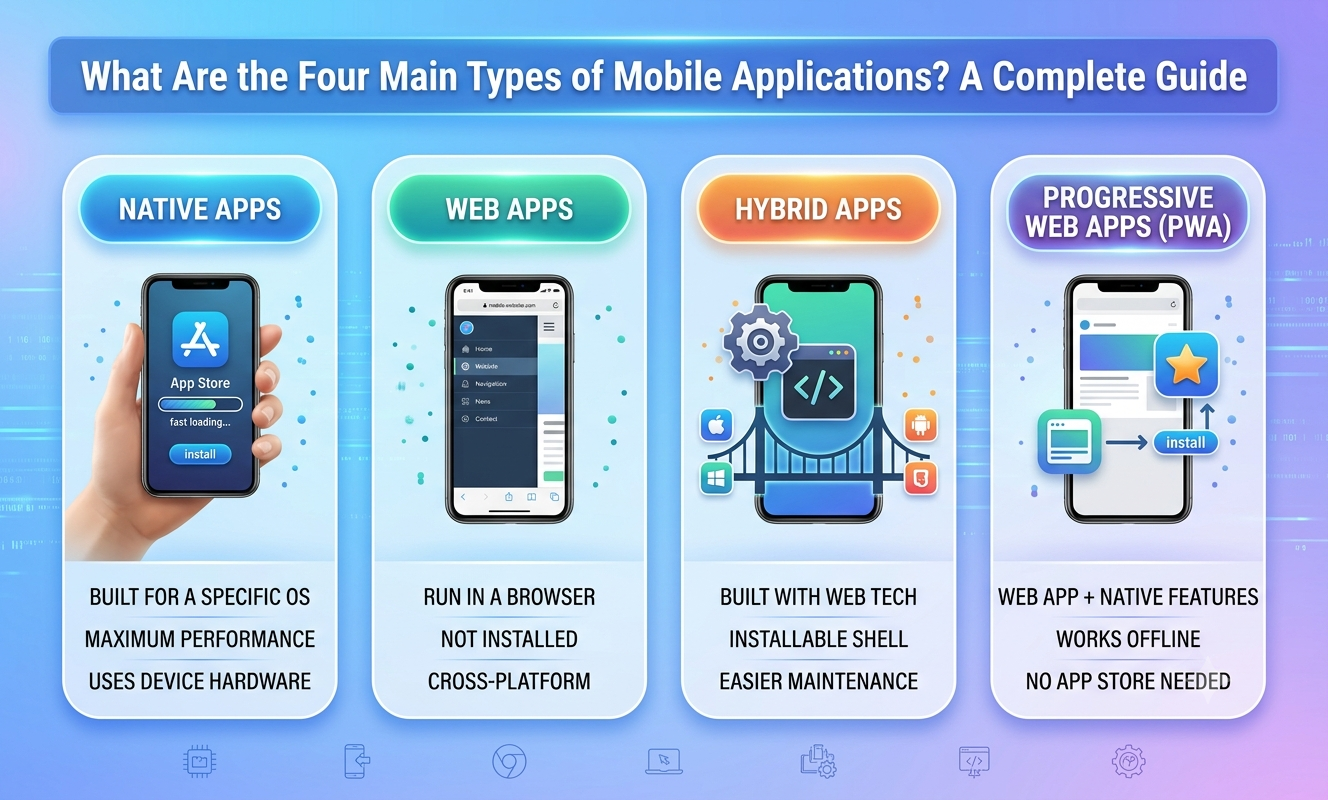
The four common types are native mobile apps, hybrid mobile apps, cross-platform mobile apps, and progressive web apps (PWAs). Each approach has its own strengths, limitations, development requirements, and ideal use cases.
Understanding the differences can help businesses choose the right technology before investing time and money into an app.
1. Native Mobile Applications
Native apps are applications developed specifically for a particular mobile operating system.
For example, an Android application is built specifically for Android devices, while an iOS application is created specifically for Apple's ecosystem.
Native development usually uses the programming languages and development tools recommended for that platform. Android apps commonly use Kotlin or Java, while iOS apps are typically developed using Swift or Objective-C.
How Do Native Apps Work?
A native application communicates closely with the operating system and the device's hardware.
This means developers can take advantage of features such as:
- GPS
- Camera
- Bluetooth
- Push notifications
- Biometric authentication
- Microphone
- Contacts
- Device storage
- Sensors
Because the application is designed for the specific platform, developers have greater control over performance and user experience.
For example, a company developing a demanding fitness application might choose native development because the app may need to communicate constantly with sensors, GPS, and other device features.
Advantages of Native Apps
The biggest advantage is performance.
Native apps generally provide smooth animations, fast response times, and strong access to device capabilities. They can also follow the design standards of the platform, giving users a familiar experience.
Security can also be easier to manage because developers have greater control over how the application interacts with the operating system.
For businesses specifically targeting Android users, professional Android Mobile App Development Services can help create applications designed around the Android ecosystem rather than trying to squeeze everything into a generic solution.
Disadvantages of Native Apps
There is one obvious catch: building separately for different platforms can increase development time and cost.
If a company wants both an Android and iOS version, developers may need to maintain two separate codebases.
That means more development work, testing, updates, and maintenance.
Native apps are therefore a strong choice when performance and platform-specific functionality are more important than keeping development costs as low as possible.
2. Hybrid Mobile Applications
Hybrid applications try to combine elements of native and web development.
Instead of creating completely separate applications for each platform, developers can build much of the application using web technologies such as HTML, CSS, and JavaScript and then package it so that it can run as a mobile application.
Think of it as taking a web-based application and giving it a mobile-app jacket.
How Do Hybrid Apps Work?
Hybrid applications typically run inside a native container. This container allows the web-based part of the application to communicate with certain device features through plugins or APIs.
This approach can make development faster because much of the code can be reused between platforms.
A business that wants to launch a relatively straightforward application on both Android and iOS may find this approach attractive.
Benefits of Hybrid Apps
One of the main benefits is code reuse.
Developers don't necessarily have to write every feature twice. A large portion of the application can be shared across platforms.
Hybrid development can therefore offer:
- Faster development
- Lower development costs
- Easier maintenance
- Shared code
- Faster deployment across platforms
For startups and smaller businesses, these advantages can be particularly useful.
Limitations of Hybrid Apps
Hybrid applications may not always deliver the same level of performance as well-optimised native applications.
This becomes more noticeable when an application involves complex animations, advanced graphics, intensive processing, or extensive interaction with device hardware.
For a simple business application, however, the difference may be barely noticeable to the average user.
3. Cross-Platform Mobile Applications
Cross-platform applications have become increasingly popular because businesses often want to reach both Android and iOS users without building everything twice.
The basic idea is simple: write a significant portion of the application once and deploy it across multiple platforms.
Technologies such as Flutter and React Native have helped make this approach popular among modern development teams.
Why Do Businesses Choose Cross-Platform Development?
Imagine a company wants to launch a food delivery app.
Its customers use a mixture of Android phones and iPhones. Building two completely separate applications could require two development teams or significantly more development time.
With cross-platform development, developers can share a large part of the code while still producing applications for different operating systems.
This can reduce development overhead and make updates easier to manage.
Key Advantages
Cross-platform development can provide several benefits:
One codebase:
A large portion of the application can be maintained in one place.
Reduced development time:
Teams don't have to duplicate every feature for every platform.
Lower costs:
Businesses may spend less compared with maintaining completely separate native projects.
Consistent experience:
The same core functionality can be delivered across different devices.
Easier maintenance:
Changes can often be implemented across platforms more efficiently.
Is Cross-Platform the Same as Hybrid?
Not exactly.
The terms are sometimes used interchangeably, but they can describe different technical approaches.
Traditional hybrid applications often rely heavily on web technologies running inside a native wrapper. Modern cross-platform frameworks can instead render or compile application interfaces in ways that provide a more native-like experience.
The technology landscape also changes quickly, so businesses should evaluate the framework based on the actual project rather than choosing a development method simply because it is fashionable.
4. Progressive Web Applications (PWAs)
Progressive Web Apps are slightly different from the first three types.
A PWA is essentially a web application that uses modern browser capabilities to provide an experience that feels more like a traditional mobile application.
Users can access a PWA through a web browser without necessarily downloading an application from the App Store or Google Play.
What Makes a PWA Different?
A good PWA can provide features such as:
- Responsive design
- Offline functionality
- Push notifications
- Fast loading
- Home-screen installation
- Caching
- Secure HTTPS connections
For example, someone could visit a company's website on their phone, add the PWA to their home screen, and then return to it almost like they would with a normal mobile app.
There is no giant installation ceremony. Just tap, add, and get on with your life.
Advantages of PWAs
The biggest attraction is accessibility.
Users don't necessarily need to visit an app store before using the application. They can simply open a URL.
PWAs can also be cheaper to develop and maintain because businesses are essentially managing a web-based application rather than separate native applications.
They can be particularly useful for:
- News platforms
- E-commerce businesses
- Content websites
- Booking systems
- Online services
- Customer portals
Limitations of PWAs
PWAs do have limitations.
Access to certain advanced device features may not be as extensive as it is with native applications. Browser support can also vary between platforms and operating systems.
For applications that require deep hardware integration or extremely high performance, a native approach may still be more appropriate.
Native vs Hybrid vs Cross-Platform vs PWA
The four approaches can look confusing at first, especially because the terminology overlaps.
Here is a simple comparison:
| App Type | Main Advantage | Potential Limitation | Best For |
|---|---|---|---|
| Native | Excellent performance | Higher development cost | High-performance apps |
| Hybrid | Code reuse and faster development | May have performance limitations | Simple to medium apps |
| Cross-platform | One codebase for multiple platforms | Some platform-specific limitations | Businesses targeting Android and iOS |
| PWA | Accessible through the web | Limited native functionality | Web-based services |
The "best" option depends entirely on what the application needs to accomplish.
How Do You Choose the Right Mobile App Type?
There isn't a universal answer.
Before choosing a development approach, businesses should consider several important questions.
Who Will Use the App?
If most customers use Android, investing heavily in iOS-specific development may not make sense initially.
On the other hand, a global consumer application may need both platforms from day one.
What Features Does the App Need?
An application requiring GPS tracking, Bluetooth communication, advanced camera functions, or intensive graphics may benefit from native development.
A basic booking application probably doesn't need that level of complexity.
What Is the Budget?
Budget matters.
A startup with limited resources may prefer cross-platform development because it can potentially reduce duplication. A large enterprise with complex requirements may be comfortable investing in separate native applications.
How Quickly Does the App Need to Launch?
If speed is a major priority, reusable-code approaches can be attractive.
However, rushing development just to launch quickly can create technical problems later. A fast launch is useful; a fast launch followed by six months of emergency fixes is considerably less impressive.
Why Mobile App Development Strategy Matters
Choosing the type of mobile application is not simply a technical decision.
It affects the budget, development timeline, scalability, maintenance requirements, user experience, and future upgrades.
A business should therefore define its requirements before choosing a framework or development method.
For companies that want guidance throughout the process, working with a professional Mobile App Development Agency UK can make it easier to evaluate the options based on the actual business requirements rather than choosing technology first and figuring out the purpose later.
A good development strategy should consider the app's target audience, required features, security, scalability, integrations, expected traffic, maintenance, and long-term goals.
Final Thoughts
So, what are the four main types of mobile applications?
The four widely used approaches are native apps, hybrid apps, cross-platform apps, and progressive web apps.
Native apps are excellent when performance and deep device integration matter. Hybrid applications can simplify development through code reuse. Cross-platform development is useful for businesses that want to target multiple operating systems efficiently. PWAs provide a convenient middle ground between websites and traditional applications.
The right choice isn't necessarily the newest technology or the cheapest option.
It is the approach that fits the users, features, budget, performance requirements, and long-term business goals.
Before starting development, it is worth mapping out those requirements first. Once you know what the application actually needs to do, choosing the right development approach becomes much easier.

 English
 Arabic
 French
 Spanish
 Portuguese
 Deutsch
 Dutch
Dutch
 Italiano
 Russian
 Romaian
 Portuguese (Brazil)
 Greek
Greek