


CPA Letter vs. CPA Certification: Understanding the Difference
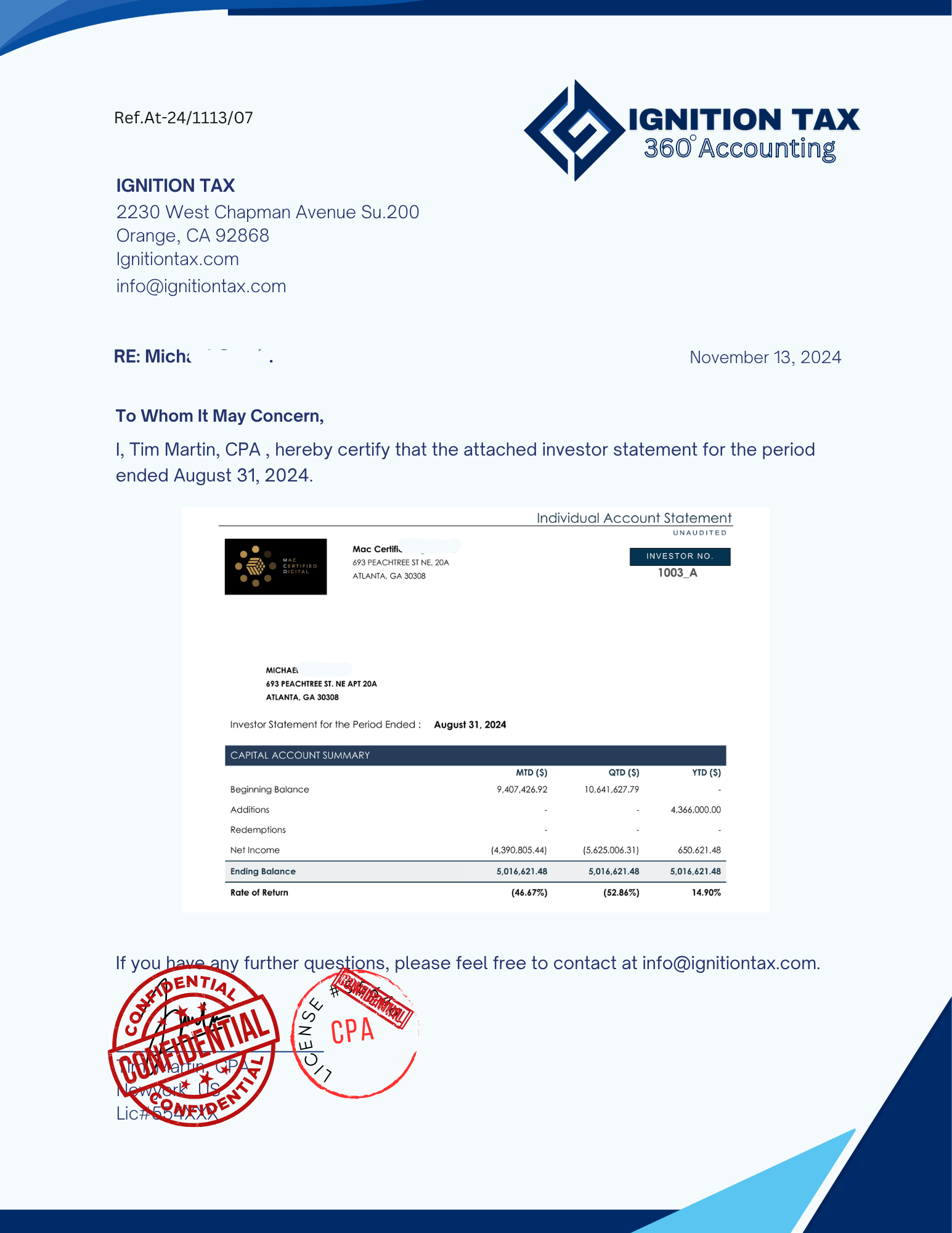
When you need to verify your income, business finances, tax information, or financial position, you may be asked to provide a CPA Letter. Because the terms “CPA letter,” “CPA certification,” and “CPA certificate” are sometimes used interchangeably, it is easy to become confused about what each document actually means.
A CPA Letter is generally a professional letter prepared and signed by a qualified Certified Public Accountant (CPA) based on financial or tax information the CPA has reviewed or is authorized to confirm. The exact contents and level of assurance can vary depending on why the letter is needed and what the requesting organization requires.
At Ignition Tax, we provide CPA letter services throughout the United States, helping individuals, self-employed professionals, business owners, and other clients obtain professionally prepared CPA letters for legitimate financial and verification purposes.
What Is a CPA Letter?
A CPA Letter is a written statement from a CPA that may confirm specific financial or tax-related information about an individual or business.
Depending on the purpose, a CPA letter may address information such as:
-
Income or self-employment income
-
Business ownership
-
Business activity or financial position
-
Tax filing information
-
Financial records reviewed by the CPA
-
Professional accounting services provided to the client
-
Other information that the CPA can appropriately verify
The contents of a CPA Letter should always reflect information that the CPA can reasonably support through appropriate records and professional knowledge.
Importantly, a CPA Letter is not automatically the same thing as an audit, review, compilation, or formal financial statement certification. The level of professional assurance depends on the engagement and the specific services performed.
Why Might Someone Need a CPA Letter?
A CPA Letter can be useful when a third party wants additional documentation or professional confirmation of financial information.
Common situations may include:
1. Income Verification
Self-employed individuals and business owners may not receive traditional pay stubs or W-2 forms. In these circumstances, a lender, landlord, financial institution, or other organization may request a letter from a CPA to help verify income.
A CPA may be able to confirm information based on the client's applicable financial and tax records.
2. Mortgage or Loan Applications
Some lenders request additional documentation from self-employed borrowers because business income can be more complex than traditional employee wages.
A CPA Letter may be requested as supporting documentation, although the lender determines what documents it will accept.
3. Rental or Housing Applications
Landlords or property managers may request proof of income or financial stability. For self-employed applicants, a CPA Letter can sometimes serve as supplementary documentation when accepted by the property owner or management company.
4. Business Verification
A business owner may need professional confirmation of business ownership, business activity, or certain financial information for a legitimate business or administrative purpose.
5. Financial or Administrative Requirements
Depending on the situation, a CPA Letter may be requested by an institution, organization, professional, or other third party that needs supporting financial information.
The requesting party should always be consulted about its specific requirements before ordering a letter.
What Is CPA Certification?
The term CPA certification can create confusion because becoming a CPA in the United States involves professional licensure rather than simply receiving a generic certificate.
According to the National Association of State Boards of Accountancy (NASBA), a CPA is a Certified Public Accountant licensed by a state board of accountancy. There is no single national CPA license; CPA licensing is handled through U.S. jurisdictions.
Generally, candidates must satisfy applicable education, examination, experience, ethics, and other state-specific requirements to obtain a CPA license. Requirements can vary by jurisdiction.
Therefore, a CPA Letter does not make someone a CPA. Instead, it is a professional document that may be prepared by a licensed CPA for a particular purpose.
CPA Letter vs. CPA Certification: Key Differences
Although the terms may sound similar, they serve different purposes.
|
CPA Letter |
CPA Certification / CPA Credential |
|
A written professional letter |
A professional credential or evidence related to CPA licensure |
|
Prepared for a specific purpose |
Associated with becoming or maintaining CPA status |
|
May verify specified financial or tax information |
Demonstrates that an individual has met applicable licensing requirements |
|
Usually addressed to a specific recipient or organization |
Generally relates to the CPA's professional status |
|
Does not make the recipient a CPA |
Relates to the CPA's qualification/licensure |
|
Requirements depend on the requesting organization |
Requirements depend on the applicable jurisdiction |
The most important distinction is simple: a CPA Letter is a document; CPA status is a professional license.
What Information Can a CPA Letter Include?
The information included in a CPA Letter depends on the client's circumstances and the purpose of the letter.
A properly prepared letter may include:
-
Client's name
-
Business name, when applicable
-
Nature of the client's business or profession
-
Relevant period of income or business activity
-
Financial information the CPA can appropriately confirm
-
Tax-related information, where applicable
-
Description of the CPA-client relationship
-
Relevant qualifications or professional information
-
CPA's signature and professional details
-
Date of the letter
-
Intended recipient or purpose, when appropriate
A CPA should not include information that cannot be supported by appropriate records or professional knowledge.
Does a CPA Letter Mean the Information Has Been Audited?
Not necessarily.
This is one of the most important points to understand when requesting a CPA Letter.
A letter from a CPA does not automatically mean that the CPA has conducted an audit or provided an audit-level opinion. Different accounting services involve different procedures and levels of assurance.
For example, a CPA may perform services involving tax preparation, bookkeeping, compilation, review, or audit work. The nature of each engagement determines what the CPA can appropriately state.
If a lender, government agency, immigration professional, landlord, or another organization specifically requires an audited financial statement or another formal accounting report, a basic CPA Letter may not satisfy that requirement.
Always confirm the exact documentation requirements with the organization requesting the document.
CPA Letter for Self-Employed Individuals
CPA Letters are particularly relevant to self-employed individuals because their income documentation can look different from that of traditional employees.
A self-employed person may have income reported through business records and tax filings rather than regular payroll documentation. In appropriate circumstances, a CPA can review relevant records and prepare a letter addressing information the CPA is able to support.
Depending on the situation, supporting records may include:
-
Tax returns
-
Profit and loss statements
-
Business accounting records
-
Bank or financial records
-
Invoices or other business documentation
-
Other relevant financial information
The exact documents needed will depend on the purpose of the CPA Letter and the CPA's professional requirements.
CPA Letter for Business Owners
Business owners may also need CPA Letters for financial verification or administrative purposes.
For example, a business owner may need professional confirmation concerning business ownership, business operations, or specific financial information.
Because every business has a different structure and accounting history, the CPA may need to review relevant records before determining what information can appropriately be included in the letter.
What Is the Process for Getting a CPA Letter?
The process is generally straightforward, but the requirements can vary depending on the purpose.
Step 1: Identify the Purpose
First, determine why you need the CPA Letter.
For example, is it for:
-
Income verification?
-
A mortgage or loan?
-
A rental application?
-
Business documentation?
-
Another financial or administrative requirement?
Step 2: Confirm the Recipient's Requirements
Ask the organization requesting the letter what it needs.
This is important because some organizations have specific wording, date, information, or documentation requirements.
Step 3: Provide Supporting Information
Your CPA may need relevant tax returns, accounting records, financial statements, identification, business information, or other documentation.
Step 4: Professional Review
The CPA reviews the information relevant to the requested letter and determines what can appropriately be stated.
Step 5: Preparation of the CPA Letter
The letter is prepared according to the applicable circumstances and professional requirements.
Step 6: Delivery
Once finalized and signed, the CPA Letter can be provided to the client or intended recipient according to the agreed process.
Why Choose Ignition Tax for CPA Letter Services?
At Ignition Tax, we understand that obtaining financial documentation can be confusing, particularly when a third party has requested a specific type of verification.
Our CPA letter services are designed to make the process more straightforward for clients throughout the United States.
We focus on:
-
Professional CPA Letter preparation
-
Understanding the purpose of your requested letter
-
Reviewing the information needed for the engagement
-
Clear communication throughout the process
-
Serving clients across the United States
-
Preparing documentation based on information that can be appropriately supported
Our goal is to help clients obtain the appropriate professional documentation for legitimate financial and verification needs.
What Should You Avoid When Requesting a CPA Letter?
A CPA Letter should always be based on accurate and supportable information.
Avoid providers who promise a letter containing information that cannot be verified or who suggest creating documentation solely to satisfy a requirement without appropriate supporting records.
A professional CPA cannot simply confirm whatever information a client requests. The contents of the letter must be consistent with the facts and the CPA's professional responsibilities.
If an organization has given you specific instructions, provide those instructions to the CPA before the letter is prepared.
Frequently Asked Questions About CPA Letters
Is a CPA Letter the same as a CPA certificate?
No. A CPA Letter is a professional written document prepared for a particular purpose. A CPA credential relates to the professional's CPA licensure and status.
Can a CPA Letter verify income?
It can, depending on the circumstances and the information the CPA can appropriately support. Whether the recipient accepts the letter is ultimately determined by the organization requesting income verification.
Can self-employed people get a CPA Letter?
Yes. Self-employed individuals are common users of professional income and financial verification letters. The CPA will generally need relevant records before determining what can be stated.
Does every CPA Letter have the same format?
No. There is no single universal CPA Letter format for every purpose. Requirements can differ depending on the recipient, purpose, facts, and professional engagement.
Can a CPA Letter replace a tax return?
Generally, a CPA Letter and a tax return serve different purposes. If an organization specifically asks for a tax return, you should provide the requested tax return in addition to any CPA Letter it may require.
Does a CPA Letter guarantee loan or rental approval?
No. A CPA Letter is supporting documentation. The lender, landlord, or other organization makes its own decision based on its requirements and underwriting or verification process.
Final Thoughts
A CPA Letter can be valuable when an individual or business needs professional confirmation of specific financial or tax-related information. However, it is important to understand that a CPA Letter is not the same as CPA licensure, an audit report, or every other type of accounting certification.
The right documentation depends on the purpose of the request and the requirements of the organization receiving it.
If you need a professionally prepared CPA Letter in the United States, Ignition Tax provides CPA letter services for eligible clients and can help you understand the information and documentation needed for your specific situation.

 Arabic
 French
 Spanish
 Portuguese
 Deutsch
 Turkish
 Dutch
Dutch
 Italiano
 Russian
 Romaian
 Portuguese (Brazil)
 Greek
Greek