


Does an IVF Lab Design Company offer validation, documentation, maintenance, and after-sales support?
INTRODUCTION
An IVF Lab Design Company can offer much more than architectural planning and installation. Depending on the project's scope and contractual agreement, a specialized provider may support validation, technical documentation, preventive maintenance, troubleshooting, staff training, system upgrades, and after-sales services. These services are particularly valuable because an IVF laboratory depends on carefully controlled environmental conditions, reliable HVAC and filtration, stable utilities, specialized equipment infrastructure, and documented operating procedures.
A well-designed laboratory should continue performing according to its intended specifications after construction and commissioning. This is why post-installation support should be considered when selecting a laboratory design and engineering partner.
Why Post-Installation Support Matters in an IVF Laboratory
An IVF laboratory is a technically sensitive environment. Embryology, ICSI, media preparation, and related activities can depend on stable environmental conditions and reliable equipment.
A laboratory may contain:
- HVAC systems
- HEPA filtration
- Air-handling units
- Environmental monitoring systems
- Incubators
- Cryogenic storage systems
- Specialized workstations
- Medical gases
- Electrical backup systems
- Temperature and humidity controls
Even a well-designed facility can experience performance changes over time because of filter loading, equipment wear, calibration drift, changes in room usage, or modifications to the facility.
Ongoing technical support helps identify these issues and maintain the intended operating conditions.
1. Validation Support
Validation and commissioning are important parts of establishing an operational IVF laboratory.
The exact validation scope depends on the facility, equipment, applicable requirements, and project specifications.
A specialized provider may support testing of:
- HVAC performance
- Airflow
- Room pressure
- Temperature
- Relative humidity
- HEPA filter integrity
- Particle levels
- Environmental monitoring systems
- Electrical systems
- Backup power systems
The objective is to verify that installed systems perform according to predetermined specifications.
It is important to distinguish commissioning, qualification, and validation, because these terms can have different meanings depending on the system and regulatory framework.
2. HVAC Testing and Commissioning
HVAC is one of the most important building systems in an IVF laboratory.
A service provider may assist with:
- Air-volume measurement
- Airflow balancing
- Temperature verification
- Humidity verification
- Pressure differential testing
- Filter integrity testing
- AHU performance checks
- Control-system verification
Testing should be performed using appropriate calibrated instruments and documented procedures.
Regular testing can also help identify performance deterioration before it becomes a major operational problem.
3. HEPA Filter Integrity Testing
HEPA filtration is frequently incorporated into controlled laboratory environments.
After installation, appropriate integrity testing can help verify that the installed filter and housing system are functioning correctly.
Testing can help identify:
- Filter damage
- Seal problems
- Leakage
- Installation issues
The testing frequency should be determined according to the laboratory's quality program, risk assessment, equipment requirements, and applicable standards.
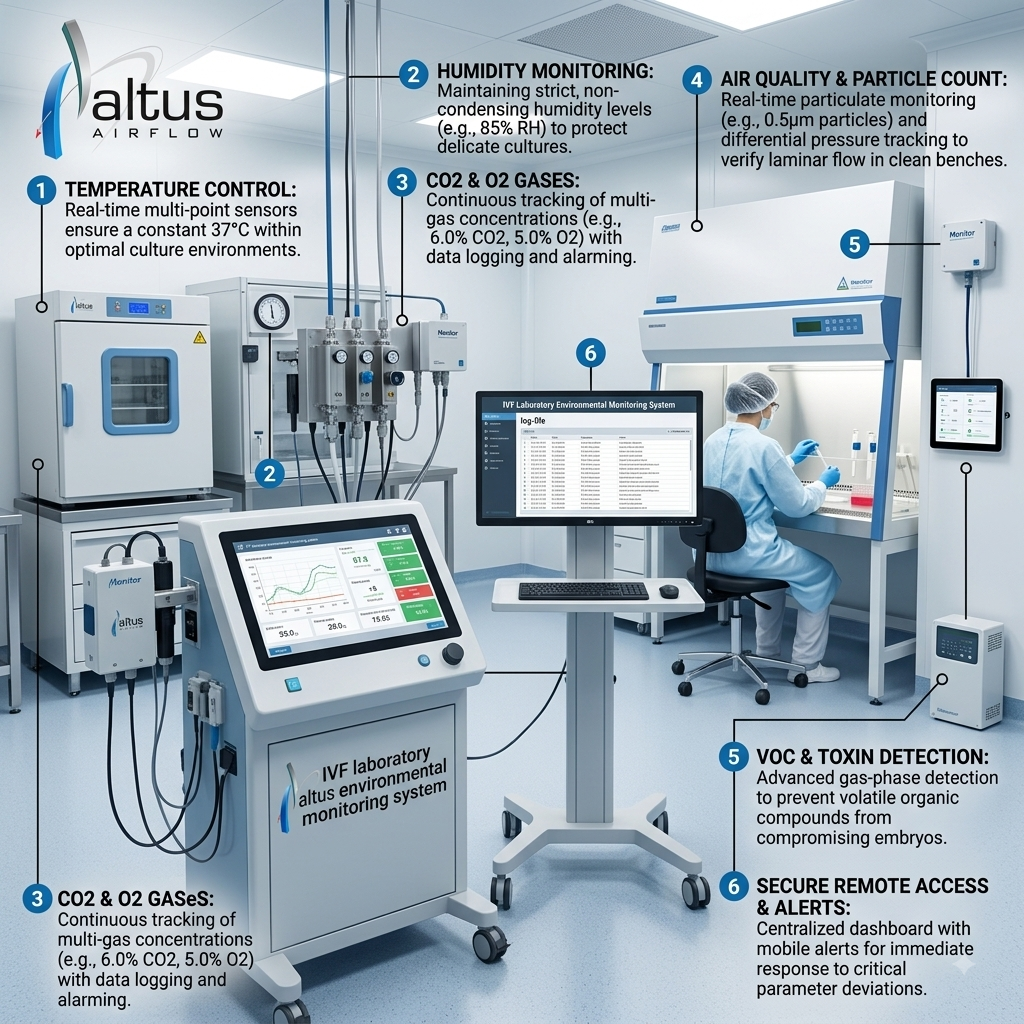
4. Environmental Monitoring
An IVF laboratory may require ongoing monitoring of critical environmental parameters.
These can include:
- Temperature
- Relative humidity
- Room pressure
- Airborne particles
- HVAC status
- Other process-specific parameters
Modern monitoring systems can provide alarms when values move outside predefined limits.
Depending on the system, historical data can also help laboratories identify trends.
For example, gradual temperature instability may indicate a developing HVAC or equipment problem.
5. Documentation Support
Documentation is another important service that a specialized laboratory engineering provider may offer.
Project documentation can include:
- Design drawings
- HVAC drawings
- Electrical drawings
- Equipment layouts
- Piping diagrams
- Control-system documentation
- Technical specifications
- Equipment manuals
- Testing reports
- Commissioning records
- As-built drawings
- Maintenance schedules
The exact documentation package depends on the project contract.
Good documentation makes future maintenance, troubleshooting, modification, and auditing easier.
6. As-Built Documentation
The laboratory constructed on site may differ slightly from the original design because of approved modifications made during construction.
As-built documentation records the final installed configuration.
It can include updated information about:
- Wall and ceiling systems
- HVAC duct routes
- Equipment locations
- Electrical circuits
- Medical gas lines
- Service connections
- Control systems
Maintaining accurate as-built documentation is valuable when future renovations or equipment replacements are required.
7. Operation and Maintenance Manuals
An experienced provider may supply operation and maintenance documentation for installed systems.
These documents can explain:
- Equipment operation
- Routine inspections
- Filter replacement
- Cleaning requirements
- Alarm conditions
- Maintenance intervals
- Troubleshooting procedures
- Safety precautions
Such manuals can help facility teams understand how systems should be operated and maintained.
8. Preventive Maintenance
Preventive maintenance is designed to identify and address potential problems before they cause system failure.
An IVF laboratory maintenance plan may include periodic inspection of:
- HVAC equipment
- Filters
- Air-handling units
- Sensors
- Controls
- Electrical systems
- Backup systems
- Doors and seals
- Modular panels
- Environmental monitoring equipment
The exact maintenance frequency depends on equipment manufacturer recommendations, usage, environmental conditions, and the facility's quality program.
9. HEPA Filter Maintenance
HEPA filters do not necessarily require replacement at a fixed universal interval.
Replacement decisions can be based on:
- Pressure drop
- Filter condition
- Integrity-test results
- Manufacturer recommendations
- Environmental conditions
- Maintenance history
A professional maintenance program can monitor filter performance and recommend replacement when appropriate.
10. HVAC Preventive Maintenance
HVAC maintenance can include:
- AHU inspection
- Fan inspection
- Coil cleaning
- Drain inspection
- Belt checks where applicable
- Sensor verification
- Filter inspection
- Control-system checks
- Airflow verification
Poor HVAC maintenance can affect temperature, humidity, pressure, airflow, and overall laboratory performance.
11. Calibration Support
Certain monitoring devices and instruments require periodic calibration.
These may include:
- Temperature sensors
- Humidity sensors
- Pressure sensors
- Differential-pressure gauges
- Particle counters
- Environmental monitoring devices
A service provider may coordinate calibration services or provide technical assistance in maintaining calibration records.
Calibration intervals should be established according to equipment specifications, risk assessment, and the laboratory's quality-management system.
12. Breakdown and Troubleshooting Support
Even with preventive maintenance, unexpected failures can occur.
After-sales support may include technical assistance for:
- HVAC faults
- Temperature deviations
- Pressure problems
- Control-system alarms
- Filter issues
- Electrical failures
- Sensor problems
Fast troubleshooting can help reduce operational interruptions.
However, critical IVF processes should always have appropriate contingency procedures established by the laboratory management team.
13. Emergency Support
Some providers offer emergency technical support through defined service agreements.
Emergency support may cover critical infrastructure such as:
- HVAC
- Power
- Environmental monitoring
- Control systems
- Filtration
- Specialized utility systems
The response time and availability should be clearly stated in the service contract rather than assumed.
14. Staff Training
Technical training can be another component of after-sales support.
Training may cover:
- HVAC operation
- Environmental monitoring
- Alarm response
- Basic maintenance
- Cleaning requirements
- Equipment handling
- System shutdown procedures
- Emergency procedures
Training helps facility staff understand how the infrastructure operates and what actions should be taken when abnormal conditions occur.
15. Training on Environmental Monitoring
Environmental monitoring systems are only useful when staff understand how to interpret their readings.
Training can explain:
- Normal operating ranges
- Alarm conditions
- Data logging
- Trend analysis
- Escalation procedures
- Documentation requirements
This helps ensure that abnormal environmental conditions are recognized promptly.
16. Annual Maintenance Contracts
An Annual Maintenance Contract (AMC) can provide structured technical support after project completion.
Depending on the agreement, an AMC may include:
- Scheduled inspections
- Preventive maintenance
- Equipment checks
- HVAC servicing
- Filter assessment
- Calibration coordination
- Breakdown support
- Technical reporting
The scope varies considerably between providers, so hospitals and fertility centers should review the agreement carefully.
17. Comprehensive Maintenance Contracts
Some facilities may prefer broader service arrangements.
A comprehensive maintenance agreement may cover a wider range of systems and replacement components, depending on the contract.
This can simplify facility management by creating a defined maintenance responsibility.
However, critical laboratory equipment may still require separate service agreements with its original equipment manufacturer.
18. Spare Parts Support
Long-term laboratory operation may require replacement parts.
A service provider may assist with sourcing or supplying components such as:
- Filters
- Sensors
- Belts
- Control components
- Fans
- Motors
- Seals
- Electrical components
The availability of critical spare parts should be considered when evaluating an after-sales service provider.
19. System Upgrades
Laboratory requirements can change as clinical services expand.
After-sales engineering support can help with:
- HVAC upgrades
- Additional filtration
- Monitoring-system upgrades
- Electrical capacity expansion
- Additional equipment connections
- Room modifications
- Control-system modernization
A modular facility can sometimes make selected upgrades easier, depending on how the original infrastructure was designed.
20. Documentation for Future Expansion
Good documentation has value beyond the original project.
Suppose a fertility center decides to add:
- An additional embryology room
- More incubators
- A larger cryostorage area
- Additional ICSI workstations
Accurate drawings and technical records can help engineers understand the existing infrastructure before modifications are made.
This can reduce unnecessary disruption.
21. Audit and Compliance Support
IVF laboratories may need to demonstrate that their facilities and processes meet applicable requirements.
A technical service provider may assist with documentation and facility records related to:
- HVAC testing
- Environmental monitoring
- Equipment maintenance
- Calibration
- Filter testing
- Commissioning
The provider's role should not be confused with the laboratory's own regulatory and quality responsibilities.
The facility remains responsible for maintaining appropriate quality systems and compliance.
22. Risk-Based Maintenance
Not every component requires the same maintenance frequency.
Critical systems should be prioritized according to their potential impact on laboratory operations.
For example:
Higher-priority systems may include:
- HVAC
- Environmental monitoring
- Critical power
- Incubation-related infrastructure
- Cryogenic storage support systems
A risk-based maintenance plan can allocate resources where they have the greatest operational value.
23. Why Documentation Should Continue After Commissioning
Documentation should not stop when the laboratory is handed over.
Maintenance teams should keep records of:
- Service visits
- Repairs
- Filter replacements
- Calibration
- Testing
- Alarm events
- System modifications
- Equipment changes
This creates a useful maintenance history.
Trend analysis of these records can help identify recurring problems.
24. Digital Maintenance Records
Modern laboratories can use digital systems to manage maintenance information.
Digital platforms can store:
- Service schedules
- Calibration certificates
- Testing reports
- Maintenance records
- Equipment information
- Alarm history
Digital records can make information easier to retrieve during inspections, audits, and troubleshooting.
25. Remote Monitoring and Technical Support
Where appropriate, connected monitoring systems can provide remote visibility into selected laboratory infrastructure.
Potential applications include monitoring:
- HVAC status
- Temperature
- Humidity
- Pressure
- Equipment alarms
Remote monitoring should always be implemented with appropriate cybersecurity, access control, and data-management measures.
26. Cleaning and Facility Maintenance Guidance
Material and system selection can influence cleaning procedures.
A specialized provider may provide recommendations for maintaining:
- Modular walls
- Ceiling panels
- Flooring
- Doors
- Seals
- HVAC components
Cleaning products should be compatible with the materials and laboratory's infection-control and quality procedures.
27. Support During Warranty Period
Most major infrastructure projects include some form of warranty.
Warranty support may cover defects in:
- Installation
- Selected equipment
- Materials
- Controls
- System workmanship
The exact coverage, exclusions, response time, and warranty duration should be defined in writing.
A warranty is different from a long-term maintenance contract.
28. After-Sales Support Reduces Operational Risk
A laboratory does not stop needing engineering support once construction is completed.
Over time:
- Filters become loaded
- Sensors may drift
- HVAC components wear
- Equipment is replaced
- Room usage changes
- New technologies become available
A continuing support relationship can help the facility respond to these changes systematically.
29. What Should a Hospital Check Before Signing a Support Contract?
Healthcare organizations should ask potential providers:
- What validation services are included?
- What documentation will be supplied?
- Is preventive maintenance included?
- What systems are covered?
- Are spare parts included?
- What is the emergency response time?
- Are calibration services included?
- Are annual testing services included?
- Is staff training provided?
- What is covered under warranty?
- What is excluded?
- Are service reports provided after every visit?
Clear answers can prevent misunderstandings later.
30. Validation, Documentation and Maintenance Work Together
These services should not be viewed independently.
Validation establishes that systems perform according to specified requirements.
Documentation records how systems were designed, installed, tested, and maintained.
Maintenance helps preserve system performance.
After-sales support provides technical assistance when problems or changes occur.
Together, these activities support the long-term reliability of the laboratory infrastructure.
31. Importance of Choosing a Specialized Provider
An IVF laboratory differs from a conventional office, commercial building, or general laboratory.
The provider should understand:
- Cleanroom principles
- HVAC engineering
- HEPA filtration
- Environmental monitoring
- Laboratory workflow
- Specialized equipment
- Utility requirements
- Maintenance
- Testing and commissioning
Specialized knowledge can make post-installation support more effective because the provider understands how different building systems interact.
32. What an Ideal Support Program Looks Like
A comprehensive support program can follow a lifecycle approach:
Design → Installation → Testing → Commissioning → Documentation → Training → Preventive Maintenance → Validation/Periodic Testing → Upgrades
This approach treats the IVF laboratory as a long-term operational system rather than a one-time construction project.
Conclusion
An IVF Lab Design Company can offer validation, documentation, maintenance, and after-sales support when these services are included in its project scope or service agreement. Support may cover HVAC testing, HEPA filter integrity testing, environmental monitoring, calibration coordination, preventive maintenance, troubleshooting, spare parts, staff training, technical documentation, and system upgrades. Before appointing a provider, fertility centers should clearly define the scope of validation, warranty coverage, maintenance responsibilities, response times, documentation, and long-term service requirements. Altus Airflow takes an engineering-focused approach to IVF laboratory infrastructure, supporting clients with coordinated design, technical systems, commissioning, documentation, and ongoing facility-support requirements.
Frequently Asked Questions
1. Does an IVF Lab Design Company provide validation services?
Yes, an IVF Lab Design Company may provide or coordinate validation and commissioning activities for HVAC, airflow, HEPA filtration, pressure, temperature, humidity, and other project-specific systems.
2. What documentation can an IVF laboratory design provider supply?
An IVF Lab Design Company may provide design drawings, equipment layouts, HVAC documentation, technical specifications, testing reports, commissioning records, operation manuals, maintenance schedules, and as-built drawings.
3. Does an IVF Lab Design Company provide maintenance after installation?
Depending on the contract, an IVF Lab Design Company may provide preventive maintenance, HVAC servicing, filter assessment, troubleshooting, calibration coordination, and technical support.
4. What is included in after-sales support?
After-sales support from an IVF Lab Design Company can include breakdown assistance, preventive maintenance, spare-parts coordination, technical troubleshooting, staff training, warranty support, and system upgrades.
5. Does an IVF Lab Design Company offer annual maintenance contracts?
Some providers offer AMCs covering specified infrastructure systems. An IVF Lab Design Company should clearly define the equipment, maintenance frequency, response times, exclusions, and replacement-parts responsibilities in the agreement.
Read Our Previous Blog------>What latest technologies are incorporated into Modular Ophthalmic OT Setup Services?

 English
 Arabic
 French
 Spanish
 Portuguese
 Deutsch
 Dutch
Dutch
 Italiano
 Russian
 Romaian
 Portuguese (Brazil)
 Greek
Greek