


Industrial Salt: Uses, Applications, Processing, and Importance Across Industries
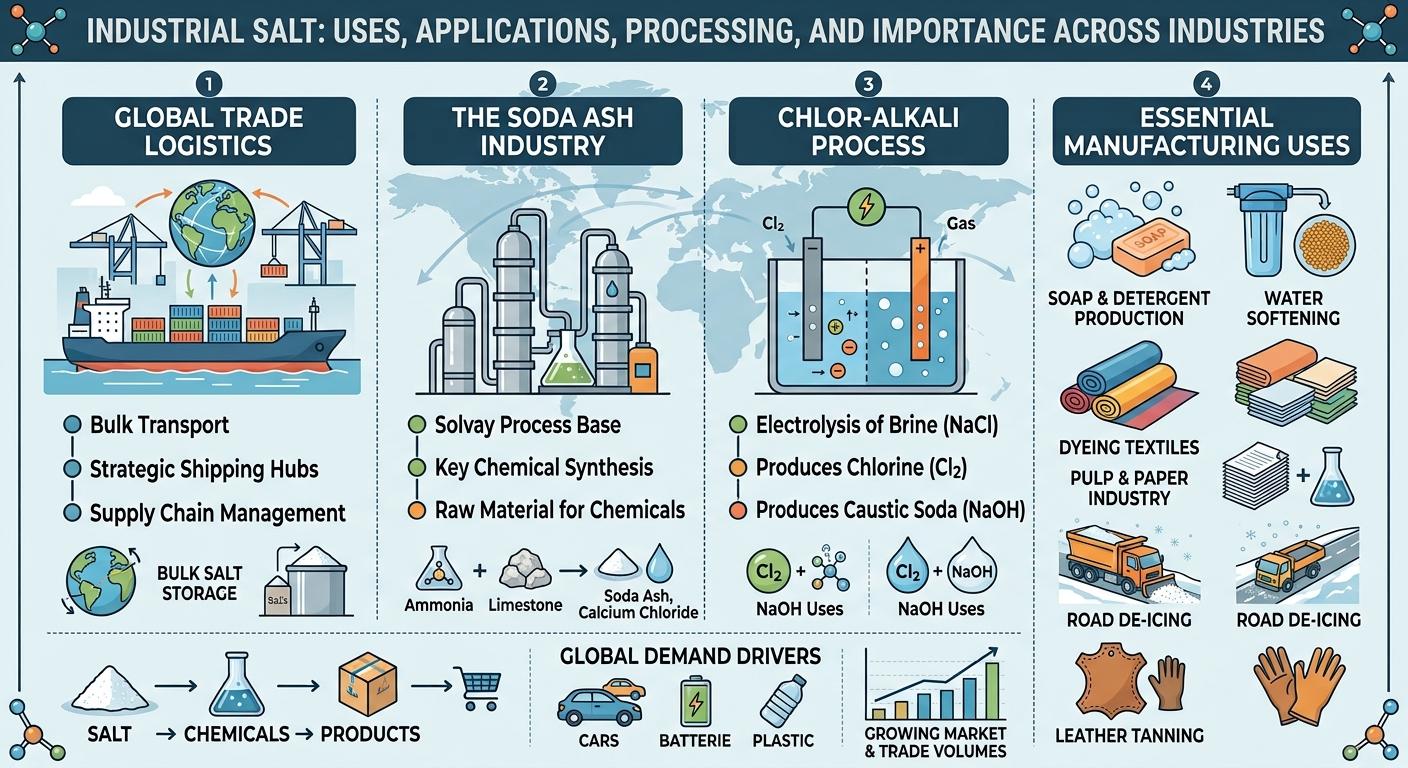
Industrial salt is an important raw material used in many manufacturing and commercial processes. Unlike edible salt, which is prepared for human consumption, industrial salt is produced for specific industrial applications.
It can be supplied as fine granules, coarse crystals, lumps, or other forms depending on the requirements of a particular industry. Its versatility makes it useful in chemical manufacturing, water treatment, textiles, leather processing, and several other sectors.
What Is Industrial Salt?
Industrial salt refers to salt that is manufactured, processed, or supplied for industrial applications rather than direct human consumption.
It is commonly sourced from natural rock salt deposits or produced through evaporation processes. After extraction, salt may be crushed, screened, washed, dried, or processed according to its intended application.
The required purity and grain size can vary considerably between industries.
How Industrial Salt Is Produced
The production of industrial salt can involve several stages.
1. Salt Extraction
Salt may be extracted from underground deposits through mining. Natural rock salt deposits can contain large quantities of sodium chloride.
2. Crushing
Large pieces are crushed into smaller crystals. The required size depends on the intended application.
3. Screening
The crushed salt is screened to separate different grain sizes. This allows manufacturers to supply fine, medium, coarse, or granular products.
4. Washing and Processing
Some applications require additional washing or purification. Processing requirements depend on the quality specifications of the final product.
5. Drying and Packaging
The processed salt may be dried and packaged in bags, bulk containers, or other suitable formats for transportation.
Industrial Salt Processing Systems
Modern industrial salt processing systems can include equipment for crushing, screening, washing, drying, conveying, and packaging.
The exact system depends on the raw material and final product specifications.
A processing facility may use several stages to achieve a consistent crystal size and appropriate purity for its target industry.
Industrial Salt Applications
There are many industrial salt applications across different sectors.
Chemical Manufacturing
Salt is an important raw material in the chemical industry. Sodium chloride can be used in processes that produce chemicals such as chlorine and caustic soda.
Water Treatment
Salt is commonly used in water-softening systems. Suitable salt products can help regenerate ion-exchange water softeners.
Textile Industry
Salt can be used during certain textile dyeing and processing operations. It can help control conditions during specific dyeing processes.
Leather Processing
Salt may be used during the preservation and processing of hides and skins.
Manufacturing
Different manufacturing processes may require salt as a processing ingredient, raw material, or functional material.
These applications demonstrate why consistent salt quality and particle size are important.
Where Can You Get Rock Salt?
People often ask, "where can you get rock salt?" Rock salt can be sourced from specialized salt producers, wholesalers, distributors, and industrial suppliers.
However, the correct product depends on the intended application.
For industrial use, buyers should consider:
- Purity requirements
- Crystal size
- Moisture content
- Packaging
- Quantity
- Delivery requirements
- Intended application
It is important not to assume that all rock salt has the same specifications.
Rock Salt for Industrial Use
Rock salt is a naturally occurring form of salt that is commonly extracted from underground deposits.
Industrial-grade rock salt can be supplied in different crystal sizes. Coarse rock salt may be suitable for applications where larger particles are required, while finer material may be preferred for other processes.
Always check the technical specifications before purchasing.
Salt Granulated for Industrial Applications
Salt granulated products contain relatively uniform salt particles and can be useful in applications where consistent grain size matters.
Granulated salt can be supplied in different grades depending on the industry and processing requirements.
Manufacturers should select a grade that matches their specific equipment and production process.
Industrial Salt and Water Softening
One of the well-known uses of industrial-grade salt is water softening.
Water softeners use salt during the regeneration process to restore the ion-exchange resin. Salt products for this purpose are available in different forms, including crystals, pellets, and other shapes.
It is important to select salt specifically designed for water-softening equipment rather than using an unsuitable industrial product.
Industrial Salt Processing and Quality
Quality control is an important part of industrial salt processing.
Manufacturers and buyers may evaluate factors such as:
- Sodium chloride content
- Moisture
- Insoluble matter
- Crystal size
- Color
- Purity
- Packaging quality
The required specifications depend on the final application.
A salt product suitable for one industrial process may not be appropriate for another.
Manufacturing Salt Products
Manufacturing salt involves producing salt products that meet specific requirements for different commercial and industrial users.
Manufacturers may produce several grades from the same source by using different crushing, screening, washing, and drying processes.
This allows salt suppliers to provide products for chemical processing, water treatment, manufacturing, and other applications.
Industrial Salt vs. Edible Salt
Industrial salt and edible salt should not be treated as interchangeable products.
Edible salt is specifically produced and labeled for human consumption, while industrial salt is intended for industrial or commercial applications.
Even when two products look similar, their purity, processing, additives, and quality standards can differ.
For this reason, industrial salt should never be used as a substitute for food-grade salt.
Choosing the Right Industrial Salt
Choosing the right industrial salt starts with understanding your application.
Ask the supplier about:
- Salt purity
- Crystal size
- Moisture level
- Insoluble content
- Packaging options
- Available quantities
- Recommended applications
Clear technical specifications can help businesses select a product that works properly with their production system.
Benefits of Buying Industrial Salt in Bulk
Businesses with high production requirements may choose industrial salt in bulk quantities.
Bulk purchasing can simplify supply management and reduce the need for frequent orders. However, storage conditions should be considered carefully.
Salt should be stored in a clean, dry environment protected from excessive moisture. Proper storage can help maintain product quality and prevent unwanted clumping.
Final Thoughts
Industrial salt is a versatile raw material used across chemical manufacturing, water treatment, textiles, leather processing, and many other industries.
From salt granulated products to rock salt, different grades and crystal sizes are available for different requirements. Modern industrial salt processing systems help manufacturers crush, screen, wash, dry, and package salt according to specific specifications.
When choosing industrial salt, businesses should focus on purity, particle size, moisture, packaging, and intended application. Most importantly, industrial-grade salt should be kept separate from food-grade products because the two are manufactured for different purposes.

 English
 Arabic
 Spanish
 Portuguese
 Deutsch
 Turkish
 Dutch
Dutch
 Italiano
 Russian
 Romaian
 Portuguese (Brazil)
 Greek
Greek