


PDQ Trays vs Counter Display Boxes for Retail Sales
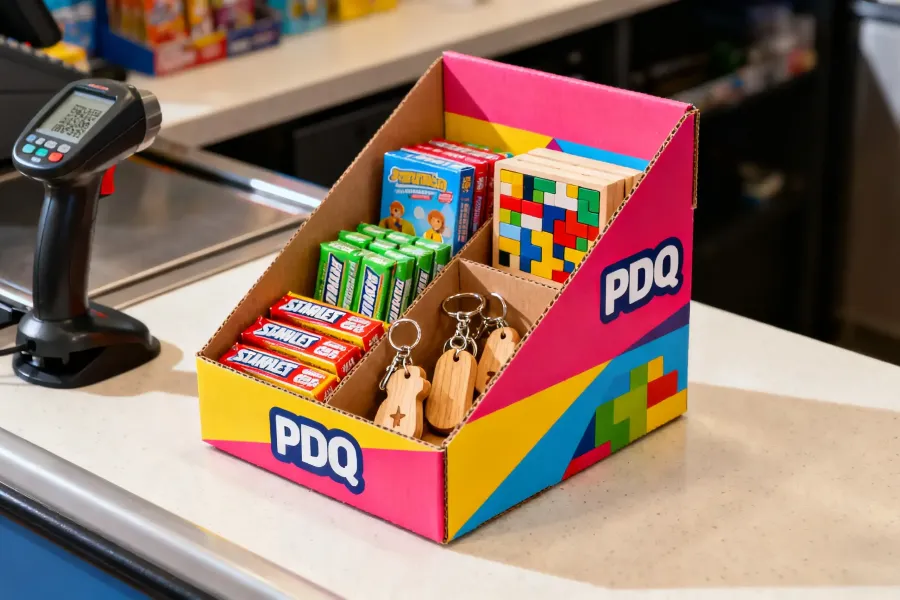
PDQ trays vs counter display boxes is a common decision point for brands negotiating retail placement, and the two formats are built for genuinely different locations and product profiles.
PDQ Trays vs Counter Display Boxes: What Distinguishes Each Format
A PDQ (Pretty Darn Quick) tray is designed to ship pre-loaded with product and convert directly into a retail-ready display with minimal handling — often just removing an outer shipping layer to reveal the display beneath. PDQ trays are typically sized for shelf or end-cap placement, holding a moderate volume of product in an organized, gravity-fed or tray-style layout.
Counter display boxes are smaller, purpose-built for checkout counter or other compact, high-traffic surfaces. They hold fewer units than a PDQ tray but are positioned for maximum visibility at the exact moment of purchase decision, often supporting impulse buys that a shelf placement wouldn't capture.
Retail partners often have a strong preference between the two formats based on their own store layout and staffing model — a retailer running lean on floor staff may favor PDQ trays specifically because they minimize setup labor, while a retailer with dedicated checkout merchandising space may actively request counter display formats to fill that specific footprint.
Placement and Capacity Trade-Offs
PDQ trays fit standard shelving and end-cap footprints, making them suitable for products a retailer wants integrated into planned merchandising sections rather than isolated at checkout. Their larger capacity supports higher-volume categories where a retailer expects sustained sell-through over a full stocking cycle.
Counter display boxes trade capacity for placement value — checkout counter space is limited and highly contested, so a counter box needs to justify its footprint with high per-unit margin or genuine impulse appeal, since the retailer is allocating scarce counter real estate rather than standard shelf space.
Seasonal versus year-round placement also factors into the PDQ trays vs counter display boxes decision. A product with steady, year-round demand often benefits more from PDQ tray integration into a permanent shelf section, while a seasonal or promotional product may perform better in a counter display format that's easier to swap in and out of a retailer's limited checkout space as promotions rotate.
Here's what most buyers overlook: the format decision should be validated with the specific retail buyer or merchandising team before production, not assumed from general category conventions. Individual retail chains often have their own standard footprints, weight limits, and even preferred vendors for display fixtures — a well-designed PDQ tray built to a generic spec can still be rejected at the loading dock if it doesn't match a specific retailer's actual shelf integration requirements.
Cost Comparison at Comparable Volumes
PDQ trays generally cost more per unit than a simple counter display box, driven by their larger material footprint and often more complex structural engineering to support shelf integration and product organization. Counter display boxes, being smaller and structurally simpler, typically run lower per-unit costs — though the actual cost difference narrows for highly customized counter formats with additional finish work.
Beyond initial placement, restocking cadence also differs meaningfully between formats. PDQ trays, holding higher product volume, generally need restocking less frequently within a given promotional cycle, while counter display boxes' smaller capacity means more frequent restocking touches from store staff, a factor worth discussing with retail partners when planning promotional duration.
Matching Format to Product Category
High-consideration or higher-price-point products that benefit from shelf integration and sustained visibility over a stocking cycle are generally better suited to PDQ tray formats. Low-cost, high-margin impulse items — candy, small accessories, seasonal novelties — tend to perform better in counter display formats where the low price point supports a spontaneous purchase decision at checkout.
Retailer relationship stage matters as well — brands new to a retail account often start with a smaller counter display commitment to prove sell-through performance before pitching for the larger shelf or end-cap space a PDQ tray typically requires, using early counter display results as evidence to support a larger merchandising ask later.
- PDQ trays: shelf or end-cap integration, sustained stocking cycle, moderate-to-higher price points
- Counter boxes: checkout-adjacent placement, impulse purchase support, lower price points
- Consider your retailer's specific merchandising standards before finalizing format
- Higher unit volume products generally favor PDQ; lower volume, high-margin items favor counter
How to Decide Which Format to Pitch a Retail Buyer
When pitching a retail buyer on a display format, leading with the specific in-store placement you're requesting, rather than the display format itself, tends to align better with how buyers actually think about merchandising space.
A buyer evaluating checkout counter space is thinking in terms of that specific footprint, not abstractly comparing PDQ trays vs counter display boxes as a category decision.
Bringing sell-through data or comparable category performance to the conversation strengthens a pitch for either format, since buyers ultimately allocate scarce retail space based on expected sales performance per square foot, not on packaging design quality alone.
Negotiating Display Placement With Retail Partners
Securing favorable placement for either a PDQ tray or counter display box typically involves negotiation with a retail buyer or category manager, and coming to that conversation with clear sell-through projections, comparable category performance data, and a specific placement request strengthens a brand's position more than a general pitch about the display's design quality alone.
Brands should also be prepared to discuss display duration and any associated slotting fees a retailer may require for premium placement like checkout counters or end caps, since these commercial terms are as much a part of the placement decision as the physical display format itself.
Frequently Asked Questions
What does PDQ stand for in retail display?
PDQ stands for 'Pretty Darn Quick,' referring to a pre-loaded shipper display designed to convert from shipping carton to retail-ready display with minimal in-store handling.
Which format costs less, PDQ trays or counter display boxes?
Counter display boxes typically cost less per unit than PDQ trays, reflecting their smaller size and simpler structural engineering, though highly customized counter formats can narrow that gap.
Where are PDQ trays typically placed in a store?
PDQ trays are typically placed on standard shelving or end caps, integrated into a retailer's planned merchandising sections for a category.
Where are counter display boxes typically placed?
Counter display boxes are positioned at checkout counters or other compact, high-traffic surfaces, designed to capture impulse purchase decisions.
Should I confirm the format with my retail buyer before production?
Yes. Individual retail chains often have their own standard footprints and requirements, so validating the format choice with the specific buyer before production reduces the risk of rejection.
Does product seasonality affect the PDQ vs counter display decision?
Yes. Year-round demand products often fit better with PDQ tray shelf integration, while seasonal or promotional products may suit a more easily rotated counter display format.
Should new retail partners start with a smaller display commitment?
Often, yes. Starting with a smaller counter display to prove sell-through performance can support a stronger pitch for larger PDQ tray or end-cap placement later.
What should I bring to a retail buyer negotiation for display placement?
Clear sell-through projections, comparable category performance data, and a specific placement request strengthen a pitch more than general design quality claims alone.
Can I run both PDQ trays and counter displays for the same product?
Yes. Some brands run both formats simultaneously to capture planned purchase browsing in the aisle and impulse purchases at checkout from the same promotional campaign.
Do PDQ trays require more assembly than counter displays?
PDQ trays are designed to convert from shipping carton to display with minimal handling, generally comparable to or simpler than assembling a counter display box.

 Arabic
 French
 Spanish
 Portuguese
 Deutsch
 Turkish
 Dutch
Dutch
 Italiano
 Russian
 Romaian
 Portuguese (Brazil)
 Greek
Greek