


Heavy-Duty Anchors Guide: Types, Loads & Selection
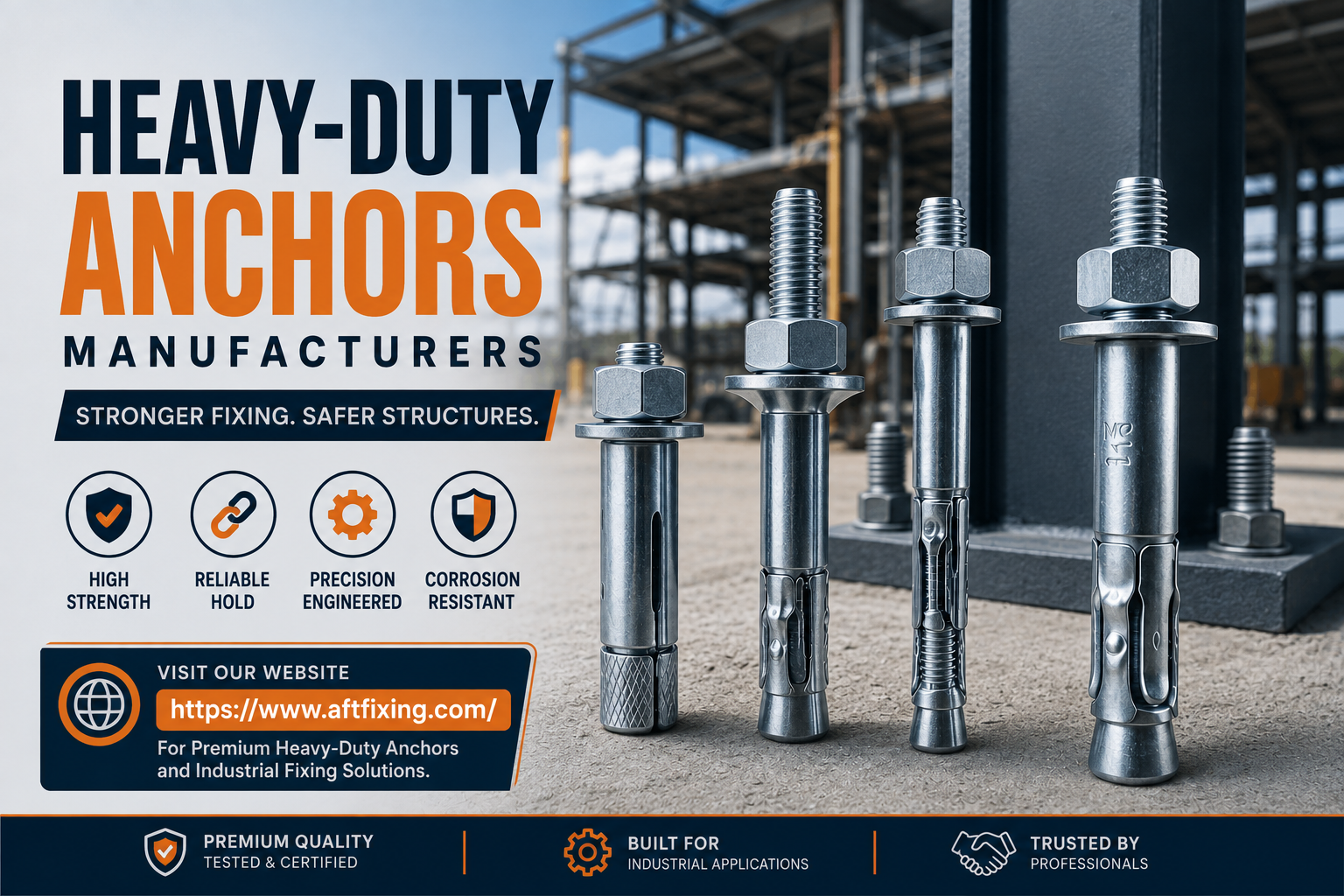
A contractor in Pune once told us he'd rather over-spec an anchor by two sizes than explain a ceiling collapse to a client. That instinct is correct. Heavy-Duty Anchors carry the entire load-bearing responsibility of whatever you're fastening — HVAC units, façade panels, structural steel, racking systems — and a wrong choice doesn't fail gracefully. It fails all at once, usually under vibration or thermal cycling, months after installation.
Most procurement teams treat anchor selection as a line item. It isn't. Substrate condition, edge distance, embedment depth, and load direction all interact, and getting even one wrong turns a ₹40 fastener into a six-figure liability claim. This guide walks through the specifications that matter, how to actually vet a supplier, and why sourcing location changes your risk profile more than most buyers realize.
Specification
Heavy-Duty Anchors fall into a few structural categories, and each one solves a different substrate problem.
Mechanical Expansion Anchors
These rely on friction generated by a cone or sleeve expanding against drilled concrete. Rated for high shear and tensile loads in solid, uncracked concrete — but they lose a shocking amount of holding capacity in cracked or low-density substrates, which is exactly the condition on most retrofit sites.
Chemical (Adhesive) Anchors
A resin cartridge — usually epoxy or vinylester — bonds a threaded rod directly to the substrate. Better for cracked concrete, closer edge distances, and higher loads, but cure time is temperature-dependent, and that's the detail most site engineers skip when they're behind schedule.
Undercut Anchors
Mechanically locked into a machined undercut at the base of the drilled hole. Highest reliability under seismic and fatigue loading. Also the most labor-intensive to install correctly, which is why they're specified far less often than they should be.
One overlooked detail: anchor spacing and edge distance aren't cosmetic guidelines. Reduce either below the manufacturer's tested minimum and the rated load capacity drops — sometimes by 40% or more — regardless of how strong the anchor itself is.
Benefits
-
Reduced liability exposure. Correctly rated anchors shift structural risk away from your procurement decision and back onto tested engineering data.
-
Fewer site call-backs. Anchors that fail post-installation cost far more in labor and reputation than the material savings from a cheaper batch ever justified.
-
Predictable lead times protect project margins. A missed anchor delivery doesn't just delay one trade — it stalls every trade scheduled behind it.
-
Consistent batch quality reduces re-inspection costs. When every shipment matches spec, your QC team stops re-testing what should already be verified.
-
Better negotiating position on bulk pricing. Wholesalers and dealers working with a Heavy-Duty Anchors Manufacturer directly — instead of through layered distribution — typically see tighter margins passed through.
-
Documentation that survives an audit. Test certificates and traceability records matter far more during a compliance review than during a smooth project.
Availability: Heavy-Duty Anchors Suppliers in India
Sourcing locally isn't just about shipping cost. Heavy-Duty Anchors Suppliers in India who manufacture domestically can respond to spec changes mid-project — something that's nearly impossible when your anchor stock is six weeks out on a container ship.
That said, location does create a real trade-off. Coastal manufacturing hubs offer faster export logistics; inland facilities often have better access to raw steel at lower cost. Which one matters more depends on whether you're supplying a single domestic project or running recurring wholesale orders. We work with Heavy-Duty Anchors Dealers in India across both profiles, and the honest answer is: nobody optimizes for both simultaneously.
For Heavy-Duty Anchors Wholesalers in India, consistent regional stock matters more than the lowest unit price — a stockout on a live construction site costs more than any discount recovers.
About Us
We've been manufacturing fastening solutions since our early export shipments taught us, the hard way, that a single missed heat-treatment spec can void an entire batch — and a client relationship along with it. That mistake changed how we run quality control permanently. We now test load ratings on sample batches from every production run, not just annually, because a supplier who only tests once a year is gambling with your project between audits.
Our facility is ISO-certified, and we export to markets that each carry different code requirements — which means our engineering team has had to get fluent in standards most domestic-only manufacturers never touch. We don't outsource our core anchor production; the parts that determine load capacity are made and tested under our own roof.
Get a Quote
Send us your substrate type, required load rating, and project quantity, and we'll respond with pricing and lead time within 24 hours. Minimum order quantities vary by anchor type — mechanical expansion anchors typically start lower than chemical anchor systems, given cartridge batching. If you're evaluating us against another Heavy-Duty Anchors Manufacturer, ask for our test reports alongside the quote. We'll send both together.
Conclusion
Choosing between Heavy-Duty Anchors isn't really a materials decision — it's a risk allocation decision, and most buyers only realize that after something fails. The right anchor, matched to the right substrate and backed by real test data, costs a little more upfront and considerably less over the life of the project. That's the trade every experienced procurement manager eventually learns to make without hesitation.
FAQs
1. What load rating do I need for a typical façade installation?
Depends entirely on wind zone, panel weight, and substrate — there's no single number. Send us your project specs and we'll calculate the required pull-out and shear values directly.
2. Are chemical anchors always stronger than mechanical anchors?
Not always. Chemical anchors generally outperform in cracked concrete, but mechanical anchors install faster and cost less when the substrate is solid. It genuinely depends on site conditions.
3. How do Heavy-Duty Anchors Dealers differ from manufacturers on pricing?
Dealers add a margin layer since they're reselling manufactured stock. Buying direct from a manufacturer usually tightens that margin, though dealers sometimes offer faster regional delivery.
4. Can Heavy-Duty Anchors Wholesalers get custom lengths or coatings?
Yes, within minimum order quantities. Custom coatings for high-corrosion environments typically add 10–15 days to standard lead time — we won't pretend that timeline doesn't exist.
5. What's the shelf life of chemical anchor cartridges?
Most resin cartridges are rated 12 months from manufacture date under proper storage. Past that, cure performance becomes unreliable, and we don't recommend using expired stock regardless of visual condition.

 Arabic
 French
 Spanish
 Portuguese
 Deutsch
 Turkish
 Dutch
Dutch
 Italiano
 Russian
 Romaian
 Portuguese (Brazil)
 Greek
Greek