


AWS vs Azure Certification: Which Certification Has Better Career Growth?
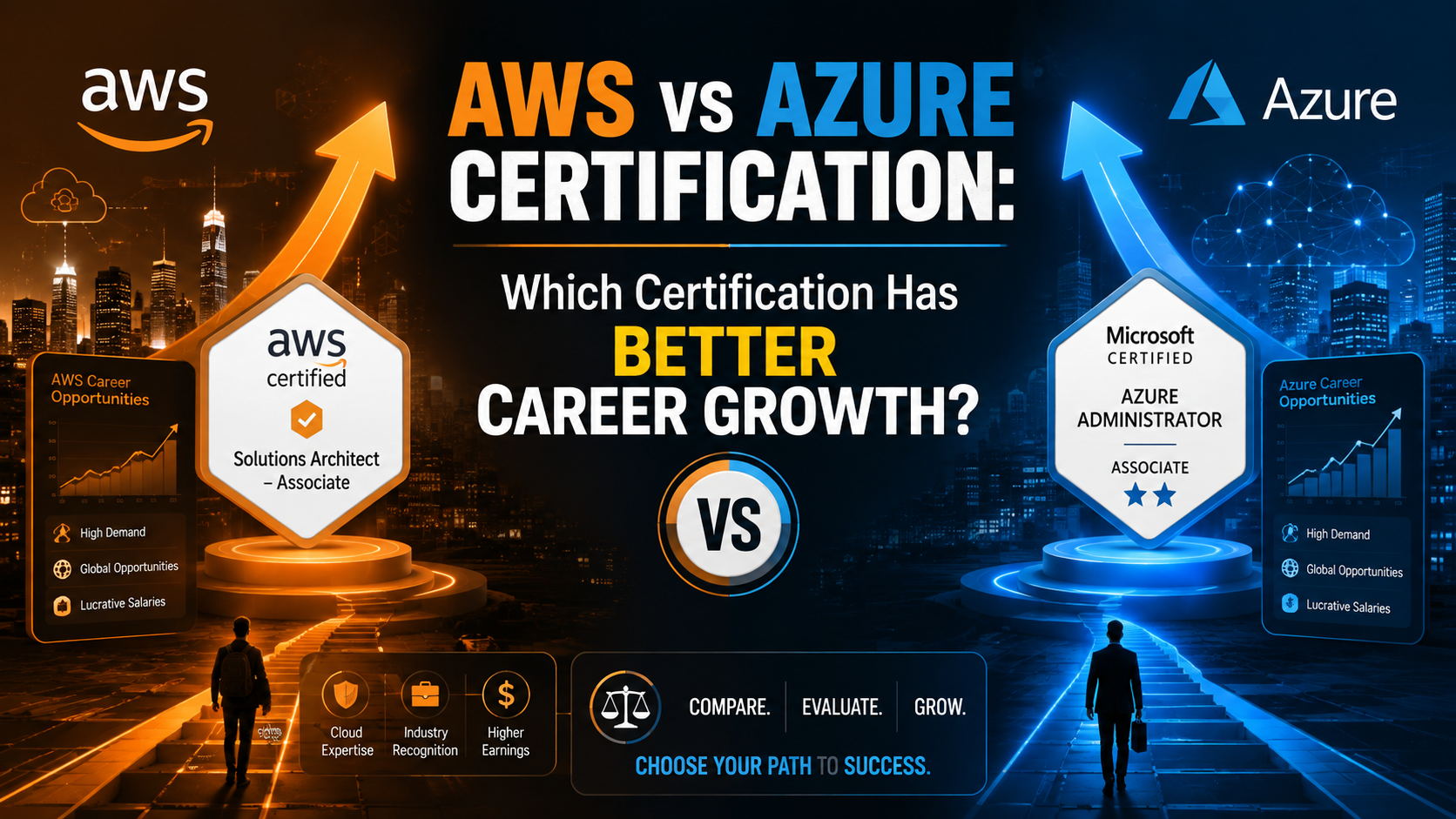
AWS and Microsoft Azure certifications are two of the strongest cloud certification paths for IT professionals in 2026. Both can support careers in cloud administration, architecture, security, DevOps, development, data, and AI, but they align with different technology ecosystems and job environments.
AWS offers a broad certification portfolio across foundational, associate, professional, and specialty levels, while Microsoft structures Azure credentials around job roles such as administrator, architect, security engineer, developer, data professional, and AI specialist. AWS certifications are generally valid for three years, while many Microsoft role-based and specialty certifications require annual renewal through a free online assessment.
A quick watch on Cert Empire’s youtube channel can clear all your confusion.
AWS vs Azure Certification at a Glance
The better certification depends on your career target rather than the popularity of one cloud platform.
|
Factor |
AWS Certification |
Azure Certification |
|
Main Platform |
Amazon Web Services |
Microsoft Azure |
|
Beginner Path |
Cloud Practitioner |
Azure Fundamentals |
|
Administration Path |
Cloud operations credentials |
Azure Administrator |
|
Architecture Path |
Solutions Architect |
Azure Solutions Architect |
|
Security |
AWS security certifications |
Azure and Microsoft security certifications |
|
AI and Data |
AWS AI, ML and data paths |
Azure AI, data and Fabric paths |
|
Typical Validity |
3 years |
Many role-based credentials: 1 year |
|
Best For |
AWS-heavy cloud environments |
Microsoft enterprise and Azure environments |
AWS Certified Cloud Practitioner is designed as an entry point for people with little or no prior cloud experience, while Microsoft Azure Fundamentals validates knowledge of cloud concepts, core Azure services, management, and governance.
Why AWS Certifications Can Support Career Growth
AWS provides certifications that support multiple stages of a cloud career.
A beginner can start with Cloud Practitioner before progressing into technical associate-level credentials. More experienced professionals can move toward architecture, operations, development, security, data, and AI-related certifications. AWS describes its certification portfolio as including role-based and specialty credentials intended to validate practical cloud expertise.
Career Areas Supported by AWS
AWS certification paths can support roles such as:
-
Cloud engineer
-
Solutions architect
-
DevOps engineer
-
Cloud operations engineer
-
Cloud security engineer
-
Data engineer
-
Machine learning engineer
-
AI developer
-
Cloud consultant
AWS also continues to update its certification portfolio. In 2026, it announced additional certification changes involving areas such as data engineering and security, reflecting the platform's continued expansion into specialized cloud roles.
Why Azure Certifications Can Support Career Growth
Microsoft Azure certifications are strongly role-based. Instead of only validating knowledge of a product, many Microsoft certifications are organized around specific job responsibilities.
Microsoft currently describes its credential structure as progressing from Fundamentals through Associate, Expert, and Specialty certifications. Its certifications span AI, cloud, security, and business roles.
Career Areas Supported by Azure
Azure certification paths can align with roles including:
-
Azure administrator
-
Cloud engineer
-
Azure solutions architect
-
Security engineer
-
DevOps engineer
-
Data engineer
-
AI engineer
-
Infrastructure engineer
-
Cloud consultant
Azure Fundamentals remains a common beginner entry point because it focuses on cloud concepts, Azure architectural components, compute, networking, storage, security, governance, and management tools.
AWS vs Azure for Beginners
For complete beginners, both platforms offer accessible starting points.
AWS Certified Cloud Practitioner validates high-level understanding of AWS Cloud services and terminology and is specifically positioned for individuals entering cloud careers, including those from non-IT backgrounds.
Azure Fundamentals similarly provides a beginner-level introduction to Microsoft Azure and cloud concepts.
Choose AWS first if:
-
You want to work primarily with AWS.
-
Your target jobs mention AWS frequently.
-
You want a clear progression into cloud architecture or operations.
-
You plan to specialize later in AWS security, AI, data, or DevOps.
Choose Azure first if:
-
You already work with Microsoft technologies.
-
Your organization uses Azure, Microsoft 365, Entra, or Windows Server.
-
You want enterprise cloud administration roles.
-
Your long-term goal involves Microsoft security, AI, data, or hybrid infrastructure.
AWS vs Azure for Cloud Architecture Careers
Cloud architecture is one of the strongest long-term career directions in both ecosystems.
AWS offers architecture-focused certification progression through Solutions Architect credentials, while Microsoft offers Azure architecture certifications within its role-based certification framework.
The technical skills required are similar at a conceptual level:
-
Compute design
-
Networking
-
Storage
-
Identity
-
Security
-
Availability
-
Cost optimization
-
Resilience
-
Governance
-
Monitoring
However, the services, terminology, management tools, and architectural patterns differ between AWS and Azure.
A professional who wants to become a cloud architect should therefore select the platform used by the employers they want to work for.
AWS vs Azure for Cybersecurity
Both platforms offer strong cybersecurity career opportunities.
AWS security certifications focus on protecting AWS cloud environments, while Microsoft provides Azure and broader security credentials covering identity, security operations, cloud security, compliance, and enterprise security.
One important factor in 2026 is that Microsoft continues to change its certification portfolio. For example, Azure Security Engineer Associate is scheduled to retire on August 31, 2026, showing why candidates should always check current certification status before building a long-term study plan.
Cloud security professionals should choose based on the security ecosystem they expect to manage.
AWS vs Azure for AI and Data Careers
AI and data are increasingly important in both certification ecosystems.
AWS continues to expand credentials related to AI, machine learning, and data engineering. Microsoft likewise provides credentials across Azure AI, data, analytics, and related technologies. Microsoft describes its certification catalog as covering AI, cloud, security, and business roles.
AWS may be attractive if your career focuses on:
-
AWS machine learning
-
Generative AI applications
-
Cloud-native data pipelines
-
AWS-based AI services
Azure may be attractive if your career focuses on:
-
Azure AI services
-
Microsoft data platforms
-
Enterprise AI integration
-
Microsoft Fabric
-
Azure-based analytics
The better option depends on the production environment you expect to work with.
Which Certification Offers Better Career Flexibility?
AWS can provide excellent flexibility for professionals who want a broad cloud-only career across architecture, DevOps, operations, security, and AI.
Azure can provide particularly strong flexibility inside organizations that already depend heavily on Microsoft's enterprise ecosystem.
This distinction matters because many companies do not use cloud platforms in isolation.
An Azure professional may also work with:
-
Microsoft Entra
-
Windows Server
-
Microsoft 365
-
Defender
-
Power Platform
-
Hybrid infrastructure
An AWS professional may work across:
-
EC2
-
S3
-
IAM
-
VPC
-
Lambda
-
RDS
-
Bedrock
-
Container services
Your career growth is stronger when certification knowledge connects to the full technical environment around your role.
AWS vs Azure Certification Maintenance
Certification maintenance is another practical difference.
AWS states that its certifications remain valid for three years before recertification is required.
Microsoft uses a different model. Eligible role-based and specialty certifications are renewable annually through a free online renewal assessment. Microsoft Fundamentals certifications do not require renewal.
This means Azure professionals need to maintain credentials more frequently, although Microsoft does not charge for the renewal assessment itself.
How to Choose Between AWS and Azure Certification
A practical decision process is:
-
Search current job postings for your target role.
-
Count how often AWS and Azure appear.
-
Identify which platform your current employer uses.
-
Choose a beginner or role-based certification.
-
Build hands-on cloud projects.
-
Learn networking, identity, security, and automation.
-
Add specialization only after building core cloud skills.
-
Reassess your path as your job responsibilities develop.
Prepare for AWS or Azure certifications with updated practice questions and study materials: https://certempire.com/aws-vs-azure-certification/
Advantages of Choosing AWS
AWS certification can offer several advantages:
-
Broad cloud certification ecosystem
-
Strong architecture progression
-
Multiple specialization options
-
Clear foundational entry point
-
Strong cloud-native focus
-
Three-year certification validity
AWS also provides training and certification resources through AWS Skill Builder and other official learning programs.
Advantages of Choosing Azure
Azure certification can be particularly valuable for professionals who already work in Microsoft environments.
Advantages include:
-
Strong integration with Microsoft enterprise technologies
-
Role-based certification structure
-
Azure administration pathways
-
Security and identity specialization
-
AI and data career options
-
Free annual renewal for eligible certifications
Microsoft's credential platform is designed to support progression from beginner Fundamentals credentials into Associate, Expert, and Specialty certifications.
Common Mistakes When Choosing a Cloud Certification
Avoid:
-
Choosing only based on popularity
-
Collecting certifications without cloud projects
-
Ignoring networking fundamentals
-
Skipping identity and security
-
Studying outdated exam versions
-
Assuming certification guarantees a job
-
Learning two cloud platforms at once as a complete beginner
-
Ignoring certification renewal requirements
For most beginners, becoming strong in one platform first is more effective than being weak in both.
Which Certification Has Better Career Growth in 2026?
There is no universal winner.
Choose AWS if you want a broad cloud-focused career, especially in AWS architecture, operations, DevOps, cloud security, data, or AI.
Choose Azure if your career is connected to Microsoft's wider enterprise ecosystem, especially Azure administration, hybrid infrastructure, Microsoft security, identity, data, or AI.
The biggest career advantage comes from combining certification with real cloud experience.
A certified professional who can design, deploy, troubleshoot, secure, and automate cloud environments will usually have stronger career potential than someone who holds several certifications but has little practical experience.
Conclusion
AWS and Azure certifications both provide strong career growth opportunities in 2026.
AWS offers a broad and mature cloud certification ecosystem with clear pathways into architecture, operations, DevOps, security, data, and AI. Azure provides equally strong opportunities, especially for professionals working in Microsoft-heavy enterprise environments where cloud services connect closely with identity, security, Windows infrastructure, and business platforms.
For beginners, choose the cloud platform that appears most often in your target jobs. Build practical skills, complete real projects, and then progress toward more advanced certifications.
The better certification is not simply AWS or Azure. It is the certification path that aligns most closely with the cloud environment, role, and specialization you want to build your career around.
FAQs
Is AWS certification better than Azure certification?
Neither is universally better. AWS is often a strong choice for broad cloud-focused careers, while Azure can be especially valuable in Microsoft enterprise and hybrid environments.
Which is easier for beginners, AWS or Azure?
Both provide beginner-level certifications. AWS Certified Cloud Practitioner and Microsoft Azure Fundamentals are designed as introductory credentials for people beginning cloud learning.
Which certification is better for cloud architects?
Both platforms offer strong architecture paths. The better certification depends mainly on whether your target employers use AWS or Azure.
How long do AWS certifications remain valid?
AWS certifications are valid for three years before recertification is required.
Do Azure certifications expire?
Many Microsoft role-based and specialty certifications expire after one year unless renewed. Eligible certifications can be renewed through a free online assessment.
Learn More: 10 Benefits of Using an Online Exam Simulator for Certification Exams

 English
 Arabic
 French
 Spanish
 Portuguese
 Deutsch
 Dutch
Dutch
 Italiano
 Russian
 Romaian
 Portuguese (Brazil)
 Greek
Greek